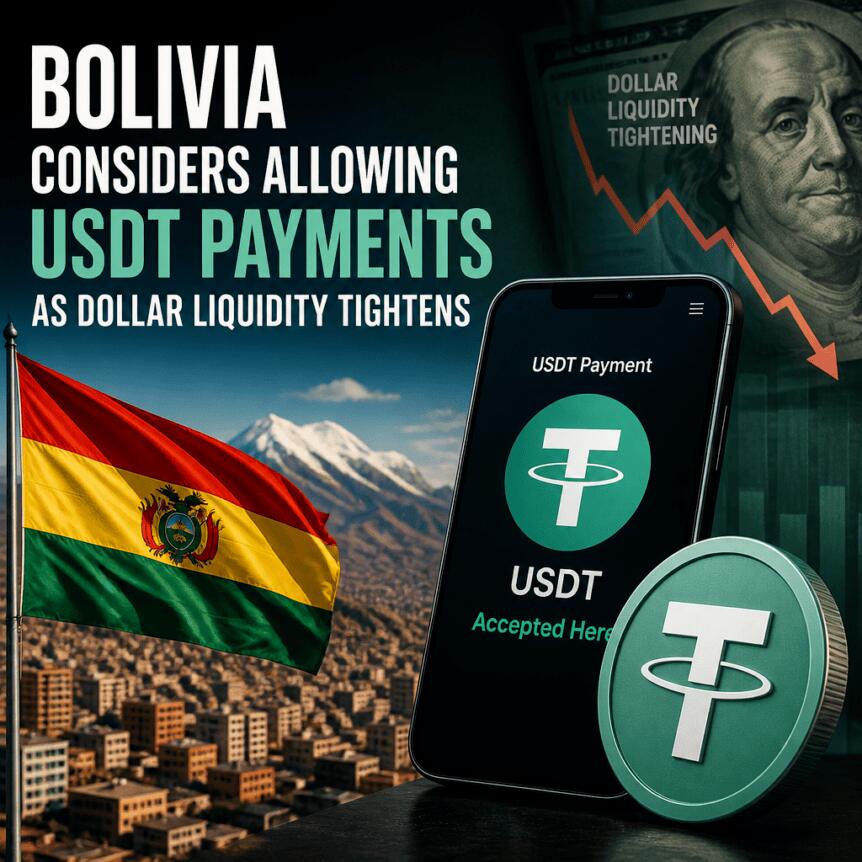
Bolivia is exploring a path to place Tether’s USDT inside its domestic payments framework, as the country searches for ways to operate in an environment where US dollars remain scarce. If the plan advances, USDT could be treated as a currency option alongside the boliviano and the US dollar—an approach aimed at supporting everyday transactions such as payments, saving, and trade.
Economy and Public Finance Minister Jose Gabriel Espinoza said during a Monday press conference that the government is assessing a regulatory structure that would allow USDT to circulate “as just another currency.” However, the minister also warned that any rollout depends on strong safeguards, including anti-money laundering controls, given that Bolivia remains on the Financial Action Task Force (FATF) grey list for deficiencies related to preventing money laundering and terrorist financing.
Key takeaways
- Bolivia’s finance ministry is evaluating whether USDT can be recognized for retail use in the national payments system.
- Officials say USDT would need a comprehensive regulatory and compliance framework due to Bolivia’s FATF grey-list status.
- The proposal follows changes in Bolivia’s stance on cryptocurrencies since its long-standing ban was lifted in 2024.
- Broader demand for dollar-denominated alternatives has intensified as Bolivia struggled with a persistent US dollar shortage and exchange-rate pressures.
- Tether is likely central to the idea given USDT’s scale as the largest stablecoin by market capitalization.
USDT as “another currency” in Bolivia’s payments system
According to reporting by CriptoNoticias, the regulatory framework under review would potentially recognize USDT for everyday use, including payments and other common financial activities. The government’s stated goal is to avoid tying usage exclusively to cash or the traditional banking channel, which can be difficult in countries where liquidity constraints and currency volatility affect how people store and move value.
Espinoza’s remarks also underline that the proposal is not simply about adoption—it is about building an enforcement-ready system. With Bolivia on the FATF grey list, authorities would need to demonstrate robust controls around compliance, monitoring, and AML requirements before any wider acceptance of stablecoins could become feasible.
Why stablecoins are gaining traction: the dollar squeeze
Bolivia’s stablecoin discussions come at a time when the country has been grappling with a prolonged shortage of US dollars, which are widely used alongside the boliviano. As Reuters reported, Bolivia held an official exchange rate—6.86 bolivianos per US dollar for purchases and 6.96 for sales—from 2011 until earlier this year, when pressure on foreign-exchange reserves forced the government to abandon the long-standing peg.
Once the peg ended, a parallel foreign exchange market expanded, and the dollar traded at a premium relative to the official rate. Reuters’ coverage links that growing gap to heightened demand for dollar-denominated alternatives. In this context, stablecoins such as USDT can appear attractive because they aim to maintain a consistent value relative to the US dollar.
That dynamic helps explain why USDT—already a dominant stablecoin globally—has become part of the policy conversation. While stablecoins do not eliminate exchange-rate and liquidity issues overnight, they can change the mechanics of payments by enabling transfers that are not directly constrained by local cash availability in the same way.
Bolivia’s policy shift after the 2024 crypto ban
The USDT payments idea also fits within Bolivia’s broader move toward regulated participation in digital assets. The country lifted its long-standing ban on cryptocurrencies in 2024, opening space for new rules and institutional integration. CriptoNoticias’ framing of the USDT proposal is consistent with a wider effort to bring crypto-related tools into the formal financial sector rather than leaving them to operate solely in the shadows.
The political direction appears to have accelerated further under President Rodrigo Paz Pereira. Earlier coverage from Cointelegraph noted that the administration, after he took office in late 2025, pledged to integrate digital assets into the formal financial system. That includes paving the way for banks to offer crypto-related products and services, potentially including stablecoin-based accounts.
USDT’s prominence is part of why it is likely to be considered first. CoinMarketCap data cited in the source notes that USDT’s market capitalization exceeds $184 billion, making it the largest stablecoin by size.
Market backdrop: adoption in Latin America and what to watch next
Bolivia is not acting in isolation. Chainalysis, in its 2025 evaluation of crypto adoption across Latin America, reported $14.8 billion in total transaction volume over a 12-month period. While that figure does not isolate Bolivia alone, it signals that stablecoin usage and broader crypto activity have found a meaningful foothold across the region.
What remains uncertain is whether Bolivia can translate its intent into implementable regulation quickly enough to affect day-to-day commerce—and whether the approach will gain institutional buy-in from banks and payment providers. The FATF grey-list constraint is a major variable: it implies that regulators must design a system that can withstand compliance scrutiny and demonstrate effective AML controls.
For users and investors, the immediate watch points are straightforward: the details of any proposed legal definition of USDT in Bolivia, the compliance obligations that would be required for institutions handling stablecoin flows, and whether pilots or limited rollouts precede any broader recognition. As Bolivia weighs stablecoin integration against its regulatory and financial constraints, the outcome could become a significant case study for how governments balance access to dollar liquidity with compliance expectations.