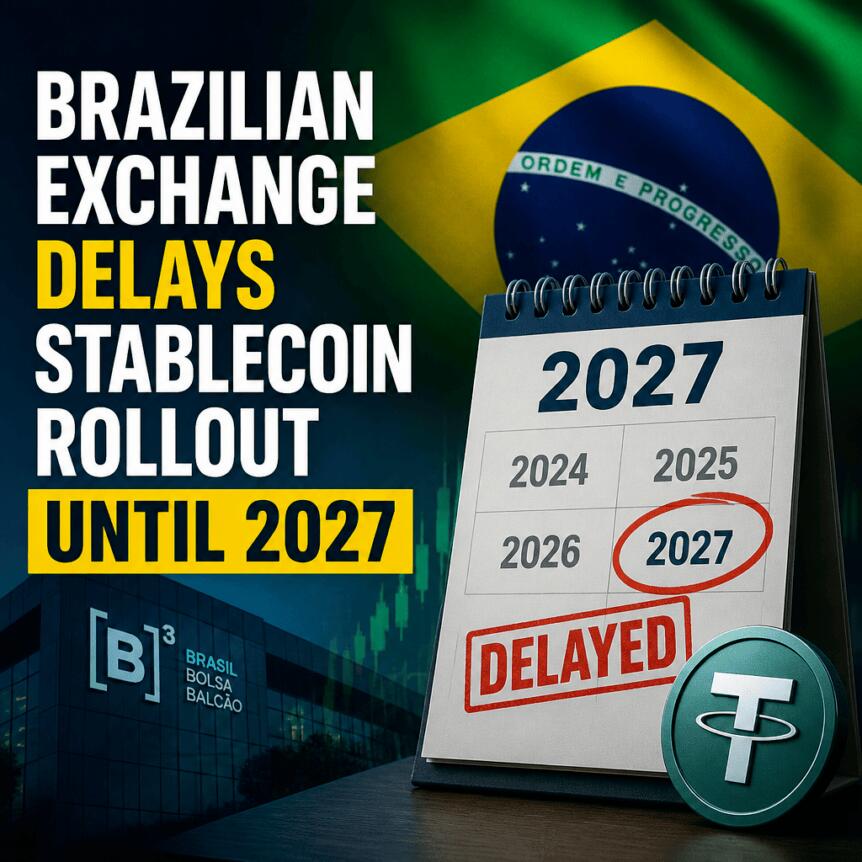
Brazil’s B3 is advancing its plan to issue a stablecoin pegged to the Brazilian real, shifting its timetable from an earlier target launch this year to a first-quarter 2027 rollout. The new effort, reported by Valor Econômico, is framed as a broader step in the exchange’s push to bring parts of traditional capital markets onto blockchain infrastructure.
Under the plan, the stablecoin—named Open BRL—would be backed 1-to-1 by Brazilian reais. B3 will develop and operate the underlying technology, while issuance is set to be handled by Banco B3, the exchange’s banking subsidiary.
Key takeaways
- Open BRL is pegged to the Brazilian real with each token backed by one real, according to Valor Econômico.
- B3 is collaborating with six major Brazilian financial institutions—Bradesco, BTG Pactual, Itaú Unibanco, Safra, Santander, and XP—on the 2027 launch.
- The stablecoin program now targets first quarter of 2027, after earlier expectations pointed to a launch sooner.
- B3 is also planning tokenized share trading in early 2027, but settlement and 24/7 trading depend on regulatory changes.
Open BRL replaces the earlier 2026 timetable
Valor Econômico reported on Friday that B3, along with six large local institutions, is moving forward with its stablecoin strategy through 2027. The report says the project is scheduled for launch in the first quarter of 2027.
The stablecoin is described as Open BRL, with issuance by Banco B3. Per the same reporting, every Open BRL token would correspond to one Brazilian real held as backing, while B3 would manage the technological layer.
This matters for market participants because pegged digital assets are often a prerequisite for more complex on-chain trading and settlement models—especially when exchanges aim to tokenize instruments such as equities and fixed-income products. In that context, B3’s stablecoin effort can be viewed as both an infrastructure component and a stepping stone toward tokenized securities trading.
From B3RL to Open BRL: uncertainty remains
B3 first disclosed plans to introduce its own stablecoin in December 2025, with an initial timeline pointing toward a 2026 launch. Earlier coverage from Cointelegraph noted that expectation.
More recently, in July, B3 was still reportedly preparing to launch a stablecoin called B3RL. CNN Brasil reported that infrastructure testing and integration work with financial institutions were expected around August and September.
At that stage, B3RL was described as being backed by Brazilian reais and secured by government bonds, with the goal of enabling blockchain-based trading of stocks and fixed-income securities beginning in 2027.
The new reporting on Open BRL raises a key question: will Open BRL replace B3RL, or will the projects run in parallel? The source material indicates it is not yet clear, and Cointelegraph said it reached out to B3 for clarification but had not received a response at the time of publication. For observers, the distinction is important because multiple overlapping stablecoin initiatives could signal either a refinement of the original design or a shift in operational priorities.
Tokenized stocks planned for 2027—settlement constraints still loom
Alongside the stablecoin roadmap, B3 is also preparing to introduce trading of tokenized shares in early 2027. The plan, as described in the source, is to use the same order book as conventional equities at launch—suggesting a transition designed to integrate tokenized assets into existing trading mechanics rather than fully replacing them from day one.
However, B3’s approach appears constrained by Brazil’s market infrastructure and regulatory framework. In October, an executive overseeing B3’s digital asset products, Humberto Costa, reportedly said the platform would retain Brazil’s two-business-day settlement cycle instead of moving to instant settlement. He also indicated that the stablecoin (B3RL, as referenced in the earlier reporting) would not handle settlement of tokenized shares at launch, and that enabling round-the-clock trading would require changes to Brazil’s regulatory framework.
From an investor and trader perspective, settlement timing and trading-hours rules are not technical details—they directly affect liquidity, counterparty risk management, and operational readiness. Even if tokenized shares can trade on-chain, settlement and operational compliance determine how seamlessly institutional players can adopt the new venue.
Regulation is the deciding factor for tokenization scale
The pace of B3’s tokenization ambitions is tightly linked to regulatory development. The Brazilian Securities and Exchange Commission (CVM) has been exploring a dedicated regulatory framework for tokenization.
According to reporting linked in the source material, the CVM presented progress on this effort at an industry meeting in October, describing work by its dedicated working group for tokenization.
That regulatory work helps explain why B3’s plans emphasize incremental adoption—such as using existing order-book structures and maintaining familiar settlement cycles—rather than immediate full transformation of how equities clear and settle.
For market observers, the key watchpoint is whether the CVM’s tokenization framework addresses settlement mechanics, eligibility, governance, and trading-hour constraints in a way that supports broader on-chain issuance and trading. Until those rules are clearer, exchanges may be limited to pilots and phased rollouts that keep risk and compliance within established parameters.
The most immediate developments to track are whether Open BRL and the earlier B3RL plans converge into a single product, and how quickly Brazil’s tokenization regulation evolves to support settlement and potential 24/7 trading for tokenized equities. Those answers will likely determine how fast B3 can scale beyond stablecoin issuance into broader tokenized capital-market offerings.