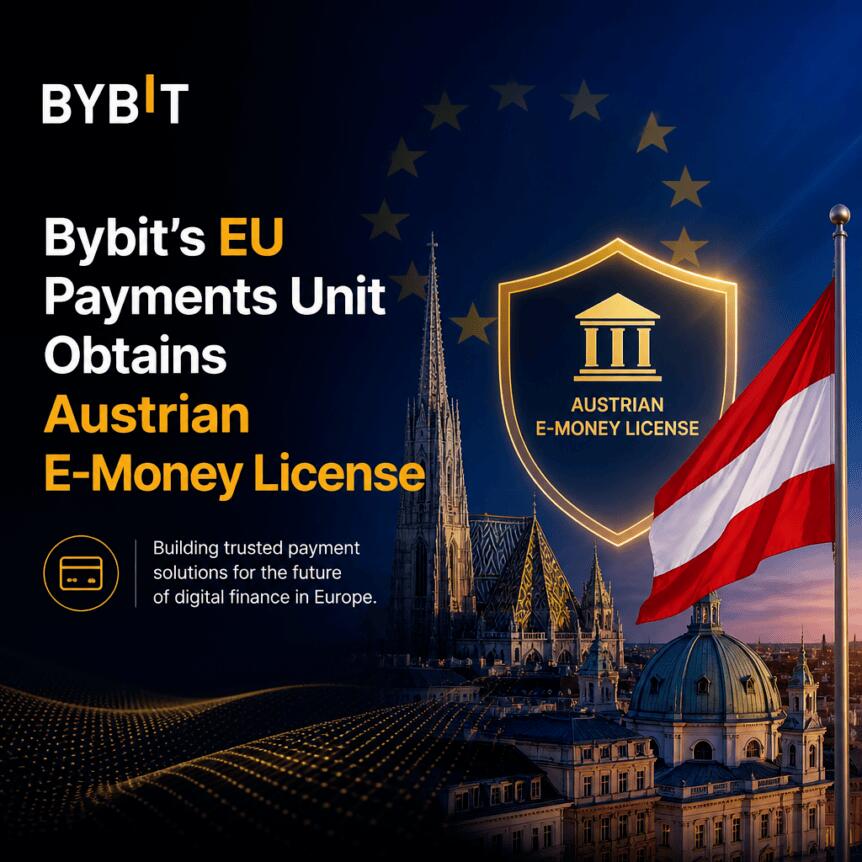
Bybit has taken another step toward expanding its regulated business in Europe after its Austria-based payments unit, Bybit Payments GmbH, received an electronic money institution (EMI) license from the country’s Financial Market Authority. The approval gives the exchange a clearer regulatory foundation to introduce payment-related products alongside its existing Europe-focused platform.
In an announcement shared on Tuesday, Bybit said the EMI authorization enables its future payment capabilities, which may eventually include person-to-person transfers, merchant payment services, open banking functionality, and card products. For users and partners, the practical impact is that Bybit is positioning to offer payment rails and e-money services under a supervisory framework rather than relying solely on third-party arrangements.
Key takeaways
- Bybit Payments GmbH has received an electronic money institution license from Austria’s Financial Market Authority.
- The authorization is intended to support future payment and e-money products, potentially including P2P, merchant solutions, open banking, and cards.
- Payments will be offered through Bybit.eu alongside existing services from a separate Austrian crypto-licensed entity.
- Bybit EU GmbH continues to operate under EU MiCA authorization (granted in May 2025), with responsibilities kept distinct from the EMI permissions.
- Bybit stated Malta is excluded, citing MiCA passporting requirements that must be met for each jurisdiction.
Austria approval lays groundwork for regulated e-money and payments
The EMI license centers on Bybit Payments GmbH’s ability to provide regulated electronic money and payment services. Bybit did not describe a specific go-live date for any particular product, but it tied the authorization to a broader plan to expand payments features as they are introduced.
For institutional and business users, this matters because payment services typically require ongoing regulatory oversight that extends beyond exchange operations. By obtaining an EMI license, Bybit can create a more direct, jurisdictionally supervised pathway to integrate with banks, payment providers, and enterprises—potentially improving operational control and reducing dependence on external payment infrastructure.
How Bybit plans to split roles across two Austrian entities
Bybit’s European structure now hinges on two different Austrian entities, each carrying different regulatory permissions. The exchange said Bybit Payments GmbH will manage the EMI and payment-related activity as e-money and payment products are launched. Meanwhile, Bybit EU GmbH—another Austrian entity—remains responsible for crypto services under EU Markets in Crypto-Assets Regulation (MiCA).
According to Bybit, Bybit EU GmbH is authorized to provide crypto custody, exchange, placement, and transfer services. This separation is designed to keep permissions and obligations distinct: one entity under the crypto regime for crypto-asset activities, and the other under the payments regime for electronic money and regulated payment products.
Bybit also said both services will be made available through Bybit.eu, suggesting the user-facing platform will continue to act as a single destination while the underlying compliance responsibilities are managed by the appropriate licensed entity.
Which regions will have access—and why Malta is missing
Bybit Payments GmbH’s services are expected to run through Bybit.eu for users across the European Economic Area (EEA), with an exception: Malta.
Bybit did not give a specific operational reason for the exclusion. Instead, it referenced its own website guidance, stating that services are offered only in jurisdictions where applicable MiCA passporting requirements have been met. The statement suggests that regulatory coverage for the overall Bybit offering—including how crypto and payments are packaged for particular regions—depends on whether passporting conditions have been satisfied.
For readers, the key takeaway is that licensing alone may not automatically translate into immediate availability across every EEA jurisdiction. Even when an entity is licensed in one country, market access can hinge on broader cross-border permissions tied to the regulatory framework involved.
Why the milestone could change how Bybit partners with banks
Beyond product expansion, Bybit framed the EMI license as a relationship-strengthening development with banks, payment providers, and enterprises. Bybit suggested the new approval could also reduce reliance on third-party payment infrastructure.
That shift is particularly relevant in Europe, where fintech and crypto firms often face a trade-off: speed to market versus the cost and complexity of building and maintaining compliant payment operations. Establishing an EMI license can support more direct routing of payment flows and potentially help standardize integrations with counterparties. It may also make it easier for partners to understand which part of Bybit’s business is responsible for regulated payment activities.
At the same time, it remains to be seen how quickly Bybit will convert the license into concrete consumer-facing offerings. An EMI authorization provides a regulatory capability, but product rollouts—especially those involving card services or open banking—typically require additional implementation work and coordination with payment networks and partners.
Related: Crypto exchange Bybit launches in Indonesia after NOBI acquisition
Investors and users should watch how Bybit translates the EMI license into specific payment features on Bybit.eu, and whether the exchange later broadens availability to additional jurisdictions currently excluded—particularly Malta. The other open question is the pace of integration between the MiCA-authorized entity and the newly licensed EMI unit, since the two permissions are meant to stay distinct even if the experience is unified.