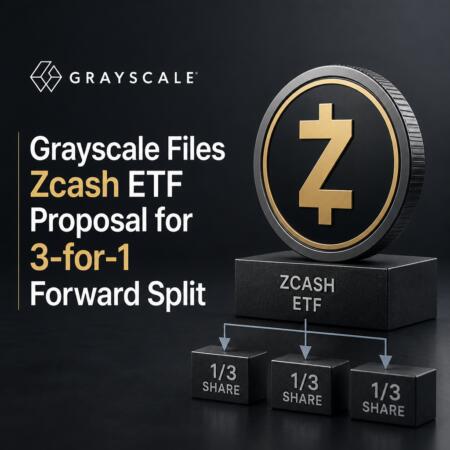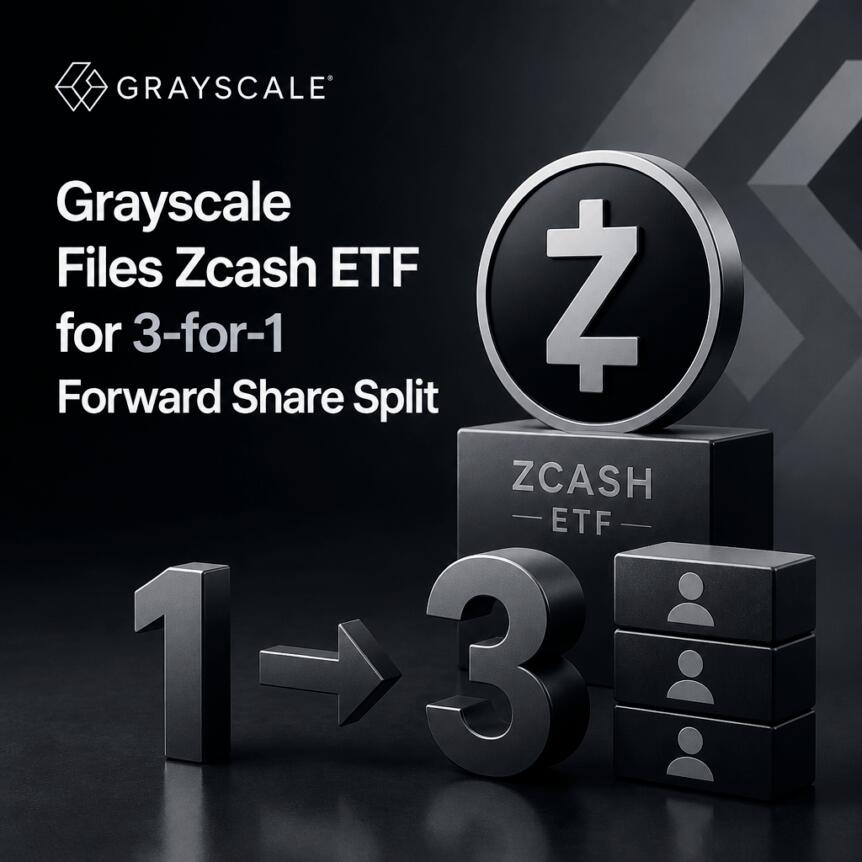
Grayscale’s Zcash ETF is set to undergo a 3-for-1 forward share split, according to a filing submitted with the U.S. Securities and Exchange Commission. The change is scheduled to take effect after the market close on Sept. 28, with shareholders set to receive two additional shares for every share they hold.
In a press release cited in the ETF filing, Grayscale said the forward split is designed to reduce the price per share while increasing the total number of shares outstanding in equal proportion—leaving the value of an investment unchanged in theory.
Key takeaways
- Grayscale’s Zcash ETF (ZCSH) plans a 3-for-1 forward split effective after the Sept. 28 market close.
- Shareholders receive two extra shares per held share; the filing describes the change as proportionate, not value-accretive.
- Grayscale expects the lower per-share price to improve accessibility, referencing that the unit price had become “too high.”
- The move comes as Zcash’s broader market momentum has been strong over the past year, with the token up about 2,800% in that period, according to the ETF materials.
What the 3-for-1 split means for ZCSH holders
The SEC filing describes the mechanism clearly: at the close of trading on Sept. 28, shareholders will receive two additional shares for each share they own. Grayscale’s included explanation—referenced in the filing—frames the result as a straightforward arithmetic adjustment rather than a change in underlying value.
For example, the materials illustrate that an investor holding 10 shares valued at $300 each—totaling $3,000—would own 30 shares priced at $100 each after the split, with the portfolio’s total value remaining the same.
The practical effect for investors is largely operational. Shares typically trade at a lower nominal price after such events, which can influence how the product is perceived and how easily some investors can size positions. However, the split does not inherently alter the ETF’s exposure to its underlying asset.
Why Grayscale is lowering the per-share price
Grayscale said the forward split is expected to “decrease the price per share” of the fund while increasing the share count proportionately. The ETF’s materials connect this to accessibility concerns, noting that Zcash’s token has risen sharply over the past year and that the per-unit price had become considered too high.
According to the filing-related press release, ZEC has increased by about 2,800% over the last year, and that surge helped push the ETF unit price to a level Grayscale deemed less convenient for potential investors. The split is therefore positioned as a way to make the ETF easier to buy and track in everyday terms.
For traders, these changes often matter most around implementation, including how order sizes and price targets are recalibrated. For longer-term investors, the key question is whether sentiment and liquidity improve as the share price becomes more “consumer-friendly,” even though the economics should remain proportionate.
Broader Zcash market momentum and ETF spotlight
While the share split is a structural adjustment inside the ETF wrapper, the timing also lands amid renewed attention on Zcash itself. Cointelegraph previously reported that Zcash had gained about 20% over a 24-hour period after Paradigm co-founder Matt Huang disclosed an unspecified purchase of ZEC.
In that coverage, Huang characterized Zcash as a “private complement to Bitcoin” and discussed the importance of long-term funding for the project, particularly as AI-driven cyber capabilities and quantum computing advance. Earlier coverage also linked Zcash’s performance to the visibility of privacy-focused assets in a market that remains sensitive to both regulation and technological narratives.
The Block reported that ZEC climbed as high as $1,521 early Friday, which would have been viewed as an effective new all-time high for the token before retreating slightly. That context matters for ETF holders and prospective investors: when the underlying asset experiences volatility and headline-driven flows, structural moves like share splits can draw additional attention to the vehicle, even if the split itself is not a market catalyst.
What investors should watch next
The most immediate checkpoint is the Sept. 28 record date tied to the forward split, since the share ratio will take effect after the market close. After that, investors should monitor how ZCSH trades relative to its adjusted share price—especially how liquidity and bid-ask spreads behave around the split window.
More broadly, the sustained relevance of ZCSH will likely track Zcash’s next fundamental and technical developments, alongside market demand for privacy-oriented assets. Even with the per-share price coming down, the underlying question for investors remains unchanged: whether the ETF continues to attract steady inflows as ZEC’s volatility and narrative momentum evolve.
Related references: Grayscale’s SEC filing includes details of the forward split (SEC EDGAR: zcsh-ex99_1.htm), and Cointelegraph previously reported on Zcash’s short-term price action and Matt Huang’s disclosure of a ZEC purchase (Cointelegraph coverage).