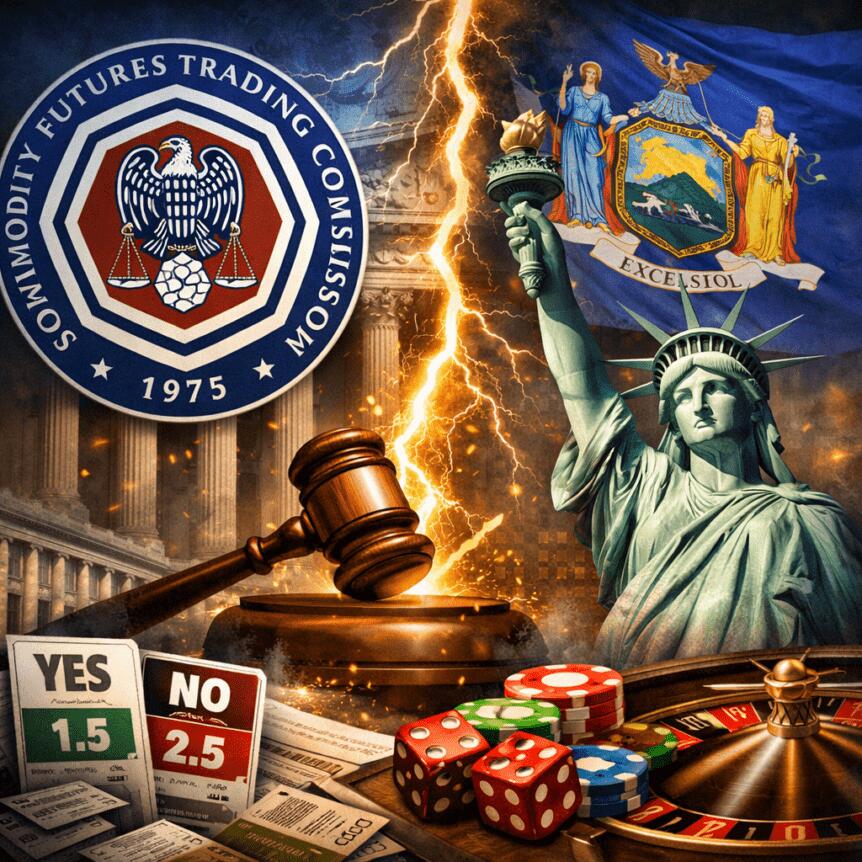
The Commodity Futures Trading Commission (CFTC) has filed a lawsuit in the Southern District of New York to block New York state authorities from applying its gambling statutes to federally regulated prediction market platforms. The action highlights a widening clash over regulatory jurisdiction between federal financial regulators and state gambling authorities, with high-stakes implications for platforms, banks, and investors that rely on event-contract products.
According to the complaint, the CFTC contends that federal law grants it exclusive authority over prediction markets, and it seeks a declaratory judgment and a permanent injunction to restrain New York’s enforcement actions. CFTC Chair Michael Selig framed the filing as part of a broader effort to defend the agency’s jurisdiction over federally registered exchanges amid an “onslaught” of state lawsuits aimed at limiting access to event contracts and undermining the CFTC’s oversight. In parallel, New York has already pursued enforcement actions against major crypto-asset venues, including Coinbase and Gemini, alleging their offerings violated state gambling rules, and had previously moved against Kalshi by ordering changes to portions of its sports-related contracts.
In another development, a broad coalition of states has weighed in on the Kalshi matter at the appellate level. On Friday, 37 states and Washington, D.C., filed an amicus brief supporting Massachusetts in its case against Kalshi, urging the state’s highest court to reject Kalshi’s argument that federal law permits a nationwide sports-betting product without adhering to state regulatory regimes. Kalshi argues its betting products qualify as “swaps” regulated by a federal financial statute enacted in 2010, while the states contend that the federal framework was not intended to centralize or override state gambling authority. The amicus brief underscores a major fault line in U.S. policy: whether federal financial regulation can or should preempt traditional state consumer protections in gambling and related markets.
Related coverage note: Kalshi, Polymarket among 27 prediction platforms banned in Brazil. This context illustrates how global regulators are intensifying scrutiny of prediction-market activity across jurisdictions.
Key takeaways
- The CFTC asserts exclusive federal authority over prediction markets and seeks judicially binding clarification to prevent state enforcement actions from applying gambling laws to these platforms.
- New York state actions have expanded beyond Kalshi to target major platforms such as Coinbase and Gemini, signaling a broader strategy to curb unlicensed offerings by crypto venues under state gambling rules.
- A coordinated multi-state effort, with 37 states and Washington, D.C., argues against a federal preemption that would broadly legalize nationwide sports betting without state oversight, highlighting a persistent policy fracture between federal and state regulators.
- State regulators are increasingly aggressive, issuing cease-and-desist notices and pursuing litigation to enforce traditional gambling licensing, age restrictions, fraud prevention, and consumer-protection measures on prediction-market products.
- The legal and regulatory dynamics raise practical concerns for platform operators, financial institutions, and investors, including licensing obligations, cross-border compliance, and the risk of conflicting standards between federal and state authorities.
Federal authority and the preemption question
The central issue in the CFTC’s litigation is whether federal law provides exclusive jurisdiction over prediction-market activity, thereby limiting or preempting state gambling laws. The complaint argues that prediction markets—where participants trade on the outcomes of real-world events—fall squarely within the CFTC’s remit as futures and derivatives markets. As such, the agency seeks a declaratory judgment that New York’s approach conflicts with federal authority and a permanent injunction to halt enforcement actions that could chill access to federally regulated platforms.
By contrast, Kalshi and its backers invoke a 2010 financial statute, contending that its betting products are swaps regulated by federal authorities and, therefore, should be shielded from state gambling regulation. The states dispute that interpretation, arguing that the statute was not intended to authorize nationwide sports betting or to nullify well-established state licensing and consumer-protection regimes. This disagreement underscores a foundational question about the reach of federal financial regulation versus state sovereignty in areas historically governed at the state level, such as gaming and gambling.
The argument has practical resonance for exchanges that operate across state lines and for banks and payment providers that support their activities. If federal law is deemed to preempt state gambling rules, compliant pathways for offering prediction-market products could shift toward a uniform federal standard. If not, operators may face a mosaic of state requirements, complicating product design, KYC/AML controls, licensing, and ongoing compliance programs. The outcome could also influence how other crypto-native products with structured payoff features are regulated in the United States.
State enforcement intensifies crackdown on prediction markets
The dispute in New York fits within a broader pattern of state actions targeting prediction markets. States across the country have increasingly viewed these products through a gambling-regulation lens, issuing cease-and-desist orders, bringing enforcement actions, and seeking to compel operators to integrate traditional licensing, responsible-gaming controls, and age-verification measures. Jurisdictions such as Arizona, Connecticut, and Illinois have been active in pursuing enforcement against prediction platforms, while Nevada recently extended a prohibition on Kalshi’s event-based contracts, siding with regulators who contend the activities constitute unlicensed gambling.
These state actions reflect concerns that predictive markets—despite their claimed hedging or informational utility—can pose consumer-protection risks, enable fraud, or facilitate unlicensed gambling without robust age checks, advertising restrictions, advertising disclosures, or capital requirements. The convergence of gaming and financial-regulatory concerns has intensified scrutiny of platforms that straddle finance, technology, and entertainment, raising the bar for compliance programs across the board. In this context, the emerging regulatory framework is less about product innovation and more about gatekeeping—who may offer such products, under what standards, and with what oversight by regulators at the federal and state levels.
In parallel, Brazil’s regulatory action against a broader set of prediction platforms serves as a cautionary signal for participants planning cross-border operations. The Brazilian context, though jurisdictionally distinct, illustrates the global patchwork of policy responses to prediction markets and the potential spillovers into U.S. activity, particularly for platforms seeking multi-jurisdictional licenses and market access.
Regulatory and market implications for incumbents and policy direction
For market participants, the core implication is heightened regulatory risk and an expanded compliance footprint. Exchanges and brokers that list prediction-market products must navigate a spectrum of requirements, including licensing regimes, consumer-protection standards, age-verification protocols, and strict anti-fraud controls. The interplay between federal and state authorities could yield a future in which a single platform operates under a federally preemptive regime in some contexts while remaining subject to state rules in others, depending on product design, client base, and where services are marketed and accessed.
The stakes extend to financial institutions and payment rails that service prediction-market platforms. Banks and custody providers must assess legal risk, programmatic controls, and Know-Your-Customer (KYC) and anti-money-laundering (AML) obligations under evolving regulatory guidance. Depending on the trajectory of the cases, there could be a renewed emphasis on licensing clarity, standardized disclosure practices, and formalized oversight structures that reduce ambiguity for counterparties and investors.
Policy context matters as well. The ongoing dispute sits at the intersection of federal financial regulation and state gaming oversight, a dynamic that has prompted calls for greater harmonization or, at minimum, clearer delineation of jurisdiction. In international terms, the U.S. framework could influence discussions around analogous regimes in other jurisdictions, including the European Union’s Markets in Crypto-Assets (MiCA) framework, which contemplates different mechanisms for regulating crypto markets at the supranational level. For operators with cross-border ambitions, aligning with a coherent, predictable regulatory posture becomes essential for risk management and capital planning.
As the litigation unfolds, analysts and compliance teams will be watching for developments on several fronts: whether the federal court grants a broad interpretation of exclusive CFTC jurisdiction; whether state courts or legislatures seek to preserve traditional gambling controls or push for regulatory convergence with federal standards; and how these legal questions translate into licensing timelines, product design changes, and enforcement priorities across jurisdictions.
Closing perspective
The unfolding disagreement between federal authority and state gambling regulation over prediction markets underscores a fundamental shift in how authorities may oversee emerging financial-technology products. For institutions, the path forward will require meticulous mapping of regulatory requirements, robust cross-jurisdictional compliance programs, and careful attention to evolving case law as courts define the boundaries of federal preemption and state sovereignty.