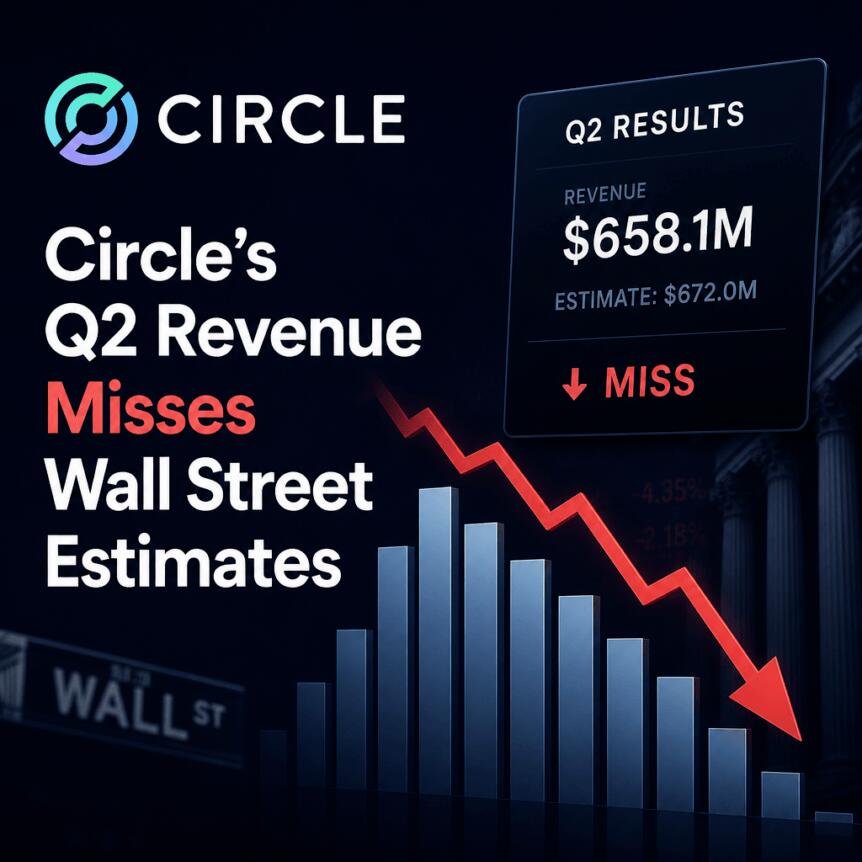
Circle posted second-quarter results for fiscal year 2026 that showed revenue growth but a slight miss versus Wall Street’s expectations. The stablecoin issuer reported $701 million in total revenue and reserve income, up 7% year-over-year, alongside net income from continuing operations of $48 million.
In parallel, the company is pushing toward the next phase of its business: a public mainnet launch for Circle’s Arc blockchain scheduled for Sept. 16. Circle also disclosed its founding validator cohort and said it has more than 100 ecosystem and institutional builders lined up ahead of the debut.
Key takeaways
- Circle reported $701 million in Q2 fiscal 2026 total revenue and reserve income, up 7% year-over-year, narrowly below the average estimate of $713.32 million compiled by Yahoo Finance.
- Reserve income totaled $668 million, growing 5% year-over-year, driven primarily by a 25% increase in average USDC circulation.
- Net income from continuing operations rose to $48 million, a $530 million improvement year-over-year.
- Guidance for “other revenue” in the current fiscal year was raised to $310 million–$330 million from $150 million–$170 million, including Arc token presale revenue.
- Arc’s launch remains scheduled for Sept. 16, with Circle naming a founding validator cohort that includes BlackRock, DTCC, Galaxy, Global Payments, ICE, Mastercard, MoneyGram, SBI Group, Standard Chartered, Sumitomo Corporation, and Visa.
Revenue growth, with reserve income still the driver
Circle’s quarterly performance centered on its reserve income stream. The company said it earned $668 million in reserve income in the quarter, representing a 5% increase compared with the same period a year earlier. Circle attributed the uptick primarily to a 25% rise in average USDC circulation.
Alongside reserve income, Circle reported total revenue and reserve income of $701 million. While the headline number reflected continued business momentum, it fell short of consensus forecasts, according to Yahoo Finance’s compilation of Wall Street analyst estimates.
On the profitability side, Circle reported net income from continuing operations of $48 million. The company framed this as a substantial year-over-year improvement, with a $530 million increase compared to the prior year period.
Guidance raised as Arc moves closer to mainnet
Although Circle’s earnings print missed the average consensus, management boosted its outlook for multiple metrics. Most notably, Circle increased its guidance for other revenue for the current fiscal year to $310 million–$330 million, up from the previous range of $150 million–$170 million. Circle stated that the higher range includes Arc token presale revenue.
The timing matters for investors and market participants because Circle’s financial narrative increasingly hinges on the Arc rollout. Circle has already set a public mainnet launch date for Sept. 16, and the company is using the period ahead of launch to position Arc as a broader platform rather than a one-off experiment.
Circle said Arc has more than 100 ecosystem and institutional builders lined up ahead of the debut. That includes not only developers, but also organizations expected to support early network activity and liquidity-related infrastructure.
Arc validator cohort signals a mainstream integration push
Circle’s Wednesday update also named the founding validator cohort for Arc. The list includes major financial and payments-focused firms: BlackRock, DTCC, Galaxy, Global Payments, ICE, Mastercard, MoneyGram, SBI Group, Standard Chartered, Sumitomo Corporation, and Visa. Circle provided the validator list in a separate press announcement alongside details about major integrations for Arc ahead of September’s mainnet launch.
From an investor standpoint, the practical significance of naming validators is less about headlines and more about operational readiness. Validator involvement can be interpreted as an attempt to reduce perceived onboarding friction for institutional participation—especially in a market where regulated entities typically prefer familiar counterparties and proven compliance frameworks.
Still, readers should note what remains unknown: Circle did not indicate any changes to the Sept. 16 timing in its earnings release. The key follow-up will be whether the company’s ecosystem commitments translate into sustained activity once mainnet goes live.
Stablecoin supply slump adds pressure to the sector
Circle’s results landed during a broader stablecoin market slowdown. CryptoQuant data cited in the report showed total stablecoin supply declining to $153 billion as of June 30, down from $156 billion on April 1.
Even in a relatively soft supply environment, Circle continues to play a prominent role. The company issues USDC, described in the report as the world’s second-largest stablecoin by circulating supply, with $72 billion in circulation. Tether’s USDt (USDT) remains first with $183 billion in circulation, based on CoinMarketCap data referenced in the article.
A stablecoin supply pause can influence issuance-linked revenue expectations, which makes Circle’s USDC circulation growth in the quarter particularly important. Circle’s reserve income growth was tied to higher average USDC circulation—suggesting that while the overall stablecoin market was not expanding rapidly, Circle found a way to move in the opposite direction within its own product line.
The broader market impact also includes usage intensity. According to a spokesperson from Talos, USDC remains dominant for on-chain settlement even as supply growth has stalled. The spokesperson cited that USDC accounted for 72% of $15.6 trillion in adjusted on-chain transfer volume, and they added that USDC supported roughly eight times more transfer volume per dollar of supply than USDT.
What to watch next
With Arc’s Sept. 16 mainnet launch approaching and management having raised guidance to include Arc token presale revenue, the next signals investors should track are Circle’s ability to convert pre-launch ecosystem commitments into measurable on-chain activity—and whether the stablecoin supply backdrop improves enough to support continued growth in USDC circulation and reserve income.