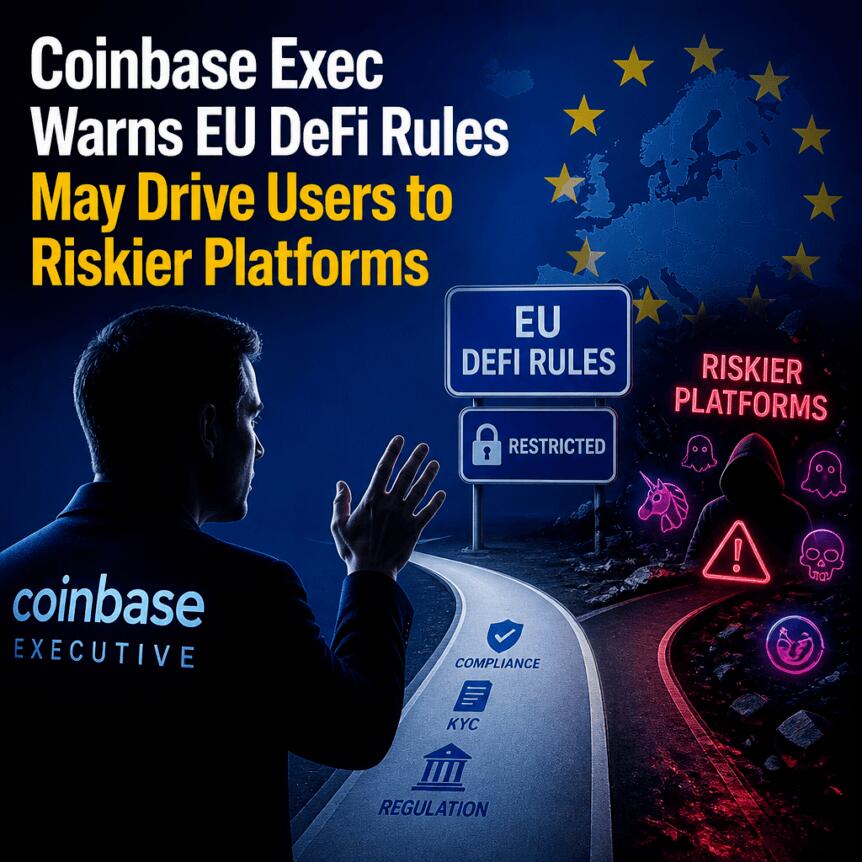
Europe’s push to tighten oversight of decentralized finance (DeFi) could have an unintended effect: rather than improving investor protection, stricter rules may push some activity away from regulated on-ramps and toward venues offering fewer safeguards. That warning came from Roeland Van der Stappen, Coinbase’s head of EU policy, who argued that the design of compliance regimes matters as much as the goal.
Speaking to Cointelegraph, Van der Stappen said regulated crypto platforms may respond to expanded DeFi requirements by limiting access to DeFi services or removing them altogether—especially if policymakers seek to apply investor-protection tools broadly across activities with very different risk profiles.
Key takeaways
- Coinbase’s EU policy chief warns that investor-protection rules could push users toward less-protected DeFi access channels.
- Regulators are considering suitability-style checks for crypto services that connect customers to DeFi, including lending protocols.
- Applying the same level of safeguards to fundamentally different DeFi actions (like swaps versus leveraged lending) may be disproportionate.
- Restricting DeFi access through regulated platforms could fragment liquidity and worsen trade execution for EU users.
Suitability tests and the question of proportionality
The debate centers on how far the Markets in Crypto-Assets Regulation (MiCA) framework—and adjacent proposals—should reach into DeFi. In September, the European Securities and Markets Authority (ESMA) recommended creating a new category of regulated crypto services for firms that enable customer access to DeFi protocols, responding to an EU consultation on MiCA.
Separately, the European Banking Authority (EBA) urged the European Commission in September to examine new rules for crypto lending and borrowing. Among the approaches EBA flagged in that consultation response was the use of suitability tests—mechanisms that evaluate whether a product or service matches a customer’s knowledge, experience, financial situation, and risk tolerance.
Van der Stappen argued that expanding suitability-style requirements beyond lending could blur important distinctions between DeFi activities. In his view, a “proportionate approach” should allow crypto-asset service providers (CASPs) to keep offering access to DeFi when they can attach safeguards matched to each activity’s risk. Otherwise, simple user actions could be treated like complex, higher-risk exposures.
He highlighted that lending, liquidity provision, and on-chain swaps would likely face the greatest compliance pressure. If requirements are too broad, some providers could narrow their offerings or withdraw DeFi access entirely.
“A proportionate approach would be to allow CASPs [crypto-asset service providers] to continue offering that access with safeguards matched to the activity,” Van der Stappen said.
Why broader rules could steer users away from EU safeguards
While the policy intent is investor protection, Van der Stappen suggested the compliance design could create a perverse incentive. If regulated providers find DeFi access too costly or operationally constrained under EU rules, users might not stop using DeFi; they may instead seek access elsewhere.
According to Van der Stappen, that dynamic could encourage “walled gardens”—more isolated ecosystems with limited interoperability—where consumer choice is narrower and safeguards may be weaker. In parallel, he warned that some users could be drawn to providers outside the EU that are not subject to the same regulatory constraints.
In practical terms, he said restrictions could fragment DeFi liquidity into smaller pools. When liquidity is split, prices can worsen and trade execution can become less efficient—an outcome that would contradict the consumer-protection rationale behind new rules.
Consumer behavior and activity trends: what the data suggests
Van der Stappen’s concerns about fragmentation and access patterns were supported by survey findings and reported adoption data referenced in the interview.
He pointed to a 2026 Adan-Ipsos survey (cited by Cointelegraph) indicating that 49% of French crypto buyers preferred accessing DeFi through exchanges, while 14% favored personal wallets. The survey result underscores a key policy risk: if regulated exchanges face limitations on DeFi connectivity, a large share of users may have to shift away from the access route they are already using.
Cointelegraph also referenced Chainalysis reporting for context. A Chainalysis report attributed a modest decline in Germany’s crypto activity to falling decentralized exchange activity. Across the EU, Chainalysis data showed overall crypto activity increased by 2.2% in the 12 months through June 2026.
Additionally, a 2025 Chainalysis report described DeFi as a small but growing part of Europe’s crypto market. In the European Economic Area, May 2025 was cited as the strongest month for DeFi lending activity within the period examined.
Taken together, the referenced figures point to a market where DeFi remains an evolving segment rather than a mature, universally standardized product. That environment can make regulatory calibration especially consequential: if compliance changes disrupt access channels before DeFi demand fully stabilizes, the effects may show up quickly in liquidity and usage patterns.
What investors and users should watch next
The immediate question is not whether DeFi should face rules, but how regulators define “appropriate” safeguards across distinct DeFi functions. Readers should watch whether policymakers move toward activity-specific requirements that differentiate swaps, lending, and liquidity provision—or whether they lean toward one-size-fits-all investor-protection tools that may be difficult for regulated platforms to apply without reducing DeFi access.