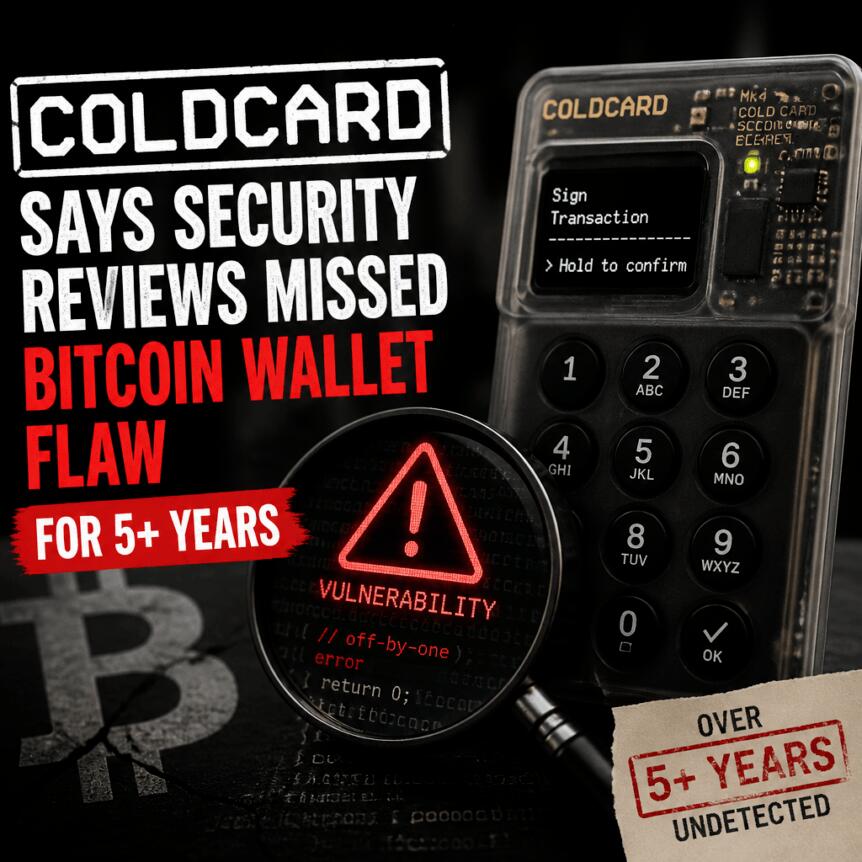
Bitcoin hardware wallet maker Coinkite has published a detailed postmortem of a Coldcard security incident, explaining why a flaw in the devices’ seed (recovery phrase) generation process remained undetected for more than five years—even after multiple independent security reviews, including those that reportedly used AI techniques.
In a report dated Nov. 23, Coinkite says it confirmed the Coldcard software was set up to generate secure recovery phrases, but the company never tested whether the wallet was actually using that secure method in practice. As a result, a software error caused the devices to rely on a weaker system, making recovery phrases significantly easier to guess under attack conditions.
Key takeaways
- Coinkite says it validated the intended secure seed-generation approach but failed to verify the Coldcard firmware was truly executing it end-to-end.
- The recovery phrases produced by the affected system looked normal and could still pass certain security checks, helping the flaw evade detection.
- Coinkite reports fixing the issue on July 31 and adding additional protections in August.
- As of Nov. 18, the company had logged roughly 300 loss-related support tickets tied to 242 accounts, though it believes the real number of victims is higher.
- The company still does not know who carried out the thefts or how the attackers discovered or exploited the flaw, but law enforcement and Canada’s cyber security authorities are investigating.
How a “correct” design still led to weaker recovery phrases
Hardware wallets are designed to keep private keys offline, with recovery phrases serving as the mechanism to restore access if a device is lost or damaged. Coinkite’s postmortem focuses on how Coldcard generated those phrases on affected systems.
According to the report, Coinkite’s security checks established that the wallet’s design could generate secure recovery phrases. However, the company didn’t perform the crucial verification step: confirming that the device was actually using the secure system during operation. Instead, a software error resulted in the wallet producing phrases using a weaker method.
Coinkite stresses that the weaker recovery phrases were not obviously abnormal. The phrases “looked normal,” and they were able to satisfy some security tests—conditions that, the company argues, allowed multiple reviews to miss the core problem.
Why multiple audits still didn’t catch the bug
Coinkite says at least 15 independent security reviews and research efforts did not identify the vulnerability before thefts began. The company also attributes this failure to the fact that attackers could still guess the recovery phrases despite the phrases passing certain checks.
Even when testers examined seed-generation behavior, Coinkite says the defect was subtle enough that it didn’t trigger the signals expected by reviewers. In other words, the checks used by audits did not include—or did not manage to reveal—the missing “real-world verification” that Coinkite later identified as essential.
The postmortem also references research and reviews that used AI. While the details of those AI approaches are not elaborated in the excerpt available here, the central point remains: the presence of advanced testing tools did not guarantee discovery if the verification strategy still didn’t confirm the device’s actual runtime behavior.
Known impact and what Coinkite says it has done
Earlier reporting by Galaxy Research, cited in the incident context, estimated that hackers stole at least 1,789 Bitcoin—worth roughly $114.7 million at the time of the thefts. Coinkite’s postmortem does not appear in the provided excerpt to contest that minimum figure.
Coinkite says it implemented a fix on July 31. In August, it introduced additional security measures alongside that update, aiming to prevent the weaker seed-generation outcome from being possible in future operation.
Even with the fix, Coinkite’s report underscores a difficult reality for impacted users: updates cannot retroactively “make safe” recovery phrases already generated using the flawed method. The company’s guidance to users therefore emphasizes the need to replace both the recovery phrase and the funds’ custody setup, not simply rely on firmware updates.
Victims, investigation status, and immediate user guidance
As of Nov. 18, Coinkite reported receiving about 300 loss-related support tickets associated with 242 accounts. It also stated that the actual number of victims is likely higher, and that it is still evaluating how to assist affected customers.
However, the company has not yet decided on a compensation plan. Coinkite also said it does not know who stole the funds or how the attackers found or exploited the flaw.
On the investigative front, the report indicates law enforcement authorities are looking into the thefts, and the Canadian Centre for Cyber Security has opened a separate case.
Coinkite continues to urge affected users to update their software, create new recovery phrases, and move funds to new wallets. The company’s warning is explicit: a patch does not protect previously created phrases if those phrases were generated under the vulnerable seed-generation process.
Cointelegraph reached out to Coinkite regarding compensation plans but did not receive a response by the time of publication.
Why this incident matters for hardware wallet trust
Beyond the immediate thefts, Coinkite’s postmortem highlights a broader challenge for the hardware wallet ecosystem: strong internal cryptographic design is not the same as robust, end-to-end validation of real device behavior. The failure mode described in the report—where recovery phrases looked normal and still passed some tests—shows how even repeated audits can miss a flaw if the test criteria don’t fully mirror how the device operates in production.
For users and builders, the incident is a reminder that “audit coverage” is only as strong as the assumptions baked into test methodologies. Coinkite’s follow-up guidance—generate fresh recovery phrases and move funds—also clarifies a practical security lesson: after a seed-generation issue, the safe path is to reset trust at the wallet-creation level, not rely on later fixes alone.
Going forward, the key open questions are who the attackers were, how they determined or verified the weakness in recovery phrases, and what form of remediation—if any—Coinkite will offer to affected customers. Until those points are resolved, users should treat recovery-phrase replacement and wallet migration as the operational standard following any credible seed-generation compromise.