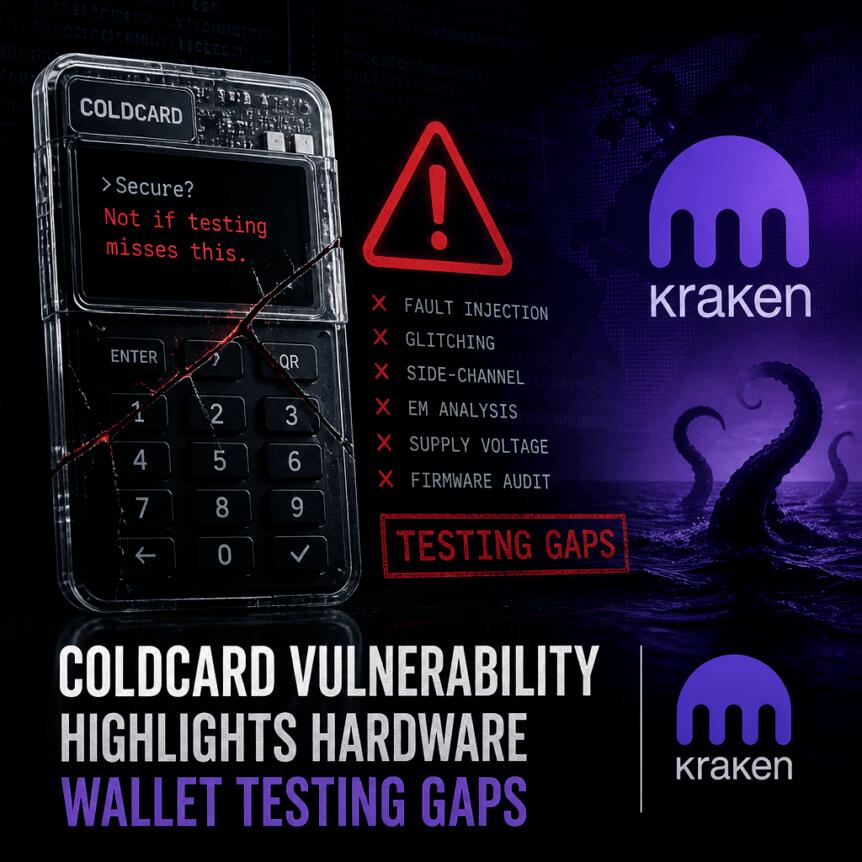
Coldcard’s five-year seed-generation flaw has become more than a single-vendor incident, with Kraken’s chief security officer Nick Percoco arguing that it highlights a structural gap in how hardware wallets are independently tested. In particular, he says security reviews often verify that the “right” entropy source exists in the codebase, but may not confirm that production firmware actually calls the validated randomness path.
Percoco’s warning follows an ongoing exploit campaign widely believed to target weak seed phrases produced by affected Coldcard devices. As of Sunday, more than 4,500 addresses were reported impacted, with losses estimated at nearly $90 million in Bitcoin, according to Cointelegraph’s ongoing coverage.
Key takeaways
- Kraken’s Nick Percoco says hardware wallets are often not subject to end-to-end verification that the approved entropy/RNG source is the one production firmware executes.
- Coldcard’s vulnerability traces to a process change approved in March 2021, after Coinkite integrated a new cryptographic library.
- Coinkite’s postmortem describes a shift where seed generation relied on a weaker MicroPython generator instead of the intended TRNG most of the time.
- Percoco points to established standards like NIST SP 800-90B and BSI AIS-31 as models for how entropy sources should be validated.
- Coinkite says it halted shipments of affected devices and destroyed remaining units containing the vulnerable firmware, while advising users not to dispose of hardware immediately.
Why the Coldcard case is a test-process problem, not just a bug
In an X post on Sunday, Percoco characterized the Coldcard issue as a “wake-up call” for hardware-wallet manufacturers. His core point was that consumers are asked to rely on a vendor’s implementation of the system’s most critical function—secure randomness—without a corresponding independent check that the validated randomness path is actually what ends up running in production.
“Consumers are asked to trust a manufacturer’s implementation of the single most critical function in the system, with no independent verification that the approved entropy path is the one actually executing,” Percoco wrote, arguing that this gap can allow critical cryptographic expectations to be silently violated.
He contrasted the state of digital-asset self-custody testing with practices in other security-critical sectors. As he framed it, industries that handle sensitive authentication hardware and cryptographic modules typically require more rigorous verification of entropy sources than what is commonly enforced in the hardware-wallet ecosystem.
What Coinkite says went wrong in March 2021
Coldcard’s broader timeline centers on changes made in March 2021. Coinkite disclosed that a software flaw had been present since then, when Coldcard altered its seed-generation approach as part of integrating a new cryptographic library.
According to Coinkite’s postmortem, the migration inadvertently routed wallet creation through a weaker MicroPython generator that already existed in the codebase, rather than using Coldcard’s intended true random number generator (TRNG). The company’s account describes a situation where the TRNG code was present and could be reviewed and confirmed, but it was not the primary source used during seed generation.
Coinkite summarized the problem by saying that “the bulk of randomness on the COLDCARD was coming from a PRNG that I didn’t know was actually in the source code base,” while the carefully crafted TRNG code was being used only “by chance” and “only for less important things.”
This distinction matters because it reframes the vulnerability: rather than the TRNG being entirely missing or nonfunctional, the risk appears to stem from the firmware executing a different randomness source than the one reviewers might reasonably assume would be used for security-critical seed creation.
Standards exist—yet Percoco says they aren’t applied end to end
Percoco said the failure to detect the issue for years is consistent with how many wallet evaluations are structured. He argued that while code reviews can establish that a TRNG is included and appears to work, there is often no systematic check that verifies the entropy source actually invoked by production firmware matches the entropy that was validated.
He pointed to requirements used for physical true random number generator design and validation, citing NIST SP 800-90B, a US standard for cryptographic randomness validation, and BSI AIS-31, an analogous German standard from the Federal Office for Information Security.
“Such checks are already standard across the rest of the security industry,” Percoco said. His broader critique was that hardware wallets currently lack an equivalent, universally enforced process that forces end-to-end validation of the RNG path—from approved design, to tested behavior, to the exact call executed at runtime.
For investors and security-focused users, the implication is straightforward: if independent testing does not verify the operational link between validated randomness and deployed firmware, the security model can be weakened even when the codebase contains the correct components.
Coldcard and Coinkite response: halted shipments and guidance to users
Following disclosure of the underlying flaw, Coldcard said Sunday it has halted all device shipments since confirming the vulnerability on Thursday. Coinkite also stated it destroyed remaining units at its facilities that contained the affected firmware.
At the same time, Coinkite advised users with affected devices not to dispose of them, noting that they “may become essential if funds are recovered.” The company also said its legal team will coordinate, as warranted, with law enforcement across multiple jurisdictions to support efforts to identify those responsible.
The ongoing nature of the exploit makes the guidance more than a technical footnote. When seed phrase weaknesses are involved, practical remediation often depends on forensic details and the potential recovery process, which can be complicated if devices are discarded.
Earlier reporting from Cointelegraph has described the exploit as targeting weak seed phrases generated by affected Coldcard devices, with additional analysis of theft totals and affected addresses. The scale reported as of Sunday—over 4,500 addresses impacted and losses approaching $90 million in Bitcoin—adds urgency to both user instructions and improvements to how wallets are tested before release.
What to watch next
For the market, the key question is whether this incident drives a measurable shift in independent validation practice—specifically, whether future hardware-wallet reviews will include end-to-end confirmation that production firmware uses the validated entropy source for seed generation. Until that standard becomes routine, incidents like Coldcard’s may continue to reveal weaknesses that are invisible to partial audits.