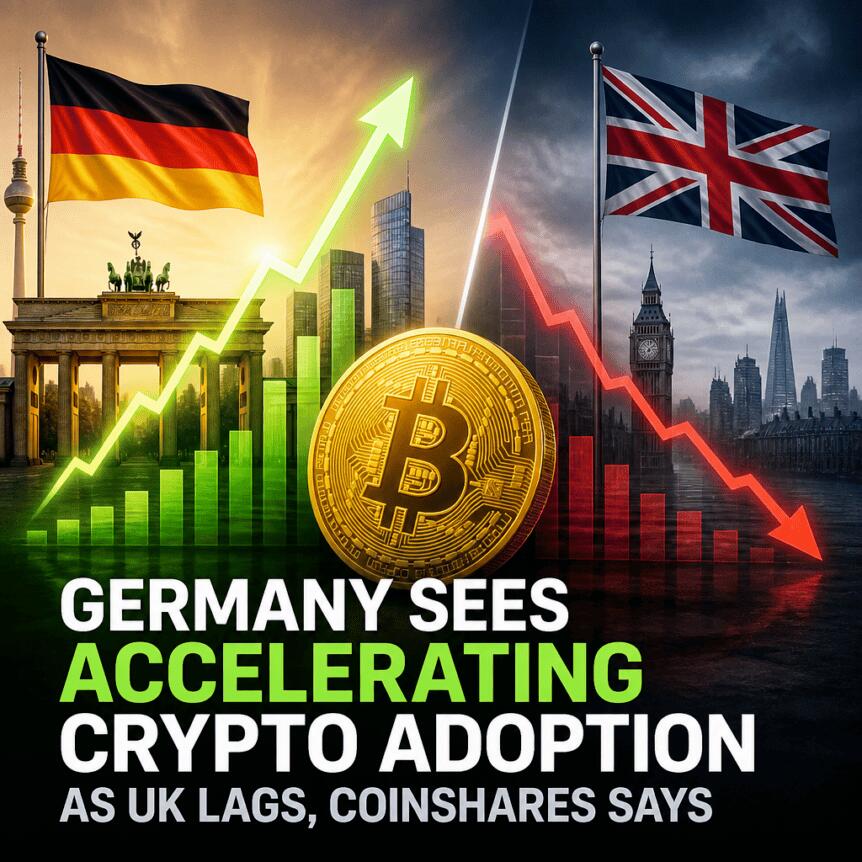
German crypto adoption is accelerating, with younger investors and wealth intermediaries increasingly pointing inherited funds toward digital assets, according to CoinShares researcher Luke Nolan. In the UK, momentum appears slower, largely tied to regulatory delays and a retail-access framework that only recently reopened.
Speaking on Cointelegraph’s Chain Reaction show, Nolan characterized Germany’s progress as “very good,” while describing the UK market as “nascent” after the Financial Conduct Authority (FCA) lifted its ban on certain crypto exchange-traded products in the last year. The difference matters for investors: where regulation and banking infrastructure move in tandem, institutions and advisors can more readily bring compliant custody and distribution into existing wealth channels.
Key takeaways
- CoinShares researcher Luke Nolan says Germany’s crypto adoption is being driven by family offices, wealth managers, individual advisors, and younger investors reallocating inherited wealth.
- The UK is behind, in Nolan’s view, because its regulatory path has been slower—especially around retail access to crypto exchange-traded products.
- Germany has 89 licensed crypto-asset service providers, representing 25.5% of companies in ESMA’s MiCA register, and holds the EU lead in MiCA authorizations by June.
- Major German banks are positioning for institutional crypto custody, while the UK FCA is advancing licensing guidance and enforcement actions.
Germany’s younger-investor and wealth-advisor momentum
Nolan’s Germany thesis centers on how crypto is being pulled into mainstream wealth planning. He highlighted family offices, wealth managers, and individual advisors as key distribution points, alongside younger cohorts seeking to invest inherited wealth in digital assets.
That adoption story aligns with regulatory and industry scaling in the EU’s largest economy. According to an ESMA update published Wednesday, Germany hosts 89 licensed crypto-asset service providers, accounting for 25.5% of the entities listed on the Markets in Crypto Assets (MiCA) register. The same regulatory milestone reinforces the idea that adoption isn’t only retail-led; it’s also shaped by the availability of licensed firms that can serve compliant clients.
Nolan also pointed to Germany’s standing within MiCA authorization rankings. Earlier coverage noted that Germany was the bloc’s leader by MiCA authorization in June, with 57 authorized crypto companies—an imbalance versus many other EU jurisdictions that suggests Germany is moving faster from framework to operational deployment.
Why the UK lags: retail access and regulatory timing
In contrast, Nolan described the UK crypto landscape as still “very much behind.” His explanation focused on regulatory sequencing, including how recently the FCA changed course on crypto exchange-traded products for retail participants.
The article referenced that the FCA lifted its ban on crypto exchange-traded products in less than a year ago, after previously banning those products from retail in January 2021. That timeline is important: long gaps between prohibitions and re-openings tend to delay habit formation, reduce the flow of compliant product offerings, and slow the expansion of advisory and distribution practices for everyday investors.
While the FCA has been actively setting the stage for the next regime, Nolan’s framing implies that UK demand will likely remain structurally constrained until products and services normalize under the new rules.
Banks move: German custody plans versus UK regulatory guidance
German institutions are not treating crypto adoption as a pure fintech experiment. Deutsche Bank, according to a Wednesday disclosure, said it was awaiting regulatory approval to launch crypto custody solutions for institutional clients in Europe, with a license expected in October. That positions a legacy bank within the custody layer—one of the most consequential components for institutional participation because it affects how assets are held, secured, and operationally managed.
Germany’s banking momentum also extends to federally supported institutions. Earlier coverage noted that Landesbank Baden-Württemberg began offering crypto custody solutions in April 2024 after partnering with Austria-based Bitpanda for its institutional custody platform. Together, these moves suggest a pattern: rather than building everything from scratch, large banks appear to be leveraging existing crypto infrastructure while aligning it to regulatory expectations.
The UK has also been progressing, but with a different emphasis—clarifying authorizations and policing activity as licensing approaches. On Wednesday, the FCA issued final guidance on when crypto activities may require authorization under the country’s incoming regulatory regime. The regulator said licensing applications would open on Sept. 30, with a Feb. 28, 2027 deadline for firms seeking transitional arrangements before the new regime takes effect on Oct. 25, 2027.
At the same time, enforcement signals are part of the regulatory picture. On Thursday, the FCA announced it sent a cease-and-desist letter to three London locations suspected of facilitating illegal peer-to-peer crypto trading. Separately, the source also noted that the UK Parliament approved regulations bringing cryptoassets within the FCA’s regulatory remit in February and that a package of rules and guidance was finalized in June.
What investors should watch next
The near-term divergence between Germany and the UK likely comes down to implementation speed: Germany’s combination of licensed providers and mainstream bank involvement may keep expanding the number of compliant ways investors can access and custody crypto. In the UK, the key variable is how quickly firms can convert guidance into applications and operational compliance once the licensing windows open—while enforcement actions continue to shape which business models can persist.