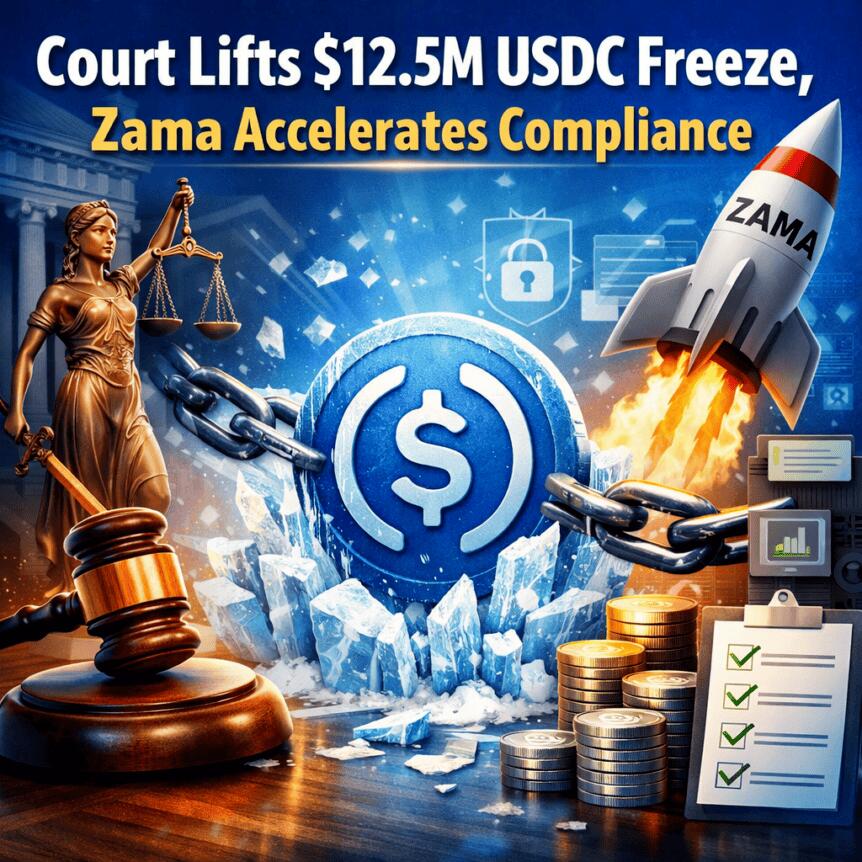
Zama, a privacy-focused blockchain protocol, has committed to accelerating its regulatory-compliance program after a U.S. court lifted a temporary freeze on roughly $12.5 million in USDC held in its confidential cUSDC wrapper. The move ends a disruption tied to a dispute involving Overnight Finance and highlights the ongoing tension between privacy-preserving infrastructure and centralized stablecoins that can be frozen by issuers under court order.
Co-founder Rand Hindi announced on X that the court determined the freeze to be unwarranted and that the cUSDC contract, along with all underlying USDC, has returned to normal operation. The deposit in question, approximately $12.5 million, was made into Zama’s confidential USDC wrapper on May 11. Hindi noted that the freeze was tied to a litigation amid a dispute unrelated to Zama, and that the umbrella effect—where the disputed account represented the majority of the contract’s value—created a blanket freeze request through Circle.
The episode underscores a broader institutional debate: how privacy-preserving protocols can coexist with the centralized controls that stablecoin issuers retain. As Hindi put it, the situation could have affected any protocol holding freezable assets, including decentralized exchanges, lending protocols, and bridges. The court’s decision to unwind the freeze is seen by Zama as a proof point that targeted responses may be possible within existing legal frameworks, even when assets are stored in pooled, centralized wrappers.
Key takeaways
- The U.S. court lifted the temporary freeze on about $12.5 million in USDC held in Zama’s cUSDC wrapper, allowing normal operations to resume.
- Zama intends to accelerate its compliance roadmap, expanding automated enforcement of issuer-level freezes and adding governance and monitoring tools.
- Under the proposed framework, if Circle freezes a USDC address, the corresponding confidential USDC tied to that address would be frozen, while the protocol aims to preserve access for unaffected users.
- The incident has not deterred institutional interest; Zama remains committed to launching its cUSDC product, including shielding $5 million of USDC from its treasury, later this month.
Unwinding the freeze and what it means for privacy-enabled rails
According to Hindi, the court concluded that freezing an entire smart contract pool imposed disproportionate harm on users not implicated in the dispute. He noted that Zama’s architecture preserves visible sender and recipient addresses while encrypting balances and amounts, enabling the protocol to isolate the disputed account without disrupting others. In his view, this capability—to target enforcement without broad collateral damage—demonstrates a critical distinction between centralized stablecoins stored in pooled contracts and more granular, privacy-preserving designs that can limit collateral effects of legal actions.
Jeremy Bradley, Zama’s chief operating officer, elaborated that the case serves as a cautionary tale for any protocol holding centralized, freeze-capable assets. He told Cointelegraph that the exact dynamics could apply to automated market makers, lending protocols, bridges, and other actors holding USDC in pooled contracts. The core takeaway, he argued, is that the absence of targeted freezing tools can leave protocols exposed to court orders that affect many users at once rather than isolating a single account.
“The same court has now lifted the freeze, determining that it was unwarranted,” Rand Hindi wrote on X. “The cUSDC contract and all underlying USDC have returned to normal operation.”
Those reflections echo a broader legal-question backdrop: how to reconcile the privacy of user balances with the transparency typically required by issuers and regulators. The Cointelegraph report on the initial freeze highlights how the interplay between user privacy and regulatory requests can escalate quickly in pooled custody scenarios. The ongoing dialogue around targeted compliance tooling—versus blanket freezes—remains central to how the ecosystem evolves.
Accelerating compliance: what Zama is changing this year
In response to the incident, Zama outlined a plan to accelerate its compliance program. The team’s roadmap now foregrounds automatic enforcement of compliance actions tied to underlying asset issuers, with a focus on limiting the blast radius of a freeze. Under the proposed approach, Circle’s action to freeze a USDC address would automatically cascade to freeze the corresponding confidential USDC holdings within Zama’s protocol, rather than requiring a blanket halt across the entire pool.
Bradley described the changes as an enhancement of an existing design principle: programmable compliance. The team intends to establish a compliance council and bring in additional transaction-monitoring tools to bolster observability and governance. He argued that the incident has shifted urgency from planning to execution, enabling institutions to engage with Zama with greater confidence that the protocol can respond to legal requests without compromising privacy for non-involved users.
Even as Zama doubles down on privacy, the project remains committed to working with Circle and other ecosystem participants to navigate the legal realities of stablecoins within a decentralized framework. Bradley emphasized that Circle’s actions were a response to a court order, and the broader challenge lies in building tools that allow precise, targeted responses rather than sweeping restrictions that impact all users of a pooled contract.
Beyond the governance and tooling improvements, Zama reiterated its intention to push forward with the launch of its cUSDC product later this month, including a plan to shield $5 million of USDC from its treasury. The company frames this as a testbed for how confidential assets can be reconciled with issuer-level controls in a real-world setting, potentially offering a blueprint for other privacy-oriented protocols facing similar regulatory pressures.
Assistants aligned to this space have noted that the lifting of the freeze demonstrates that privacy rails can operate within the legal framework when they include precise, auditable controls. The broader takeaway is not a retreat from privacy but a pivot toward interoperable, compliance-ready privacy tooling that can coexist with the stability mechanisms central to the broader crypto ecosystem.
For now, the market will be watching how quickly Zama can implement its enhanced compliance features and how other protocols that rely on centralized stablecoins respond to the lesson that blanket freezes can be mitigated through targeted, isolable actions. The unfolding developments surrounding cUSDC and programmable compliance will likely influence discussions on custody, governance, and legal transparency across privacy protocols and stablecoins alike.
As Zama advances, observers will be looking for further clarity on how targeted freezing could function in practice across different asset wrappers, and whether other issuers and protocols adopt similar approaches to balance user privacy with legitimate regulatory demands. The next milestones—Zama’s cUSDC launch, the rollout of governance and monitoring tools, and any regulatory guidance—will shape how privacy-focused infrastructure can scale safely in a tightly monitored financial landscape.