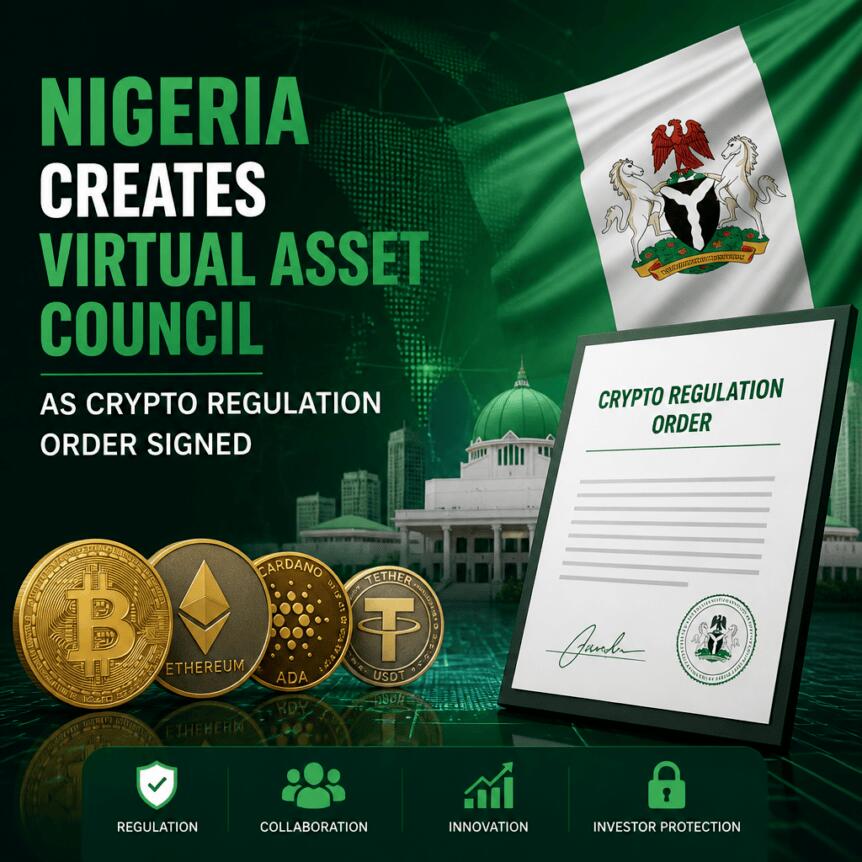
Nigeria’s President Bola Ahmed Tinubu has signed an executive order aimed at reducing what his administration described as the fragmentation of digital-asset regulation. The move is intended to align oversight across agencies, improve protections for consumers, and create a clearer compliance environment for businesses operating in cryptocurrencies and stablecoins.
According to a statement from Tinubu’s special adviser, Bayo Onanuga, the order—signed on Friday—sets out a framework to “harmonize” regulation of virtual assets, strengthen cooperation among Nigeria’s financial, revenue and capital markets bodies, protect citizens from fraud, and “safeguard the integrity of the financial system while enabling responsible innovation.”
Key takeaways
- Nigeria’s executive order is designed to coordinate existing regulators rather than create a new authority or transfer powers.
- A new virtual asset council will be chaired by senior representatives from major financial regulators to steer related policy.
- Registration requirements are expected to be tied to the “nature of the activity” and the specific asset involved, addressing gaps that previously allowed some operators to avoid oversight.
- Nigeria’s tax authority, the Nigerian Revenue Service, is preparing additional guidance following earlier reforms requiring crypto providers to link transactions to tax identifiers.
- The policy shift comes amid rapid stablecoin and crypto inflows into Nigeria, including a major share of sub-Saharan Africa’s stablecoin activity since 2019, per an IMF report.
Executive order targets regulatory gaps without changing mandates
Onanuga emphasized that the executive order does not create a new regulator or reallocate statutory powers. Instead, he said each institution retains its mandate and independence, while the new framework is meant to coordinate their work “rather than replacing it.”
The adviser also indicated that Nigeria plans to provide clearer certainty for market participants by basing registration on how an actor participates in the market and what type of asset is involved. In the administration’s framing, the order is intended to “close the gaps” that allowed certain unregistered operators to avoid supervision.
For investors, exchanges, payment firms, and other service providers, the core practical question is not whether regulators will become stricter overnight, but whether coordination will be more predictable. Fragmentation often translates into overlapping compliance demands or enforcement uncertainty; a harmonized approach can reduce friction while still increasing the barriers for entities that previously operated outside established oversight.
A virtual asset council to coordinate policy across regulators
The executive order establishes a virtual asset council, led by senior figures from Nigeria’s top financial regulators, with responsibility for directing related policies. The intention, as described by the administration, is to strengthen cooperation across agencies that oversee different parts of the broader financial system.
That matters because digital assets span multiple regulatory domains: market conduct, financial stability concerns, anti-fraud measures, taxation, and capital markets oversight. When these responsibilities are distributed without tight coordination, businesses can face inconsistent rules depending on which agency is driving enforcement at a given time.
Nigeria’s approach appears to be aimed at consolidating how policies are directed across agencies while leaving each regulator’s formal legal powers intact—an arrangement that could improve consistency without triggering the disruption that sometimes comes with sweeping institutional restructuring.
Tax reforms continue: Nigeria links crypto activity to identifiers
Beyond the coordination effort, the executive order also points to tax administration updates. Onanuga noted that the Nigerian Revenue Service would provide additional details about the effects on taxpayers, while earlier measures suggest the direction of travel is already underway.
In January, Nigerian authorities said that under the Nigeria Tax Administration Act, crypto service providers were required to link transactions to tax identification numbers. In some situations, national identification numbers were also required.
The policy emphasis on identifier-linked reporting is particularly relevant in a market where cross-border activity and informal rails can complicate compliance. If Nigeria tightens data requirements while harmonizing regulator oversight, firms operating locally may need to upgrade their onboarding and transaction-record systems to demonstrate that counterparties and transactions can be mapped to the relevant tax records.
The next watchpoint is how the “additional details” referenced in the executive order translate into enforceable operational requirements—such as what data formats will be expected, how compliance will be assessed, and how reporting obligations interact with existing rules for different classes of digital-asset services.
Rapid stablecoin adoption increases pressure for clearer rules
Nigeria’s regulatory attention comes as digital asset usage has expanded quickly. According to a June report from the International Monetary Fund (IMF), Nigeria accounted for about 60% of stablecoin inflows within sub-Saharan Africa since 2019. The IMF also reported that Nigeria had approximately $59 billion in crypto inflows between July 2023 and June 2024, citing the scale of activity tied to crypto demand in the region.
The IMF also framed Nigeria’s policy challenge as balancing innovation with risk control. In its discussion of stablecoin adoption, the institution said the problem is to “narrow the gap that made the workaround attractive” in cross-border payments while ensuring that “new risks remain contained.” The IMF added that doing so requires “a clear strategy: open to innovation but anchored in sound macroeconomic policy and effective regulation.”
That framing highlights a tension policymakers often face: stablecoins can meet real user needs—especially when traditional payment channels are costly or slow—but they can also introduce compliance, consumer protection, and financial integrity risks if governance is unclear. Nigeria’s executive order is positioned as an attempt to bring those risks under a more coordinated regulatory umbrella while keeping the market open for “responsible innovation,” in the administration’s wording.
The meaningful change from a practical standpoint will be whether harmonization leads to consistent enforcement and clearer registration pathways. The administration’s commitment that registration follows the nature of the activity and the asset suggests rules may be tiered rather than one-size-fits-all, which could help regulators target higher-risk activities while reducing uncertainty for lower-risk providers.
What to watch next
Market participants should focus on how the new virtual asset council operationalizes guidance, how registration requirements will be defined by activity type and asset category, and what specific compliance and reporting updates the Nigerian Revenue Service issues following earlier identifier-based tax reforms.