In an evolving cryptocurrency landscape, recent data highlights a shift in how newcomers approach digital assets. A new survey reveals fewer individuals are entering the market by solely relying on Bitcoin, signaling a maturing ecosystem where diverse assets and narratives are taking center stage. As altcoins, DeFi projects, and NFTs gain competitive ground, the role of Bitcoin as the primary gateway to crypto appears to be broadening, reflecting increased diversification and innovation within the space.
- Only 55% of new crypto owners started with Bitcoin, down from previous years, indicating diversification in entry points.
- 10% of respondents have never purchased Bitcoin, suggesting alternative sectors like DeFi and memecoins are gaining traction.
- Altcoins account for 37% of market entry, driven by lower costs and vibrant community engagement.
- Market participants foresee Bitcoin maintaining relevance, but long-term growth relies on innovation and ecosystem diversity.
- Fears of missing out and recent bullish runs have propelled investors into altcoins and memecoins, beyond Bitcoin.
A recent survey conducted by data aggregator CoinGecko analyzed responses from 2,549 cryptocurrency enthusiasts and investors, revealing a notable trend: Bitcoin, once the primary onboarding asset, now accounts for just over half of new participants’ initial investments. Furthermore, 10% of those surveyed have never engaged with Bitcoin at all, reflecting a shift towards alternative narratives and altcoin communities.
Altcoin entry is a sign of healthy market
Jonathon Miller, general manager at crypto exchange Kraken, noted that investors are increasingly exploring sectors like DeFi and memecoins for their entry into digital assets. “This progression illustrates the maturation of the crypto ecosystem,” he explained. “Bitcoin no longer dominates as the sole major asset, and the increasingly frictionless access to diverse narratives makes it easier for newcomers to participate.”
Despite this, Miller believes that growing geopolitical tensions, monetary debasement, and Bitcoin’s reputation as a store of value will likely draw latecomers back to Bitcoin. “Over time, many in the market who initially pursued speculative trends will recognize Bitcoin’s enduring role and adjust their portfolios accordingly,” he said.
“Over time, many crypto market participants initially drawn in by more speculative trends will come to recognize Bitcoin’s enduring importance and adjust their portfolios accordingly.”
Why altcoins appeal
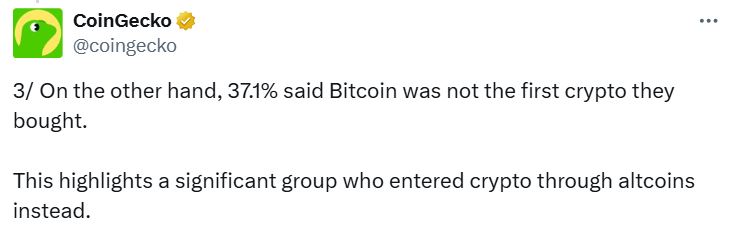
Hank Huang, CEO of Kronos Research, explained that new investors often bypass Bitcoin because of lower entry costs and strong community engagement in altcoins. “Investors are drawn to the lower unit prices and vibrant communities within projects like Solana and Ethereum, which foster greater participation,” Huang said. CoinGecko’s latest survey found that 37% of respondents entered the market through altcoins rather than Bitcoin.
Huang emphasized that as crypto adoption continues to grow, diversifying into lower-cap altcoins and niche communities signals a maturing market. “The hype is shifting toward projects like Solana, Ethereum, and even memecoins, transforming Bitcoin from the default entry point to just one destination among many,” he said. Looking ahead, he predicts the future ecosystem will be driven by innovation, culture, and community rather than solely by Bitcoin’s dominance.
He further noted that long-term success in crypto won’t depend entirely on Bitcoin. As new frameworks and ecosystems develop, participation will increasingly reflect a broader spectrum of assets where technological and cultural factors are equally influential.
Users might be afraid they missed the boat
Tom Bruni, head of markets at Stocktwits, pointed out that many potential investors feel pressured by rising Bitcoin prices and a lack of understanding. “While seasoned crypto enthusiasts see the industry as still in its early stages, newcomers might believe they’ve already missed their chance if they didn’t buy Bitcoin at lower levels, especially with its recent surge past $124,000,” he explained.
“This recent bull run has seen significant outperformance from certain altcoins, and the desire to find a ‘cheaper’ crypto than Bitcoin to invest in has driven people further out on the risk spectrum into altcoins and memecoins.”
Bitcoin’s multiple all-time highs this year demonstrate its increasing value. Meanwhile, Bruni notes that the expanding universe of stablecoins, tokenized assets, and application-layer projects will likely reduce Bitcoin’s overall market share but retain its position as a key portfolio anchor. “Performance remains a critical driver; if Bitcoin continues to deliver strong returns, more investors will maintain exposure,” he said. “Should markets turn volatile, investors tend to retreat into Bitcoin’s perceived stability.”
Zero Bitcoiners won’t last long
Qin En Looi of Onigiri Capital sees early adopters already holding Bitcoin, with mainstream acceptance expected to come once traditional financial channels adopt crypto infrastructure. “As infrastructure matures, fewer investors will have zero exposure, but trust-building takes time,” he remarked. Ultimately, Looi believes Bitcoin’s role will evolve but remain integral, much like gold in traditional finance. “What we’re witnessing is a broadening of what’s relevant, including stablecoins and tokenized assets, rather than a decline in Bitcoin’s importance.”
He emphasizes that Bitcoin’s influence as the flagship digital asset remains intact, though the crypto ecosystem’s diversity grows. “Performance will dictate how assets are allocated, and as long as Bitcoin’s returns keep pace, it will continue to be a foundational element in crypto portfolios,” Looi concluded.