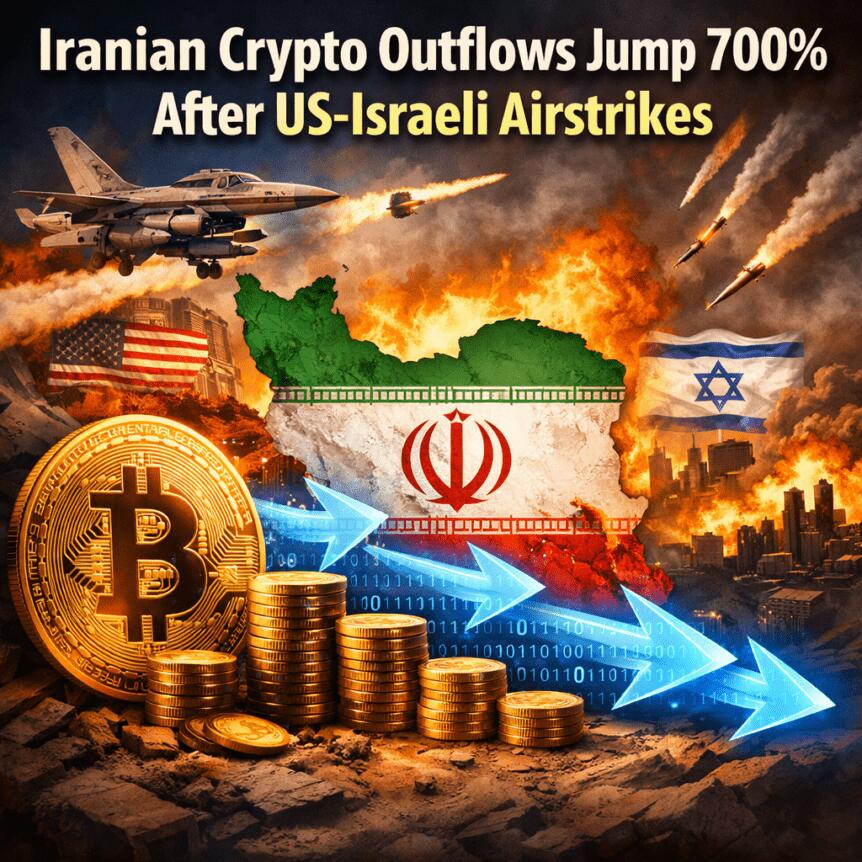
Amid intensifying geopolitical tension and significant internet disruptions in Iran, the country’s largest crypto exchange experienced a rapid churn of funds. Nobitex saw crypto withdrawals surge within minutes of the first airstrikes by the United States and Israel, with on-chain analytics showing a rise of more than 700% to well over $500,000, and later estimates pegging hourly outflows near $3 million. The spike occurred as Iranians faced reduced online connectivity, complicating further movement of funds and possibly indicating a broader shift in how citizens navigate financial restrictions during conflict. Some observers framed the moves as a potential capital flight, while others cautioned that infrastructural outages could have distorted the data and limited subsequent activity.
Key takeaways
- Outflows from Nobitex spiked more than sevenfold within minutes of the airstrikes, with initial figures exceeding $500,000 and a later one-hour total approaching $3 million, according to on-chain analytics.
- The surge occurred in a context of widespread internet outages in Iran, which analysts say likely curtailed further flows even as the event drew attention to how crypto can enable cross-border transfers outside traditional banking channels.
- Nobitex accounts for roughly 87% of Iran’s crypto transaction volume, and the platform’s 2025 activity reportedly reached about $7.2 billion in trades across more than 11 million users.
- Historical friction in Iran’s financial sector—such as the $81 million Nobitex hack in June and looming bank reforms—creates ongoing volatility for domestic crypto users who rely on digital assets to navigate sanctions and a fragile banking system.
- Analysts diverge on interpretation: Elliptic frames the flows as possible capital flight; TRM Labs emphasizes that a blackout regime coinciding with the conflict has driven a downturn in activity rather than a sustained exodus.
Tickers mentioned: $BTC
Sentiment: Neutral
Market context: The incident sits at the intersection of geopolitics, sanctions pressure, and evolving crypto liquidity, where regional outages and policy uncertainty shape the pace and direction of on-chain flows.
Why it matters
The episode underscores how crypto markets can respond quickly to political shocks, with individuals and communities in Iran potentially using digital assets to sidestep traditional banking constraints. Nobitex, as Iran’s largest trading venue, sits at the center of a system where 87% of domestic crypto volume passes through a single gateway, amplifying any disturbance in its activity. The reported figures for 2025—about $7.2 billion in trades and more than 11 million users—illustrate the scale of crypto usage inside the country and the reliance on digital instruments to preserve liquidity amid sanctions and banking fragility.
Yet the situation also highlights the fragility of data in conflict zones. As Elliptic notes, the early surge in outflows could reflect capital movement out of Iran that avoids certain banking scrutiny, hinting at the ongoing usefulness of crypto for cross-border transfers. The contrasting view from TRM Labs—drawing attention to the internet blackout and reduced transaction volumes—reminds readers that on-chain activity can be heavily mediated by connectivity and state controls. In practical terms, the volatility surrounding Nobitex’s flows can ripple through the broader market sentiment, influencing risk tolerance among traders who monitor sanctions-driven narratives and regional risk indicators.
Contextual factors extend beyond the exchange itself. Iran’s banking sector has faced long-standing structural challenges, including high-profile stress events such as Ayandeh Bank’s bankruptcy in October, which exposed the fragility of domestic lenders and reverberated across the financial ecosystem. Authorities have issued warnings about the reform needs of other banks, signaling a broader push to recalibrate the domestic financial framework. In this environment, crypto often assumes a dual role: a practical mechanism for moving value and a focal point for policy debate about capital controls, sanctions, and the limits of digital finance in sovereign economies.
The narrative around these movements has periodically intersected with geopolitical objectives in the region. As external powers have sought to pressure Iran’s nuclear and missile programs, market participants watch how sanctions influence both on-chain usage and access to global liquidity. In parallel, the ongoing narrative of global crypto risk—ranging from volatility in Bitcoin’s price to regulatory developments—continues to shape how investors perceive the safety and resilience of digital assets amid upheaval. Bitcoin (CRYPTO: BTC) itself has shown sensitivity to macro and regional factors, a reminder that crypto markets are not isolated from the broader geopolitical dynamic. For readers seeking direct context, ongoing coverage and analyses related to Bitcoin movements amid the broader regional volatility can be found through linked analyses on market activity and policy developments.
Nobitex’s role in Iran’s crypto ecosystem extends beyond a single incident. The exchange has faced its own security challenges, including a notable $81 million hack in June, which underscored the risk environment that domestic users navigate when capital flow channels are subject to external pressures and internal safeguards. The combination of sanctions, network disruptions, and security incidents forms a complex backdrop for the country’s crypto activity, with many citizens simultaneously seeking alternatives to the traditional banking rails that are constrained by external policy and domestic regulation.
Beyond the immediate market dynamics, the episode raises questions about the resilience of crypto infrastructure in countries under pressure. Can exchanges like Nobitex maintain steady liquidity and user trust when external shocks test connectivity and regulatory stability? How will regulators balance the need for financial stability with the realities of a growing crypto user base that relies on digital assets for daily transactions and savings? As the regional conflict unfolds and connectivity fluctuates, analysts will continue to monitor outflows, on-chain volumes, and the broader implications for both the domestic economy and the global crypto market.
What to watch next
- Updates from Elliptic and TRM Labs on outflow dynamics and connectivity disruptions, including any revised figures for Nobitex’s activity during the incident.
- Further data from Nobitex on withdrawal vs. deposit volumes as internet access stabilizes or deteriorates, and any changes in trading metrics as sanctions and governance evolve.
- Official statements from Iranian authorities regarding banking reforms, sanctions responses, or restrictions that affect crypto use and exchange operations.
- Security and resilience news related to Nobitex, including any updates on past incidents and measures to mitigate future hacks.
- Broader regional implications for crypto liquidity and risk sentiment as the geopolitical situation develops, including potential regulatory moves affecting exchanges and cross-border transfers.
Sources & verification
- Elliptic blog: Iranian cryptoasset outflows surge 700 percent following attacks
- TRM Labs blog: How Iran’s crypto market is reacting to conflict
- Ayandeh Bank bankruptcy article: Iran’s private lender bankruptcy and customer impact
- Nobitex-related hack: Iranian crypto exchange Nobitex exploited for $81m
- Bitcoin-related market context: Bitcoin recovers to 68k following the reported death of the Iranian Supreme Leader
Market reaction and key details
The events surrounding Nobitex’s outflows underscore a central tension in the current crypto landscape: the ability of digital assets to move value quickly across borders even as the infrastructure for traditional finance under strain can impede transactions. Elliptic’s analysis captured an immediate 700% spike in outbound transfers, with the first-hour figure approaching $3 million, signaling a rapid reallocation of funds that could be aimed at safeguarding assets or pursuing opportunities beyond domestic channels. However, the subsequent moderation in activity tied to widespread internet blackouts suggests that the data may reflect a temporarily constrained market rather than a sustained exodus.
As observers compare the two analytics from Elliptic and TRM Labs, the importance of connectivity becomes clear. TRM’s assessment—rooted in its observation of a roughly 99% dip in Iran’s internet connectivity during the early phases of the conflict—points to a crucial driver of activity: when the pipes fill with data, flows can surge; when the pipes clog, activity contracts. The debate over capital flight versus downturn driven by outages remains unresolved, but the fact that both groups are analyzing Nobitex’s flows indicates growing attention to how crypto networks behave under stress and how far those networks can sustain operations when external conditions deteriorate.
From a market participant perspective, the numbers tied to Nobitex—nearly 87% of Iran’s crypto transaction volume and a 2025 footprint of around $7.2 billion in trades across more than 11 million users—underscore the potential systemic impact of any disruption in the country’s crypto rails. While global liquidity remains available in other markets, the domestic environment shapes behavior in ways that can have ripple effects through regional risk sentiment and the broader crypto economy. The episode also adds to a long-running narrative about crypto’s role as a supplementary tool for people navigating sanctioned economies—an area of ongoing policy and market consideration for years to come. For readers, the episode provides a concrete case study in how geopolitical shocks intersect with on-chain activity, exchange resilience, and the broader calculus of digital asset adoption in a tightly controlled financial landscape.
What to watch next
- Monitoring Nobitex withdrawal and trading volumes as connectivity stabilizes or remains constrained.
- New assessments from Elliptic and TRM Labs clarifying whether observed outflows reflect capital flight or data distortions caused by outages.
- Regulatory and policy updates from Iranian authorities regarding banking reforms and crypto governance.
- Security updates on Nobitex’s platform following past incidents and potential improvements to prevent future breaches.
- Broader regional liquidity shifts and how sanctions pressures influence cross-border crypto flows and exchange volumes.