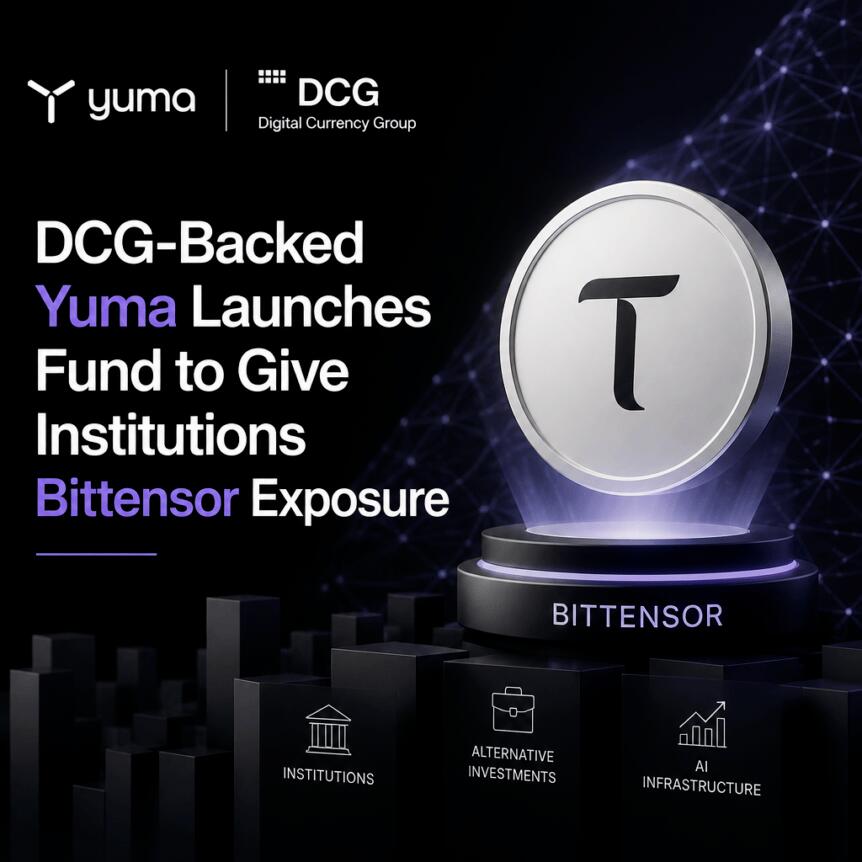
Yuma, an investment firm backed by Digital Currency Group, has launched the Yuma Total Market Fund to give institutional investors diversified exposure to the Bittensor decentralized AI ecosystem in a single vehicle. The fund is designed to track both Bittensor’s native TAO token and a basket of AI-focused subnets without requiring investors to hold or select individual subnet tokens.
In a Thursday announcement, Yuma said the fund began with seed capital from an undisclosed anchor investor. The launch comes as asset managers increasingly look for regulated products tied to decentralized AI networks, following broader institutional interest in blockchain-based alternatives to centralized AI providers.
Key takeaways
- Yuma’s fund targets diversified exposure to Bittensor by combining TAO holdings with a basket of AI subnet exposure under one investment strategy.
- The fund is positioned as a simpler entry point for investors who want Bittensor exposure without manually building a subnet portfolio.
- Bittensor’s subnet economy is often cited as very large, but network data from Taostats indicates the combined subnet value is closer to $300 million than higher estimates.
- Institutional allocation shifts already signal growing interest in TAO and the broader decentralized AI theme, including changes in Grayscale’s Decentralized AI Fund.
- Regulatory product momentum continues, with filings and conversions aimed at bringing TAO exposure into ETF wrappers.
A one-stop fund for Bittensor exposure
According to Yuma, the Yuma Total Market Fund provides exposure to TAO and a basket of AI-oriented subnets through a single investment vehicle. The stated intent is to reduce complexity for institutions that want exposure to the ecosystem’s “total market” rather than picking specific subnets themselves.
Yuma also framed the timing around expanding institutional demand for decentralized AI products. Bittensor, the network behind the ecosystem, supports AI infrastructure and application development using specialized subnets that span areas including compute, marketplaces, and identity.
How big is the subnet economy?
Yuma pointed to Bittensor’s scale, stating that its 128 subnets represent more than $900 million in combined value. However, network tracker Taostats shows a combined subnet value closer to $300 million.
For investors, the difference matters because it can affect how the “basket” inside the fund is sized, weighted, and interpreted relative to the overall ecosystem. Even if TAO remains the focal point for market attention, subnet value is relevant for understanding how diversified exposure may behave when network activity, demand for specific subnet services, or token economics shift.
Institutional interest in TAO is evolving
Yuma’s announcement arrives amid a broader institutional pivot toward decentralized AI exposure, particularly through TAO. Earlier this year, Grayscale increased TAO’s weighting in its Grayscale Decentralized AI Fund to 43% during the fund’s quarterly rebalance in April. Since then, the allocation has reportedly fallen to about 20%.
As Grayscale’s rebalancing progressed, Near Protocol’s NEAR moved into the lead position within the fund at roughly 44%. The shifting weights underscore that decentralized AI exposure inside institutional portfolios is not static—asset managers are adjusting allocations as constituent components change in relative performance, risk, and market interest.
TAO’s broader institutional visibility has also been reflected in its market capitalization being cited at nearly $2.4 billion, according to CoinMarketCap.
ETF momentum and product building
The fund launch also fits a larger wave of attempts to package TAO exposure into familiar exchange-traded wrappers. In April, Bitwise filed for a TAO Strategy ETF with the US Securities and Exchange Commission (SEC). Separately, Grayscale submitted an amended registration statement aimed at converting its existing Bittensor Trust into a spot TAO exchange-traded fund that—if approved—would list on NYSE Arca. The SEC filing is available through its public EDGAR archive.
While Yuma’s product is a fund and not necessarily an ETF, the parallel push highlights a shared strategy among managers: broaden access to TAO and decentralized AI networks in forms that institutions can more easily allocate to, benchmark, and trade compared with direct, token-by-token exposure.
Why decentralized AI is back in the spotlight
Interest in decentralized AI has also been reinforced by renewed attention to the risks of reliance on a single provider. The renewed debate picked up momentum after the US Commerce Department suspended public access to Anthropic’s Fable 5 and Mythos 5 models over national security and export control concerns.
Grayscale head of research Zach Pandl argued at the time that the restrictions highlighted the dangers of centralized control over AI systems, adding that he expected demand for decentralized AI such as Bittensor and its TAO token to rise as investors look for alternatives to centralized model providers. Earlier coverage also linked the shutdown to a broader case for decentralized approaches to AI infrastructure.
Since then, the situation appears to have eased: the Commerce Department restored access to Mythos 5 on Friday, and Axios reported Saturday that the Trump administration is expected to allow Anthropic to resume public access to Fable 5 as soon as next week.
Even with the access restoration, the episode illustrates the kind of operational and policy risk that can make “provider diversity” an investment theme—exactly the idea behind products that bundle exposure across decentralized ecosystems rather than hinging on a single company’s model availability.
Investors should watch how Yuma’s fund constructs its subnet basket over time and how quickly institutional allocations shift between TAO-centric exposure and broader subnet diversification. With multiple TAO ETF-related filings in motion and policy-driven headlines repeatedly reshaping the decentralized AI narrative, the next key signal will be how regulators and asset managers respond as demand for decentralized AI wrappers grows.