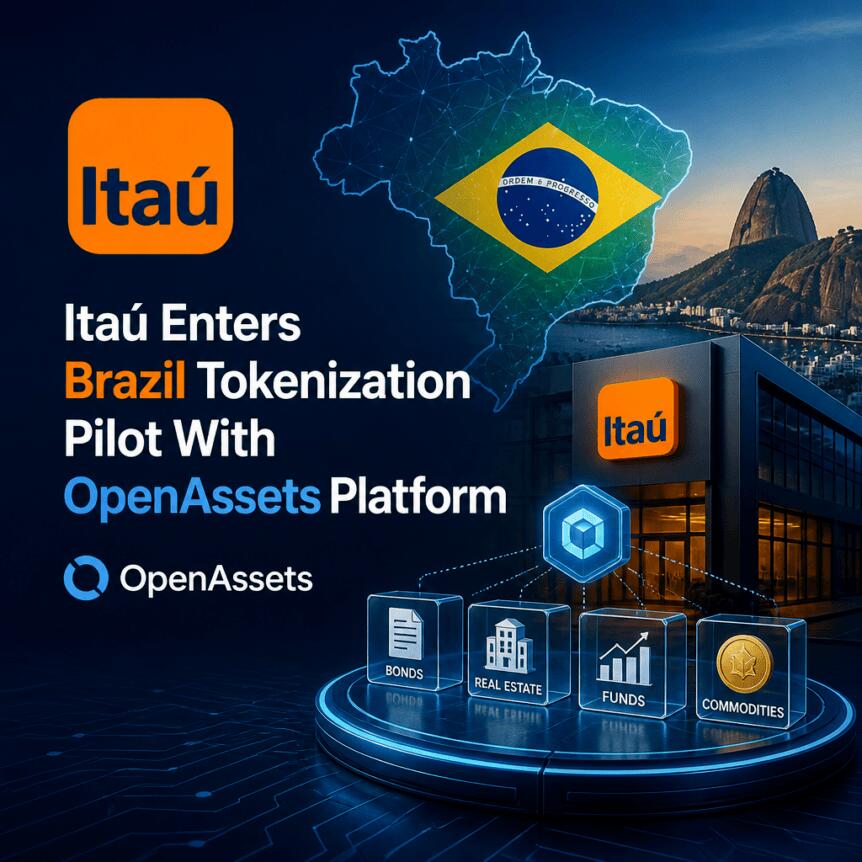
Itaú, the largest private-sector bank in Latin America, is joining an industry pilot to explore how tokenized fixed-income instruments and investment funds could work in Brazil’s capital markets. The bank has partnered with digital asset infrastructure provider OpenAssets to participate in the testing phase focused on tokenizing real-world securities using distributed ledger technology (DLT).
According to an announcement made on Tuesday, the work will center on technical proofs of concept and an evaluation of the operational, compliance, and technology requirements needed for tokenized assets. Debentures and investment funds are among the use cases being considered as the parties assess how tokenized instruments might fit within existing institutional workflows.
Key takeaways
- Itaú and OpenAssets are participating in an ANBIMA-led pilot to test tokenized fixed-income securities and investment funds in Brazil.
- The pilot aims to validate the technical feasibility of issuing, trading, and settling capital markets instruments on DLT, along with compliance and operational prerequisites.
- Tests are being conducted on a private, permissioned DLT network in a simulated setting without real financial transactions.
- ANBIMA selected 20 pilot use cases from 39 proposals submitted by more than 50 institutions and technology firms.
- Interest in tokenized real-world assets continues to expand, with RWA.xyz reporting more than doubling in value over the past year.
ANBIMA’s pilot expands beyond concept into controlled testing
The initiative is led by the Brazilian Financial and Capital Markets Association (ANBIMA), which is running a structured pilot to evaluate capital markets activities—issuance, trading, and settlement—using DLT. Unlike public blockchain experiments that rely on live settlement, the pilot is designed around controlled conditions: it uses a private, permissioned network and a simulated environment to test key mechanics without executing actual trades.
ANBIMA selected the pilot’s initial set of 20 use cases in April from 39 proposals submitted by more than 50 banks, asset managers, and technology companies. Itaú and OpenAssets are now contributing to the effort by developing proofs of concept and examining what it would take for tokenized instruments to operate within institutional and regulatory expectations.
What Itaú and OpenAssets are expected to do
Under the partnership, OpenAssets will supply its tokenization infrastructure. Itaú’s role focuses on bringing capital markets expertise to the testing process, particularly as the partners examine how tokenized assets could be integrated into existing institutional frameworks.
The work is not limited to testing token issuance mechanics. The Tuesday announcement emphasizes that the parties will assess operational requirements, compliance considerations, and broader technology needs for tokenized products. In practice, these evaluations often determine whether tokenization can be deployed without undermining governance, auditability, custody models, or the controls financial institutions rely on for regulated market activity.
Debentures and investment funds are specifically named among the use cases being explored, highlighting that the pilot targets more than a single asset type. That breadth matters for investors and market participants because it can clarify whether one technical approach can generalize across different security structures—or whether separate designs are needed for different product categories.
Where tokenization demand is coming from
While the Brazil pilot remains focused on technical feasibility and institutional requirements, the broader market backdrop continues to draw attention to tokenized real-world assets (RWAs). RWA.xyz data cited in the announcement indicates that the total value of tokenized RWAs distributed on public blockchains has more than doubled over the past year, rising from roughly $18.9 billion in August 2025 to about $38.3 billion at the time of writing.
According to the same data, US Treasury debt is the largest category, representing more than $16 billion. This concentration suggests that the RWA market—at least in terms of public-chain issuance—has largely started with highly standardized government instruments. The ANBIMA pilot’s focus on Brazilian debentures and investment funds therefore sits at an important junction: it tests whether tokenization approaches can be adapted from relatively uniform instruments to a wider set of capital markets products with distinct legal and operational features.
Why permissioned, simulated DLT matters for institutional adoption
A key detail in the pilot design is the use of a private, permissioned DLT network operating in a simulated environment without real financial transactions. For institutional participants, this approach can accelerate learning while containing risk: participants can evaluate workflow integration, data handling, and settlement logic before moving toward any live environment.
For market watchers, the permissioned and simulated structure also sets expectations around what success looks like. Rather than measuring immediate liquidity or adoption, the pilot’s milestones are likely to be tied to how issuance, trading, and settlement processes can be mapped into tokenized representations—and whether those representations can satisfy compliance and operational constraints under Brazil’s market rules.
What remains uncertain is how quickly any workable model can be translated into production deployments in the real economy. Tokenization pilots often uncover implementation gaps—ranging from data standardization and system integration to control frameworks—that take time to resolve, even when the core DLT mechanics perform as intended.
For readers tracking the tokenization race, the next signal to watch is how ANBIMA and its partners move from technical proofs of concept toward clearer operational and compliance pathways—particularly whether debentures and investment funds can be tokenized in a way that preserves institutional requirements without sacrificing efficiency.