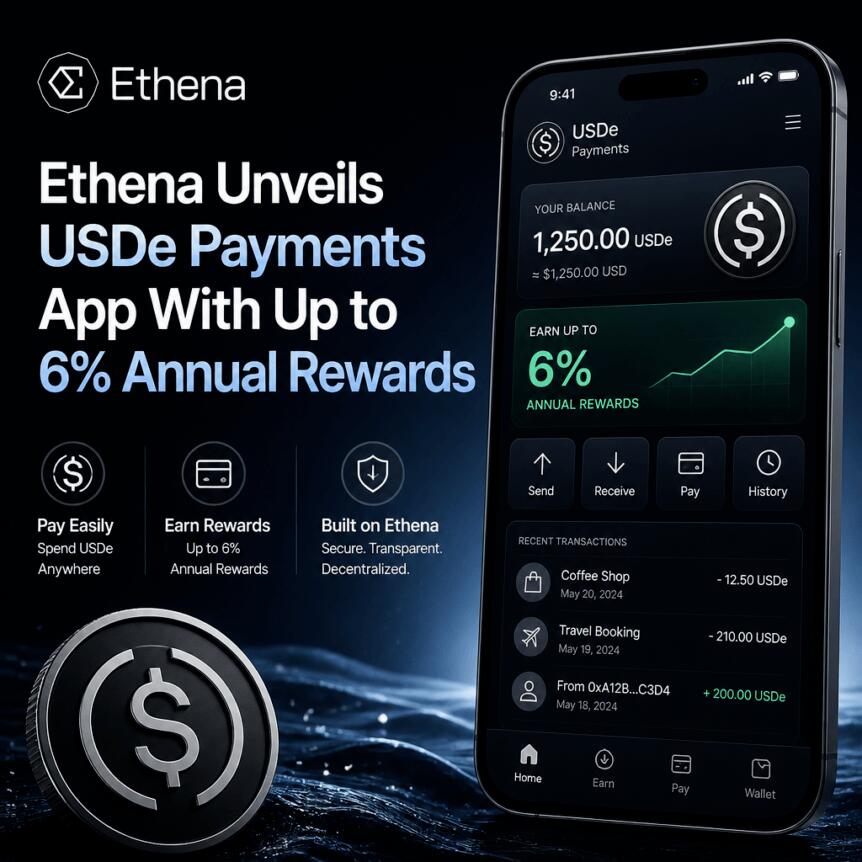
Ethena has moved beyond synthetic-dollar trading with the launch of Ethena Pay, a crypto-native “global money app” designed to make its USDe stablecoin usable for everyday payments, savings, and cross-border transfers.
Announced in a Tuesday post on X, the self-custodial app is built around holding USDe in a dollar-denominated balance, earning up to 6% annualized rewards, and spending via a payment card. Ethena says fiat access is supported through onboarding tools that convert deposits into USDe.
Key takeaways
- Ethena Pay turns USDe into a wallet-based balance for payments, savings, and transfers, with up to 6% annualized rewards for eligible users.
- In the beta, Ethena will begin with 400 users, expanding access weekly across 48 countries.
- Avalanche is listed as the exclusive settlement layer for payments and transfers.
- The app supports moving money using IBAN details and local-currency rails, but is not initially available in the US, EU, Canada, Taiwan, or South Korea.
- USDe’s market has continued to scale: DefiLlama data cited by Ethena’s report puts USDe at roughly $4.1 billion market cap, while ENA is up sharply in recent weeks.
Ethena Pay: a USDe-focused wallet for spending and transfers
Ethena positions its new product as a “money app” rather than a pure trading interface. According to the Tuesday announcement, users can deposit fiat or crypto, after which funds are converted into USDe (USDe) to create a dollar-denominated balance inside the app.
The product is also designed for external transfers. Ethena says users will be able to use IBAN details to move funds between bank accounts and settle into local currencies. For payment execution, Ethena Pay includes a payment card flow that allows users to spend their USDe balance, while also offering fiat onramps to fund the wallet.
Ethena further notes that MoonPay-owned Iron supplies backend infrastructure for the service.
Where the beta starts—and where it doesn’t
The rollout is structured as a limited beta across broad regions, including Latin America, the Caribbean, Africa, and parts of Asia. Ethena said the beta spans 48 countries, but access is initially restricted to 400 users, with availability expanding weekly.
There’s also a clear geography boundary for regulatory or operational reasons. Ethena Pay is not initially available in the United States, the European Union, Canada, Taiwan, or South Korea. Ethena indicated it expects to expand into those markets during the beta, subject to regulatory approval.
For investors and users watching stablecoin “real use” narratives, the staged launch matters: it suggests Ethena is testing both product mechanics (on/off ramps, card spend, transfer rails) and compliance constraints in select regions first, rather than attempting a full global release immediately.
Why the settlement choice matters: Avalanche for transfers
A key technical detail in the announcement is settlement. Ethena says Avalanche will serve as the exclusive settlement layer for Ethena Pay’s payments and transfers.
This matters because the user experience of a payments product depends not just on custody and user interfaces, but also on how value is processed behind the scenes—especially for cross-border activity. By naming a single settlement layer, Ethena is effectively narrowing one major variable for the beta: how transfers are finalized and coordinated as transactions scale.
As Ethena expands the app in waves, traders and ecosystem builders will likely watch whether the payment and transfer flows remain consistent in speed and reliability across regions, and whether the company adds settlement options later or keeps Avalanche exclusively for the broader rollout.
USDe and ENA: growth backdrop for the payments push
USDe is the synthetic dollar that underpins Ethena Pay. Ethena describes it as an Ethereum-based protocol designed to keep its value close to $1 without relying on traditional banking infrastructure.
According to the information provided, USDe maintains its peg using crypto collateral and hedging strategies, including derivatives positions. Ethena’s announcement cites DefiLlama data indicating USDe has reached a market capitalization of about $4.1 billion, which it characterizes as making it the sixth-largest stablecoin by market cap.
Ethena also operates ENA, its governance token. The same coverage notes ENA’s market capitalization at roughly $1.5 billion, and says the token has rallied about 68% over the past month, though it remains below earlier highs.
Separately, the Ethena Foundation proposed on Friday directing 95% of the net revenue it receives from Ethena’s core businesses toward ENA buybacks, conditional on USDe’s circulating supply reaching $7.5 billion. Following that proposal, Ethena’s reporting states ENA rose more than 10% and then added 27% over the week.
On the market data side, the article cites CoinGecko for ENA trading information, including a reference trading price around $0.16 on Tuesday. It also references trading volume of about $595 million over the past 24 hours, up 16% from the previous day.
What to watch next
With Ethena Pay moving into a limited, multi-country beta, the key question is whether the app can translate USDe’s stablecoin mechanics into dependable payments and transfer experiences at scale. As access expands weekly and Ethena seeks regulatory approval for additional regions, users and market observers should watch for improvements in coverage, any changes to settlement approach, and how USDe adoption in real-world rails affects demand for both USDe and ENA.