Stablecoin-funded remittances are continuing to outcompete traditional money transfers on cost, according to a new third-quarter report from Borderless.xyz, a stablecoin payments network. The report frames digital-dollar rails as one of the most direct real-world applications for stablecoins: moving money across borders while keeping fees—and effective exchange costs—lower.
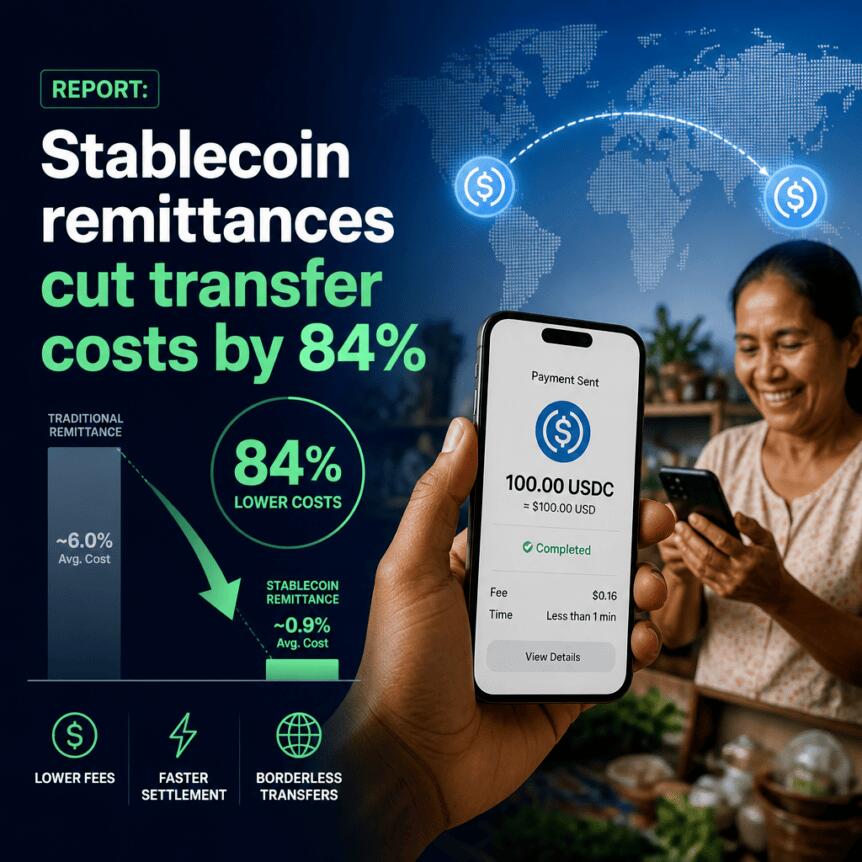
Borderless.xyz estimates that sending a $200 remittance using stablecoin-funded payment rails costs a median 1% (about $2), compared with 6.36% (about $12.72) for traditional remittances, using World Bank data for comparison. The analysis suggests stablecoin-funded transfers are roughly 84% cheaper on average, though the figures rely on Borderless’s third-quarter 2026 pricing alongside World Bank figures from the same period in 2025.
Key takeaways
- A $200 remittance via stablecoin-funded rails is priced at a median 1% (≈$2), versus 6.36% (≈$12.72) for traditional remittances, using World Bank comparison data.
- Estimated savings hold across major emerging regions: Sub-Saharan Africa (2.9% vs 8.46%) and Latin America (1.25% vs 5.64%).
- For larger business payments, Borderless reports notably lower stablecoin routing costs on eurozone corridors than traditional bank wire pricing.
- Settlement speed can be minutes rather than days, but payment completion rates vary by local network.
Lower fees for remittances and regional adoption signals
Borderless’s cost comparison centers on an often-cited friction in cross-border transfers: fees compounded by exchange costs. In its framework, stablecoin-funded remittances reduce both the direct transfer cost and the overall expense for senders—an advantage that tends to matter most where remittance costs have historically been highest.
The report’s regional breakdown reinforces that point. In Sub-Saharan Africa, stablecoin-funded remittances are estimated at 2.9% compared with 8.46% for traditional transfers. For Latin America, the gap is even wider: 1.25% for stablecoin-funded payments versus 5.64% for conventional methods. While the report does not claim identical conditions across every corridor, the consistent directional savings suggest the model is not limited to a single geography.
For investors and operators watching stablecoin use cases, this matters because remittances provide a measurable, repeatable payment flow. Unlike speculative trading activity, remittance-driven volume links stablecoin demand to real consumer and business needs—particularly in markets where transfer costs can materially affect household budgets.
Business payments: cheaper routing on stablecoin rails
The Borderless report extends beyond consumer remittances and highlights cost differences for larger transfers routed through stablecoin networks. For a $10,000 stablecoin-funded transfer to the eurozone, Borderless estimates costs as low as $26 when routed through the lowest-cost provider. At the median provider level, the same transfer is reported at $52 across all corridors.
To provide context, the report compares these figures with traditional international bank wire costs of $135 to $150 for the same amount. That traditional range includes transfer fees and assumes a 1% foreign-exchange margin. Even allowing for variation in banking relationships and corridor-specific pricing, the order-of-magnitude gap is substantial—and it points to why payment operators are exploring stablecoin rails for settlement and liquidity management.
Still, readers should note that the “lowest-cost provider” and “median provider” framing implies a spectrum of outcomes rather than a single universal cost. The practical takeaway is not only that stablecoins can be cheaper, but that the economics depend on routing and provider selection—an operational detail that can influence user experience as much as the headline rate.
Minutes-long settlement versus traditional transfer timelines
Cost is only one side of the story. The Borderless report also claims stablecoin-funded payments can reach local bank accounts in minutes, with settlement time varying by the underlying payment network used to deliver funds domestically after stablecoin settlement.
In Brazil, stablecoin payouts routed through the PIX network settled in a median of two minutes during the third quarter. Mexico’s SPEI network recorded a median settlement time of three minutes. Colombia’s PSE network also posted a median settlement time of two minutes. These are materially faster than traditional alternatives: Borderless reports that SWIFT transfers typically settle the next business day, with the slowest 10% taking three business days.
For businesses and payment providers, faster settlement can improve cash-flow planning and reduce the operational overhead associated with delayed inbound funds. However, speed alone does not guarantee reliability—completion rates are a crucial complement, especially when payouts must be made consistently at scale.
Completion rates vary by corridor and network
Borderless’s data shows that while stablecoin-funded payments may settle quickly, completion rates are not uniform across every network. According to the report, Mexico’s SPEI network completed 98.6% of payouts, and Brazil’s PIX achieved 97.8%. Colombia’s PSE network completed 79%, while Costa Rica’s SINPE recorded a 73% completion rate.
This is an important nuance for anyone evaluating stablecoins as payment infrastructure. Settlement time statistics can look strong even when some payouts fail or do not complete within the measured window. The same corridor can therefore produce different real-world results depending on network performance, operational constraints, and how retries or failures are handled.
As stablecoin usage expands, these differences are likely to matter more—not less. Growth in transaction activity may increase pressure on settlement partners, counterparties, and compliance workflows, potentially affecting completion and throughput in ways that do not show up in average settlement time alone.
Earlier coverage from Cointelegraph highlighted rising stablecoin transaction volumes despite relatively flat growth in overall market capitalization this year. Standard Chartered, referenced in that coverage, expects the stablecoin market to reach $2 trillion by 2030, two years later than its previous forecast. Taken together, Borderless’s performance metrics suggest the industry’s progress is increasingly measured by execution—cost, settlement speed, and completion reliability—rather than only by aggregate growth in issuance.
Looking ahead, readers should watch whether stablecoin-funded payment completion rates improve in lower-performing corridors, and how pricing evolves as more providers compete on routing. Those two factors—execution reliability and cost consistency—will likely determine how quickly stablecoin rails move from “promising savings” to dependable mainstream payment behavior.