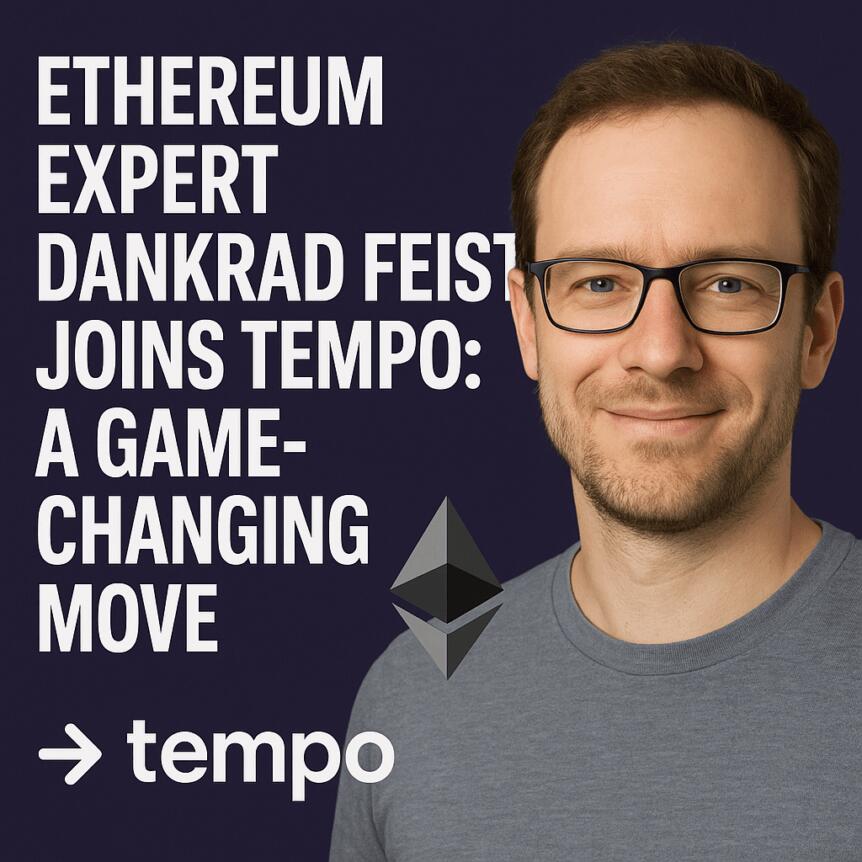
- Ethereum researcher Dankrad Feist joins Tempo, a new layer-1 blockchain built for payments and stablecoins, while remaining as a research adviser to Ethereum Foundation.
- Feist emphasizes Tempo’s open-source technology compatibility with Ethereum, aligning with the permissionless ethos of the broader ecosystem.
- The announcement has sparked mixed reactions—some community members see it as a loss of a key contributor, while others welcome the potential for integration.
- The crypto community debates whether a dedicated stablecoin blockchain like Tempo is necessary, with concerns over the proliferation of chains and Layer-2 scaling solutions.
- Critics question the strategic value of launching purpose-built chains over expanding Ethereum’s existing infrastructure, citing centralization and regulatory issues.
Ethereum Developer Moves to New Payments-Focused Blockchain
Dankrad Feist, a prominent Ethereum researcher and developer affiliated with the Ethereum Foundation, revealed on Friday that he is joining Tempo—a layer-1 blockchain dedicated to payments and stablecoins, developed through a partnership between Stripe and Paradigm. Despite shifting his focus, Feist assured he will continue to provide guidance as a “research adviser” for Ethereum, focusing on scaling technology, user experience enhancements, and blobs—a feature that temporarily stores data to optimize blockspace utilization. He expressed optimism about Tempo’s compatibility with Ethereum, noting that their open-source tech can integrate back into the network, strengthening the broader ecosystem’s permissionless ideals.
“Tempo’s open-source technology can easily integrate back into Ethereum, benefiting the entire ecosystem. Ethereum and Tempo are strongly aligned, as they are built with the same permissionless ideals in mind,” he said.
Feist further shared his intention to stay actively involved with the Ethereum community, continuing efforts to advance the network’s scalability and usability. The announcement, however, drew mixed reactions, with some community members perceiving it as a significant loss of expertise within Ethereum’s ranks during a period of significant transformation in the ecosystem.
Community Divided Over the Future of Blockchain Payment Solutions
The move has intensified debate within the crypto space regarding the necessity of new blockchain networks designed specifically for payments and stablecoins. Some industry voices argue that another dedicated chain adds unnecessary complexity, echoing concerns about blockchain proliferation.
Joe Petrich, head of engineering at NFT platform Courtyard, responded to the announcement by stating, “No one wants another chain,” criticizing the idea of introducing a new blockchain when existing solutions could suffice. He questioned whether such a purpose-built blockchain offers enough advantages to justify overhauling current infrastructure.
Meanwhile, Ethereum Foundation researcher Devansh Mehta expressed skepticism regarding the strategic move to develop Tempo as a standalone blockchain rather than expanding Ethereum’s layer-2 solutions. He pointed out that app-specific layer-1 chains face centralization risks and could increase legal liabilities, complicating broader adoption and security.
The debate also touches on ongoing tension between Ethereum’s base layer and its layer-2 scaling protocols, which have been criticized for cannibalizing the network’s transaction fee revenue and impacting ETH’s price despite driving user engagement in the ecosystem.
As the community navigates these discussions, the evolution of blockchain solutions—whether through dedicated chains or layered scaling—remains a central theme in the future of cryptocurrency’s mainstream adoption and regulation.