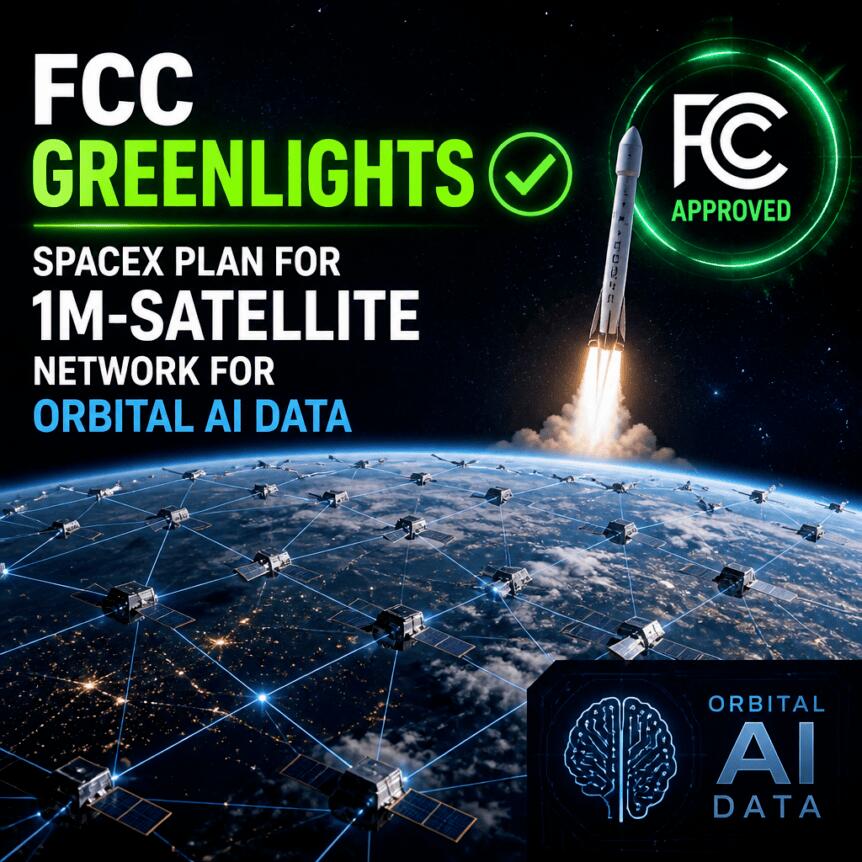
The U.S. Federal Communications Commission (FCC) has approved SpaceX to deploy up to 1 million satellites for an “orbital data center” network, a move the agency called a historic first. The authorization covers SpaceX’s constellation, dubbed “Starmind,” which is intended to provide computing and data-processing infrastructure in space to support growing artificial intelligence (AI) workloads.
In a Wednesday FCC announcement, the agency said the network is designed to process large volumes of data that would then be used on Earth, while it continues reviewing additional orbital data center proposals from other companies. The FCC did not provide a deployment schedule or cost estimate for Starmind.
Key takeaways
- The FCC authorized SpaceX to launch up to 1 million “orbital data center” satellites under the Starmind plan.
- FCC materials describe Starmind as using optical links for satellite-to-satellite communication, with radio as backup for contingency operations.
- The FCC said the design complies with its orbital debris rules.
- SpaceX’s proposal faced formal industry objections before approval, particularly around technical details and collision prevention.
- The approval lands as political and public resistance to new AI data centers continues to intensify in the United States.
FCC approval for SpaceX’s “Starmind” orbital computing network
The FCC said SpaceX’s Starmind constellation is meant to create computing infrastructure beyond Earth, reflecting broader industry efforts to shift portions of data processing away from terrestrial facilities. FCC Chairman Brendan Carr characterized the authorization as opening a new frontier for computing infrastructure as companies look to expand capacity for AI-related data processing.
According to the FCC announcement, the satellites would communicate with one another using optical links, while radio frequencies would serve as backup for communications and emergency operations. The agency also stated that the system complies with its orbital debris requirements.
While the approval authorizes up to 1 million satellites, the FCC did not specify key planning details such as when deployment could begin, how quickly the full constellation would be built out, or what the overall program might cost.
What earlier objections claimed—and how SpaceX responded
SpaceX first applied for permission to launch up to 1 million orbital data center satellites on Jan. 30, and the FCC opened the proposal to public comment on Feb. 4. Notably, within days of filing, SpaceX completed its acquisition of Musk’s AI company xAI, which develops the Grok chatbot—an acquisition that brought the space and AI operations under one corporate umbrella.
Even with that integration, the FCC review process attracted pushback from Amazon’s satellite internet business, Amazon Leo. In a petition filed in March, Amazon Leo argued the application lacked sufficient details, including information about satellite designs, orbital configurations, and collision prevention measures.
SpaceX disputed those concerns. The company argued that using optical communications would reduce interference risks with other satellite networks. Prior to its initial public offering process, SpaceX also disclosed that deployment could start as early as 2028, according to an SEC filing referenced in the original reporting.
During the IPO period, Musk described the broader rationale for orbital computing as reducing the need for large terrestrial power plants by using solar energy in space, and he argued that this could simplify cooling for computing infrastructure. SpaceX has also highlighted hardware partnerships relevant to its computational goals, including work with Nvidia. Nvidia, in turn, announced that the first-generation Starmind satellite would use a modified version of its Vera Rubin NVL72 computing system.
Broader AI infrastructure backlash in the United States
The FCC’s decision arrives amid growing public scrutiny of AI data centers across the United States. Concerns highlighted in political and public discussions include electricity costs, water usage, and environmental effects. These issues became more prominent around the period of the November midterm elections.
One example cited in the source reporting came from a September poll by the University of Massachusetts Amherst, which found that 65% of Americans opposed the construction of AI data centers in their communities, while 11% supported them. The opposition was reported across party lines, with 76% of Democrats and 52% of Republicans opposing local construction.
During the Nov. 3 midterm elections, voters backed data center limits in many local races. Earlier coverage referenced by the source indicates that in 40 of 41 local contests tracked by Ballotpedia, voters supported measures that ranged from outright bans and temporary moratoriums to requirements for approval of large-scale projects.
Against that backdrop, an FCC authorization for orbital computing can be read as part of a wider search for alternatives to conventional growth in land-based data centers—though the outcome for any Starmind deployment will still depend on engineering execution, orbital operations, and continued regulatory oversight.
What to watch next for Starmind
With the FCC authorization in place, the next questions for investors, operators, and observers are practical: how quickly SpaceX can progress from permission to launch, how the optical communication architecture performs in orbit, and whether additional orbital data center proposals will face similar levels of scrutiny as Starmind moves forward. Readers should also monitor how policymakers balance pressure on terrestrial AI infrastructure with support—or resistance—toward new space-based computing models.