The Federal Reserve is moving to enshrine a rule that would remove reputational risk as a driver of banking supervision, a shift crypto advocates say could blunt a pattern of debanking in recent years. The central bank began codifying the change last June, directing its supervisors to stop pressuring banks to sever client ties over reputation concerns and instead assess banking relationships primarily through financial risk management. Now, in a formal rulemaking proposal published on Monday, the Fed is inviting public comment on turning that approach into law, with a 60-day window to hear from stakeholders. The initiative arrives amid ongoing debates about the boundaries of political and ideological considerations in financial services and bears directly on how crypto firms access banking pathways that were once routine.
The Fed’s upward move comes with explicit acknowledgment of the concerns raised by lawmakers and industry observers about how reputation risk has been wielded in ways that affect crypto and other disfavored sectors. In the accompanying release, vice chair for supervision Michelle Bowman framed the issue in stark terms: “We have heard troubling cases of debanking — where supervisors use concerns about reputation risk to pressure financial institutions to debank customers because of their political views, religious beliefs, or involvement in disfavored but lawful businesses.” She stressed that discrimination on these bases runs counter to federal policy and has no place in the Fed’s supervisory framework. The push to formalize this standard reflects a desire to shield legitimate business activity from ad hoc revocation of banking access under the guise of reputation risk.
As the digital asset ecosystem pushes for clearer rules and a more stable banking landscape, political observers weighed in as well. In a post on X, Senator Cynthia Lummis lauded the Fed’s move, arguing that it should not be the regulator’s role to adjudicate who can participate in the crypto economy. She framed the reform as a breaking point that could help “permanently remove ‘reputation risk’ from Fed policy and put Operation Chokepoint 2.0 to rest so America can become the digital asset capital of the world.” The sentiment was echoed by Galaxy Digital’s head of firmwide research, Alex Thorn, who lauded the development as part of the industry’s ongoing push to roll back what supporters call choke points in traditional finance. Thorn signaled via X that the rollback continues, underscoring the ongoing tension between crypto firms seeking direct access to banking services and legacy financial institutions wary of reputational exposure.
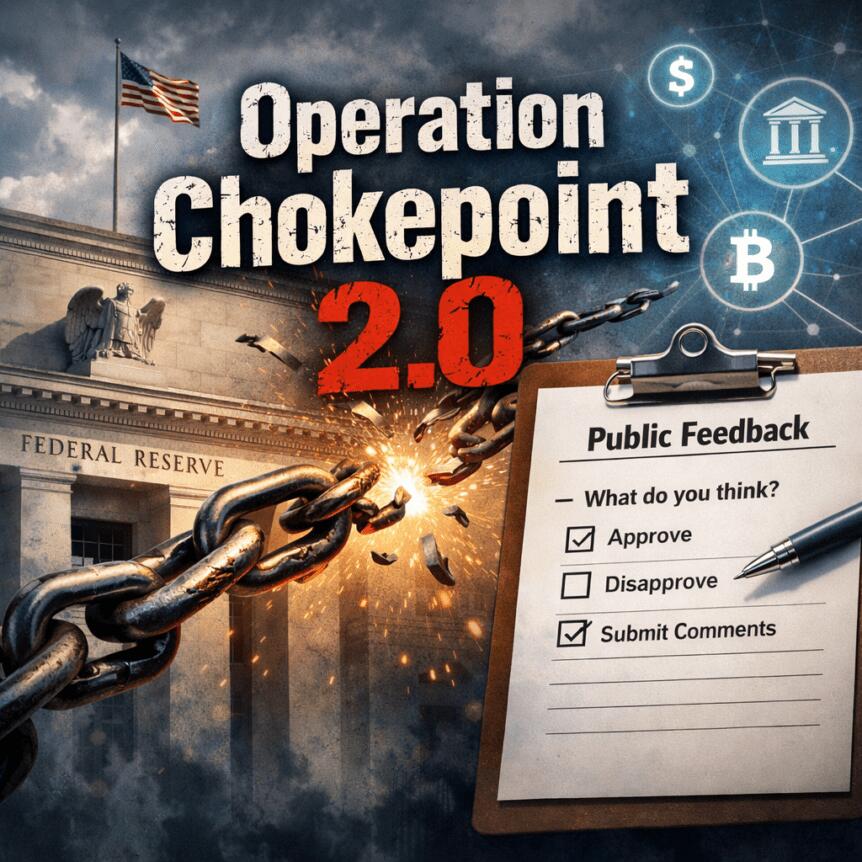
Operation Chokepoint 2.0 is a label used within crypto circles to describe what some perceived as a coordinated effort by the Biden administration and the banking sector to restrict crypto firms’ access to essential banking services. The discourse around this concept has included references to previous policy debates and actions that crypto insiders argued were designed to curb the industry’s growth by pressuring banks to sever ties. The Fed’s latest move—aimed at removing reputation-based triggers from supervisory decisions—has been positioned by supporters as a corrective step toward neutral, risk-based decisions that prioritize financial metrics over political or ideological considerations. The discourse surrounding debanking isn’t new: disclosures and investigations have connected the policy debate to broader questions about regulatory overreach, financial privacy, and the U.S.’s stance toward crypto innovation.
The policy questions extend beyond banking practices into the political discourse around regulation. The administration has signaled an intent to curb debanking in the United States, with discussions touching on how regulators should approach crypto-related clients. The public record features a mix of official statements and industry commentary about the proper balance between safeguarding the financial system and enabling a vibrant digital asset sector. The thread linking this initiative to broader regulatory reform remains a focal point for crypto firms seeking greater clarity and predictability in how banks evaluate risk and structure services for digital assets.
In parallel, proponents of the reform have pointed to links between reputational considerations and broader regulatory strategies aimed at safeguarding consumers while not constraining legitimate innovation. The Fed’s invitation for public comment signals a willingness to test the proposed framework against diverse viewpoints before any final rule is enshrined. If adopted, the rule could set a precedent for how U.S. supervisory agencies weigh risk and approach non-financial considerations in decisions that affect access to fundamental banking services for crypto businesses and other sectors that have faced similar pressures.
Beyond the policy debate, the legal and practical implications loom large. Some observers have highlighted how banks may recalibrate due to the clarity this rule would provide or because it reduces discretionary leverage tied to reputational risk. Others warn that a formalized standard would still require careful definition to avoid unintended consequences, such as banks underreacting to financial risk signals or inadvertently channeling risk through opaque channels. In the end, the rule’s success hinges on how well the Fed can translate a principle into a measurable framework that stands up to scrutiny and serves as a reliable reference for bankers, crypto firms, and regulators alike. The Fed’s consultation period will be a key barometer of how broad support is for codifying this approach and what refinements may be necessary to address edge cases and evolving digital-asset landscapes.
The evolving narrative around debanking and regulatory clarity has also intersected with political dimensions, including ongoing disputes over how bank accounts are treated during periods of political or ideological contention. While the Fed’s move is framed as a technical adjustment to supervisory practice, the broader implications touch on the dynamics of financial inclusion, national competitiveness in the crypto space, and the boundaries of regulatory intervention in private-sector decisions. As negotiators and policymakers weigh the future of digital asset markets, this rulemaking could become a touchstone for how the United States balances the need to manage risk with the desire to foster innovation and maintain the country’s pull in the global crypto economy. The public comment period will determine not only the technical shape of the rule but also the degree to which the policy resonates across industry, advocacy groups, and financial institutions that must implement it in the months ahead.
Key takeaways
- The Fed is seeking to codify the removal of reputation risk as a factor in banking supervision, a move crypto advocates view as reducing punitive pressure on banks over political or ideological considerations.
- A 60-day public-comment window accompanies the proposal, signaling an invitation for industry, lawmakers, and the public to weigh in on the formal rule.
- The initiative follows a June policy shift in which the Fed directed supervisors to base decisions on financial risk management rather than reputational concerns.
- Supporters, including lawmakers and industry figures, frame the reform as a step toward restoring access to banking for crypto firms and ending what critics call “Chokepoint 2.0.”
- Opponents may push for careful definitions of “reputation risk” to avoid unintended loopholes or gaps in enforcement that could leave some customers exposed to informal criteria.
Market context: The policy sits within a broader regulatory environment where liquidity, risk sentiment, and clarity around digital assets influence the willingness of traditional banks to service crypto clients. As policymakers push for explicit standards, market participants look for predictable frameworks that reduce opacity in a space historically marked by sudden access changes and reputational triggers.
Why it matters
For crypto companies, the Fed’s potential rule offers a clearer path to banking access that is less contingent on perceived reputational concerns. In a sector where financial infrastructure—payments, settlement, and treasury services—can determine a project’s viability, a formal standard buffers firms against abrupt disconnections from banking rails. The change could also incentivize banks to adopt uniform risk-based criteria, improving consistency across institutions and reducing the likelihood that decisions are swayed by external factors unrelated to financial health.
From a policy perspective, the move indicates an intent to articulate a more transparent governance framework for supervisory actions. If successfully enacted, the rule could help normalize the treatment of crypto firms within mainstream financial services and strengthen the U.S. position as a hub for digital asset innovation. Support from lawmakers who view debanking as a civil-rights or anti-competitive concern further underscores the political resonance of the issue, elevating the debate beyond technocratic risk management into a broader discussion about access to finance and national competitiveness.
Nevertheless, the discussion remains nuanced. Advocates stress the need for precise definitions to avoid softening risk controls or eroding the ability of regulators to intervene when broader financial crime or consumer protection concerns arise. The rule will likely require ongoing refinement to address newly emergent business models and evolving threats, including opaque financial arrangements or non-traditional counterparties that still carry risk. The Fed’s engagement with industry stakeholders, as evidenced by the 60-day comment period, will be a critical litmus test for how quickly and effectively a clearer, more stable regime can take shape.
What to watch next
- Public comments: The 60-day window opens with the formal proposal and should yield a spectrum of views from banks, crypto firms, consumer groups, and policymakers.
- Final rule release: The Fed will publish the final text, outlining definitions, enforcement mechanisms, and transition timelines for banks to align with the new standard.
- Banking industry response: Expect filings, memos, and industry white papers detailing how lenders foresee applying the rule in practice and where they foresee friction or ambiguities.
- Regulatory coordination: Observers will look for alignment with other regulators’ approaches to reputational risk and how the rule interacts with anti-money-laundering and sanctions regimes.
Sources & verification
- Federal Reserve press release: June 23, 2025, announcing changes to supervision focused away from reputation risk
- Federal Reserve press release: February 23, 2026, inviting public comment on turning the approach into law
- Senator Cynthia Lummis (X) post praising the move: https://x.com/senlummis/status/2026060712305365065
- Galaxy Digital Alex Thorn (X) post commenting on the rollback: https://x.com/intangiblecoins/status/2026069012124164150
- Cointelegraph article: Operation Chokepoint crypto banking restrictions
Market reaction and key details
The Fed’s initiative to codify reputation-risk exclusion from supervisory judgment underscores a broader shift toward risk-based banking decisions that foreground financial metrics over reputational considerations. The formal rulemaking process, including a 60-day comment window, invites a wide spectrum of perspectives, ensuring that the final framework balances financial stability with the industry’s push for more straightforward access to banking services. Industry observers note that the policy’s success will hinge on how clearly the Fed defines “reputation risk” and how it handles edge cases where reputational concerns intersect with legitimate risk signals. The conversation also weaves in the historical debate around “Operation Chokepoint 2.0,” a label used by crypto insiders to describe perceived regulatory and banking pressures on crypto firms, which the current proposals seek to reverse or at least diminish in influence over supervisory outcomes. The official narrative aligns with a broader push to position the United States as a competitive, innovation-friendly environment for digital assets while maintaining guardrails that deter illicit activity.
The momentum behind the policy has drawn attention from lawmakers and industry figures who argue it could restore a more predictable banking environment for crypto companies. The ongoing public debate touches on questions of how much regulatory discretion should be exercised based on non-financial considerations and how transparent the decision-making process should be for banks that service digital-asset businesses. With the 60-day window now open, observers will be watching not only for the rule’s final form but also for the evidence of consensus around where the balance should lie between risk control and access to essential banking services.
Ultimately, the Fed’s proposed rule is part of a larger narrative about how the United States intends to steward innovation in the digital asset space while preserving the integrity of the financial system. If the rule stands up to scrutiny and gains broad support, it could reduce the volatility that arises when firms lose access to banking for reasons tied more to reputation than to tangible financial risk. For participants across the industry—from fintech startups to established crypto exchanges—the development represents a potential turning point in the governance of banking relationships and the speed at which the U.S. can keep pace with global peers in the digital economy.