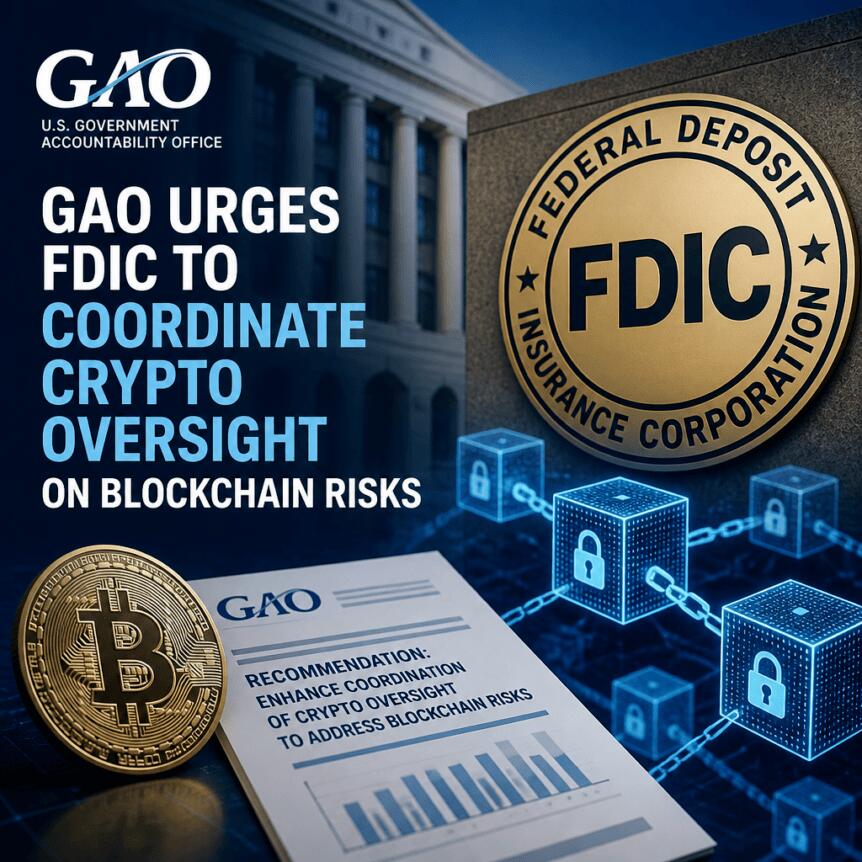
The U.S. Government Accountability Office (GAO) has urged the Federal Deposit Insurance Corporation (FDIC) to strengthen coordination with other federal regulators to manage risks associated with blockchain-based financial products. In a letter made public on June 8, GAO recommended that the FDIC develop an ongoing mechanism to help agencies identify, assess, and respond to emerging blockchain-related threats more consistently.
GAO also pressed the FDIC to revisit how it assigns supervisors to institutions, arguing that changes to case manager rotation could improve supervisory independence and reduce the risk that oversight outcomes are compromised. The recommendations arrive as lawmakers and regulators continue to work through the supervisory gaps created by the cross-border and rapidly evolving nature of crypto and stablecoin activities.
Key takeaways
- GAO urged the FDIC to coordinate with other federal agencies through an ongoing mechanism for addressing blockchain risks.
- GAO cited findings from 2023 that regulators lacked a continuous coordination structure while blockchain-related financial services grew significantly.
- GAO recommended rotating FDIC case managers to strengthen supervisory independence.
- GAO linked supervisory questions to the 2023 failures of several crypto-exposed banks, in the aftermath of the FTX collapse.
- Policy developments under the GENIUS Act and proposed broader crypto legislation shape the regulatory context for stablecoin and wider crypto market oversight.
GAO calls for cross-agency coordination on blockchain risk
In its June 8 letter to FDIC Chairman Travis Hill, GAO said it first raised the issue of blockchain risk coordination as a priority matter in May of the prior year. GAO described blockchain technology as an area of concern that it placed on its “High Risk List,” reflecting difficulties regulators face in overseeing blockchain-based financial products and the potential effects on U.S. markets.
GAO’s position is grounded in an earlier assessment it conducted in 2023. The agency found that financial regulators did not have an “ongoing coordination mechanism for addressing blockchain risks,” despite the growing scale of blockchain-related products and services. In practice, GAO argued that without a durable coordination channel, agencies may identify similar risks at different times or respond inconsistently—an issue that becomes more acute when crypto-related activities span multiple regulated entities and regulatory authorities.
GAO maintained that establishing the coordination mechanism it recommended would enable the FDIC and other regulators to collectively identify risks and implement regulatory responses in a timely manner. The emphasis on timeliness is particularly relevant for compliance monitoring: blockchain-linked products can evolve quickly, and regulatory responses often depend on rapid information-sharing across agencies responsible for distinct parts of the financial system.
Stablecoin oversight under GENIUS and the broader legislative push
The FDIC’s role in blockchain-related oversight is closely tied to stablecoins. Under the GENIUS Act passed last year, the FDIC serves as the main regulator for stablecoin issuers that are subsidiaries of banks under FDIC supervision. That framework positions the FDIC as a key gatekeeper for a segment of the crypto market that directly intersects with the banking system.
GAO’s call for coordination therefore has both immediate supervisory implications and longer-term policy relevance. The letter comes as Senate lawmakers consider a bill intended to clarify how federal agencies would regulate the wider crypto market beyond the stablecoin context. As described by Cointelegraph, lawmakers are looking to pass legislation that would outline the regulatory approach across federal bodies—an effort that underscores the current fragmentation problem regulators face when crypto activity cuts across agency mandates.
For institutional stakeholders, the coordination question is not only about enforcement readiness; it also affects compliance design. Firms operating stablecoin-related products, custody services, or other blockchain-based financial offerings may need to map evolving obligations across regulators. A clearer coordination mechanism could reduce the chance of duplicative requests, shifting interpretations, or gaps where risks fall between agencies.
Supervisory independence: GAO urges rotation of case managers
Beyond coordination, GAO recommended a supervisory process change: rotating case managers assigned to banks. GAO said that in 2024 it found the FDIC did not require supervisors to rotate to different banks. According to GAO, a lack of rotation could compromise supervisor independence and interfere with supervision outcomes.
GAO further reasoned that a rotation requirement could mitigate threats to independence. While the specifics of supervisory staffing and governance vary by institution, independence concerns are central to bank oversight. If supervisors become too closely embedded with particular institutions over extended periods, the ability to challenge management assessments and respond objectively to emerging risks may be weakened.
GAO also linked the staffing concern to what it described as unanswered questions raised by bank failures in 2023, particularly whether bank watchdogs took sufficient action to ensure institutions “promptly addressed supervisory concerns.”
Lessons cited from 2023 bank failures tied to crypto exposure
GAO pointed to the collapse of several banks in 2023—Silicon Valley Bank, Silvergate Bank, and Signature Bank—as events that raised questions about the robustness and timeliness of supervisory actions. All three failed in less than a week in March 2023, following the bankruptcy of FTX, which contributed to severe disruption across crypto markets.
From a policy and enforcement standpoint, GAO’s emphasis suggests that supervisors may face heightened risk signals when banks have significant exposure to crypto-linked counterparties, custody arrangements, or related liquidity and asset-liability pressures. GAO’s recommendation to strengthen oversight processes—through both improved interagency coordination and enhanced supervisory independence—aims to address systemic vulnerabilities that can surface during periods of market stress.
At the same time, unresolved questions remain. GAO’s findings do not automatically specify what a “blockchain risk response” should look like in every scenario, nor do they replace the need for agency-specific rulemaking or supervisory guidance. For compliance teams, this means expectations may evolve incrementally as regulators operationalize coordination mechanisms and adjust supervisory staffing practices.
What to watch next
GAO’s letter adds pressure for measurable procedural follow-through at the FDIC, including how coordination with other regulators will be structured and how supervisory staffing will be implemented in practice. The trajectory of broader federal crypto legislation will also influence how these recommendations interact with stablecoin-specific oversight and the wider regulatory landscape.