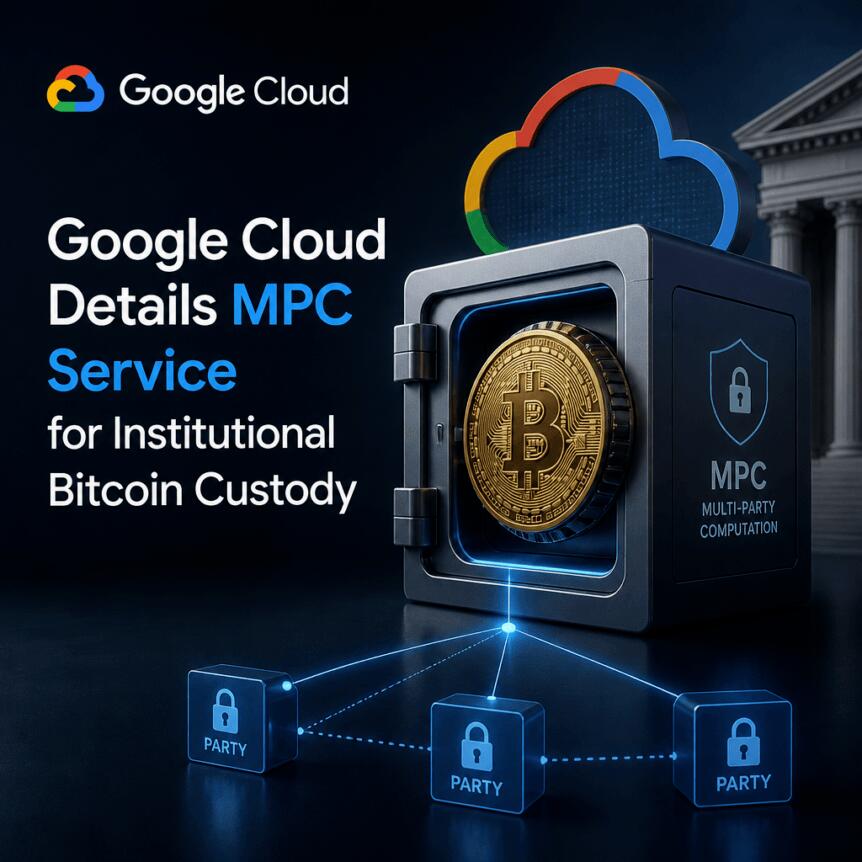
Google Cloud is moving forward with a multi-party computation (MPC) service designed to let financial institutions jointly authorize and sign cryptocurrency transactions—without any single participant holding the full private key. The effort is positioned as a building block for institutional crypto custody and custody-adjacent workflows, according to updated documentation published Monday.
The service is still in preview, which in practical terms means it is provided “as is,” with potentially limited support. Google Cloud also scheduled a related event—an MPC symposium in New York on Wednesday—intended to showcase its “frontier MPC product and research projects.”
Key takeaways
- Google Cloud’s Multi-party Compute service targets joint transaction signing while preventing any one party from controlling the complete private key.
- The feature remains in preview, and Google’s documentation indicates support may be limited compared with generally available products.
- Recent documentation updates include expanded Bitcoin security checks, including rules that consider transaction amounts and detect change outputs.
- Google’s MPC work is positioned alongside broader confidential computing efforts previously outlined under “Confidential Space.”
Why Google’s MPC approach matters for custody
Institutional custody has long focused on reducing single points of failure—whether through hardware security modules, geographic redundancy, access controls, or operational policies. Google Cloud’s MPC framing adds another layer: rather than concentrating the private key in a way that one entity can fully reconstruct or control, MPC splits authorization and signing across parties so that control is distributed.
In the context of Bitcoin, the custody objective is straightforward to describe but complex to implement: transactions must be authorized and signed correctly, while minimizing the risk that compromise of one system or one actor leads to unilateral spending. By emphasizing “jointly authorize and sign” and by preventing any single party from having the full private key, Google Cloud’s preview service is aimed at that exact institutional risk model.
Documentation updates and the Bitcoin security rules
According to the Google Cloud documentation, the MPC service details were updated Monday, with preview status maintained. Google also points to release notes that extend back to August 2026, suggesting the product work has been underway for some time and is now reaching a more defined stage for Bitcoin-related use cases.
Notably, Google Cloud says it expanded its Bitcoin security rules on Oct. 1. The changes, as described in the documentation, involve evaluating transaction amounts, identifying destination address types, and detecting change outputs.
Those additions are significant because they address practical, transaction-level concerns that go beyond basic signing. Security rules that account for how value moves (including how change outputs appear) can help institutions apply stronger constraints before signing—constraints that can matter during policy enforcement, audits, and incident response. Traders and analysts may not see these checks directly, but they affect the reliability and safety of custody operations where policy must be automated and repeatable.
MPC symposium points to deeper work with institutional participants
Google Cloud’s documentation update arrived ahead of the company’s MPC Symposium in New York on Wednesday. The event description says it will provide an “exclusive revealing of Google’s frontier MPC product and research projects,” and lists speakers from financial institutions including Morgan Stanley, OKX, Citi, and Wells Fargo.
While the symposium details in the documentation snippet do not define an immediate product launch date, the presence of major banks and a crypto exchange signals that Google is at least aligning its MPC roadmap with market participants who have real operational needs—namely, secure transaction authorization and the compliance-grade workflows that institutions expect.
Google’s broader MPC push matters because it suggests the technology is moving from experimental research toward more structured deployment paths. However, readers should still treat the current service as an early-stage option given the preview status and the possibility of constrained support.
From Confidential Space to MPC for transaction signing
Google Cloud has not confined its MPC efforts to crypto alone. The company previously explored related technology through “Confidential Space,” a cloud environment designed to support secure multi-party computation and data sharing, as described in a June blog post.
That continuity is relevant for investors and builders because secure computation often depends on the surrounding infrastructure: how data is isolated, how computation is verified, and how multiple parties can interact without leaking sensitive information. Google’s MPC service, as presented in the documentation update, appears to build on that ecosystem rather than introducing an entirely separate security model.
What to watch next: availability and operational support
Google Cloud has not, in the provided information, confirmed a specific launch timeline beyond stating the service remains in preview. As Google Cloud continues expanding Bitcoin security rules and promotes the product through an institutional symposium, the next question for market participants will be when the service becomes broadly available—and what level of operational support and tooling institutions can expect as they plan custody and signing workflows.