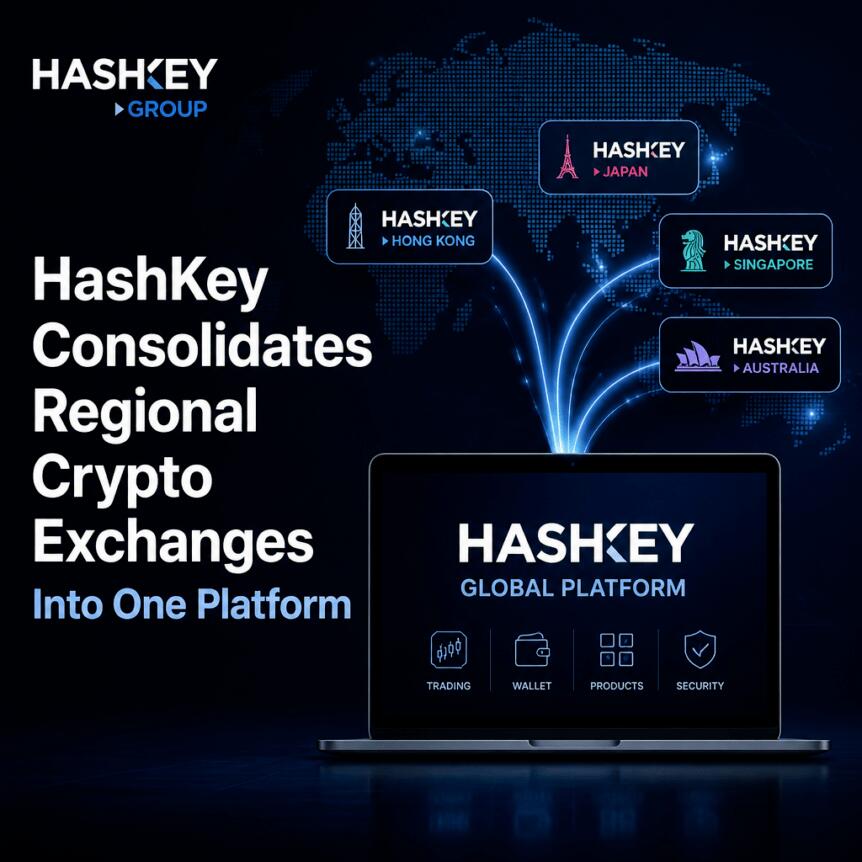
HashKey Holdings says it has consolidated its exchange operations into a single user-facing platform, bringing together what were previously separate apps for different regions. In an announcement released Monday, the Hong Kong digital asset services firm said customers across Hong Kong, “Global,” Singapore, and the Middle East (Dubai) will use the same application—while compliance controls are handled according to each jurisdiction’s legal requirements.
The update reflects a broader shift away from early “regional silo” exchange models, where licensing and front-end products were often kept separate to reduce compliance complexity. HashKey’s approach is built around a principle it describes as “unified entry, localized compliance.”
Key takeaways
- HashKey has merged its HashKey Exchange and HashKey Global into one platform and one application for users across multiple regions.
- The front-end experience is centralized, while regulatory compliance is managed based on each customer’s legislative domain.
- HashKey frames the change as a move from earlier jurisdiction-by-jurisdiction exchange silos toward a unified model.
- Other major exchanges have implemented similar structures, though with different ways of routing users to local legal entities.
One app across regions, with compliance tailored locally
HashKey said it has consolidated core jurisdictional hubs—including Hong Kong, Singapore, the Middle East (Dubai), and Bermuda—under a single platform and application. While the firm’s statement emphasizes that the “front-end” is unified, it also stresses that the system is designed to remain compliant with local frameworks by managing compliance requirements in line with each user’s jurisdiction.
Under HashKey’s model, users download the same application, but the platform applies localized compliance handling across the Hong Kong, Global, Singapore, and Middle East regions. In practical terms, that means the product experience is simpler to access, even though the legal and regulatory obligations still differ by geography.
Why unified platforms are becoming more common
HashKey’s announcement positions the merger as an evolution from the early days of virtual asset trading. In those early stages, many licensed exchanges operated through regional silos—separate platforms, separate apps, and often separate operational setups—to make it easier to compartmentalize compliance.
According to HashKey, its updated structure is intended to preserve compliance benefits while reducing friction for users who operate across or move between markets. The promise is a single front-end that can simplify access to systems expected to remain aligned with local regulatory requirements, as compliance is managed within the platform rather than through separate customer-facing products.
For traders and liquidity providers, a unified application can also reduce the risk of confusion around which interface, account type, or supported features apply in different jurisdictions. For the operator, it can streamline development and user onboarding workflows by consolidating the customer entry point while maintaining jurisdiction-specific controls in the background.
How this compares with other exchanges’ structures
HashKey is not alone in moving toward centralized user experiences paired with jurisdiction-specific legal coverage.
As one comparison, the article notes that OKX presents its website and mobile apps as one platform. However, OKX’s terms reportedly assign customers to different providers based on residence. In other words, the customer-facing “one app” concept is paired with a legal routing layer that maps users to the appropriate entity depending on where they are.
Kraken provides another example. The announcement referenced that Kraken consolidated a Dutch broker entity—BCM—into its platform after acquiring it in September 2024. Kraken has also expanded its European offering through a MiCA structure: the firm reportedly began serving the EEA through its Irish MiCA entity in August, suggesting that compliance alignment is achieved within a unified operational framework.
These comparisons underscore that while the “single platform” idea is spreading, implementations can differ. The key variable is how an exchange ties a unified front-end to jurisdiction-appropriate regulatory responsibility—whether by assigning users to distinct providers behind the scenes or by applying compliance processes localized to each customer’s jurisdiction.
What users should watch after the consolidation
HashKey’s transition to a single application across multiple regions raises questions that matter most to customers: how onboarding flows will change, how jurisdiction-specific feature access will be reflected in the user experience, and whether account management will remain seamless when users interact with region-specific compliance requirements.
For regulators and industry observers, the merger is also a useful test case for whether exchanges can maintain strong compliance controls while consolidating products and codebases—an approach that could become more attractive as regulatory regimes mature and operational efficiency becomes a competitive differentiator.
Readers should watch for further details on the rollout mechanics, such as how HashKey handles user migration from previously separate platforms and how the unified app communicates jurisdiction-dependent limitations, if any. As the exchange environment continues to tighten, the ability to centralize the user interface without diluting regulatory obligations will likely be a key measure of operational readiness.