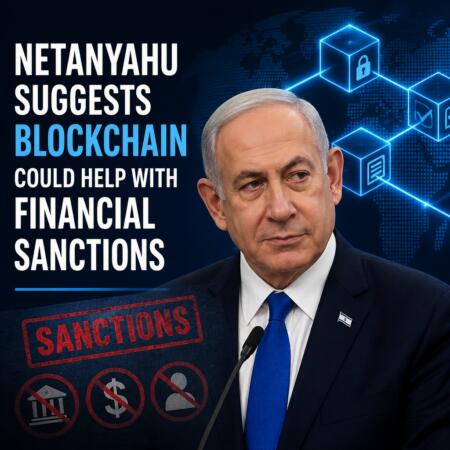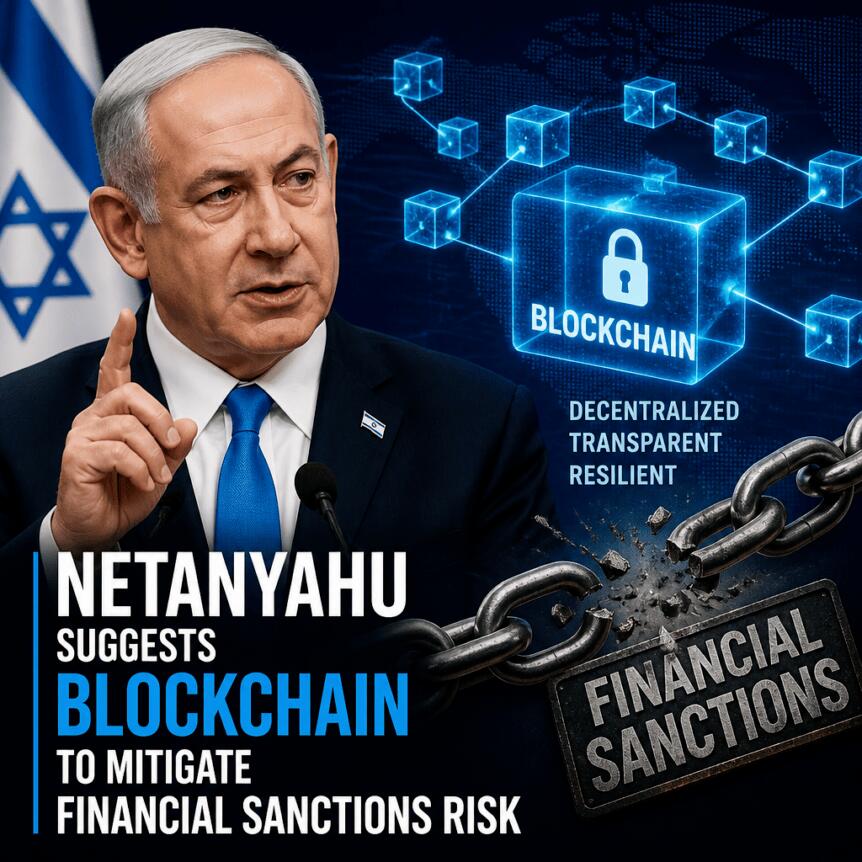
Israel’s election campaign has taken an unexpected turn as Prime Minister Benjamin Netanyahu argued that blockchain and cryptocurrencies could help the country withstand potential international financial sanctions. Speaking on Friday to Channel 10’s economic network, Netanyahu framed “blockchain” as an alternative to sanctions and said Israel is exploring its use alongside digital assets.
His comments have triggered rapid pushback from political figures and Israel’s central bank, while also intensifying scrutiny of whether cryptocurrencies could realistically function as a national-level safeguard against restrictions on Israeli financial activity. The debate now sits at the center of the pre-election conversation leading up to Israel’s Oct. 27 vote.
Key takeaways
- Netanyahu said Israel is considering blockchain and cryptocurrencies to reduce pressure from potential sanctions, calling blockchain “an alternative to sanctions.”
- The Bank of Israel rejected the idea, stating cryptocurrencies “cannot be used as a route for bypassing sanctions.”
- Opposition figures quickly criticized the plan as a national security risk, while commentators argued crypto cannot replace a formal financial system.
- Western sanctions aimed at Israeli settlement goods could expand beyond the settlements, increasing the political urgency around financial resilience.
- The dispute highlights a core tension: the privacy and transfer mechanics of crypto versus enforcement and compliance realities in sanction regimes.
Netanyahu positions blockchain as economic “defense”
Netanyahu’s remarks came as concerns grow that sanctions already directed at goods tied to West Bank settlements could widen to cover more of Israel’s economy. As reported by The Times of Israel, economists and industry figures warned last month that the measures could extend into Israel proper.
In that context, Netanyahu told Channel 10 that “blockchain is an alternative to sanctions,” and described the technology as a “national strategic tool.” According to CryptoJungle, Israel’s largest crypto media platform, the framing suggests a shift in the government’s posture—from a view of digital assets as an investment topic to an element of the country’s broader economic defense strategy.
Still, the key question for readers and market participants is not whether crypto networks can move value, but whether such movement meaningfully helps a sanctioned economy in practice—particularly under internationally coordinated enforcement.
Bank of Israel and candidates challenge the “bypass” narrative
Several candidates seeking to replace Netanyahu and the head of the Bank of Israel responded quickly to dispute the proposal’s premise. One of the most direct criticisms came from Gadi Eisenkot, leader of the Yashar party, who posted on X that the “BibiCoin vision” poses a threat to national security.
On the institutional side, the Bank of Israel issued a statement rejecting the idea that cryptocurrencies could be used to circumvent sanctions. As reported by Globes, the central bank said crypto “cannot be used as a route for bypassing sanctions,” underscoring that the mechanism does not provide a reliable escape hatch from legally mandated restrictions.
This matters for governance and compliance because sanctions are not only about payment rails; they also involve legal accountability, banking relationships, intermediary controls, and enforcement. Even if crypto transfers occur outside traditional banking channels, the broader financial system often still connects to the “on/off ramps” where fiat conversion and custody happen.
Street reactions and media scrutiny intensify
The controversy spilled beyond official statements. At an anti-government rally in Tel Aviv on Saturday evening, attendees discussed Netanyahu’s blockchain claim publicly. One rallygoer, Aryeh Cohen, said an economy that depends on the “dark web” would not make Israel safer or morally better than its opponents. Another attendee, who identified herself only as Pnina, suggested that the next step would involve the Bank of Israel “living ‘neath the law.”
Media criticism also focused on what cryptocurrencies can and cannot do. In an X post highlighted by Nadav Eyal, a Yediot Ahronot columnist, Eyal argued that while digital currencies can move value outside some conventional banking channels, they do not substitute for a national financial system. He pointed to limits such as the lack of credit lines to banks, the inability to replace international capital markets, and the fact that they do not compel foreign companies to violate sanctions.
That argument reflects a practical constraint: capital markets depend on regulated intermediaries and relationships that are often the direct targets of sanction regimes. Without access to those channels, crypto’s usefulness as an economic stabilizer may be narrower than political rhetoric suggests.
CryptoJungle founder: blockchain can be tracked—and Israel isn’t built to evade sanctions
CryptoJungle founder Ben Samocha told Cointelegraph on Sunday that crypto and blockchain-based solutions are not a tool for bypassing sanctions. He cited lessons from enforcement actions—most notably, the U.S. Treasury’s approach toward Iran—arguing that blockchain investigation can enable tracking of illicit funds, blocking fiat entry points, and even freezing assets.
Samocha also argued that Israel’s economy is not positioned to bypass sanctions using crypto, a claim that aligns with the central bank’s rejection of the “bypass” framing. If enforcement can reach the fiat gateway and intermediaries, then crypto can shift activity rather than neutralize sanctions pressure.
For investors and builders, the implication is that the compliance landscape may be more important than the underlying technology. Even where transfers are possible on-chain, the risk of exposure through exchanges, custodians, payment processors, or counterparties remains a major determinant of whether any “sanctions resistance” strategy is workable.
As readers watch the political debate progress into the final weeks before the election, the next developments to track are whether Netanyahu’s proposal translates into concrete policy steps, and how regulators—both in Israel and abroad—signal their approach to crypto compliance in any expanding sanction scenario.