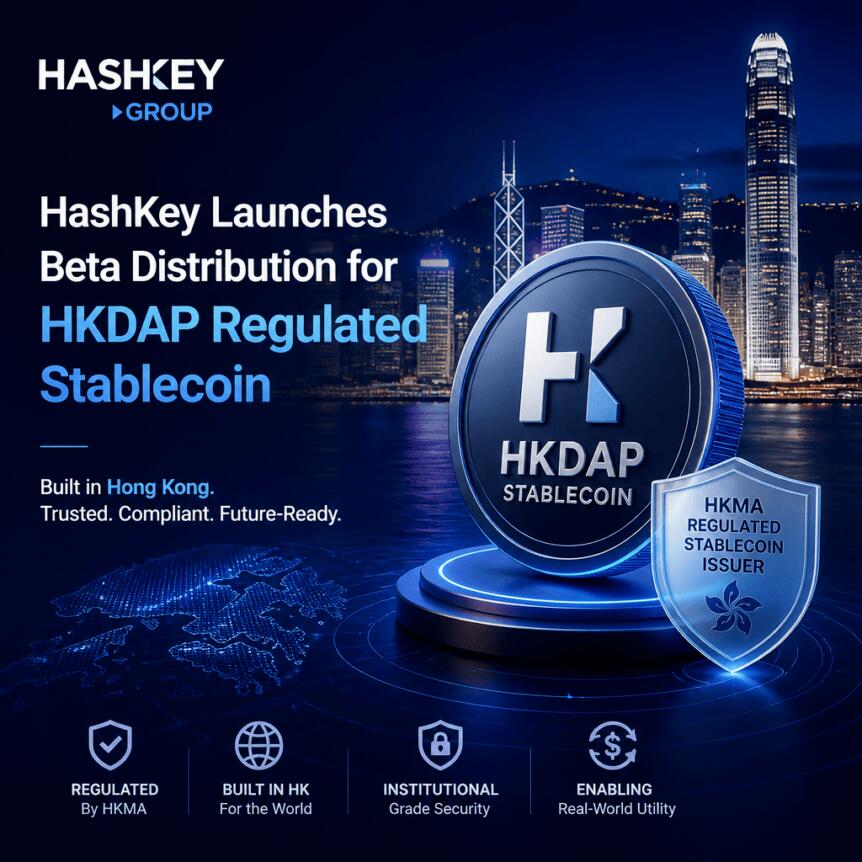
Anchorpoint Financial, a Hong Kong-licensed stablecoin issuer, has named HashKey Exchange as an authorized distributor for its Hong Kong dollar stablecoin, HKDAP. The move is designed to broaden eligible institutions’ and professional investors’ access to the fiat-backed token as Hong Kong’s regulated stablecoin framework continues to roll out.
In a Tuesday announcement, the companies said the distribution arrangement is part of a beta phase. HashKey reported that it has already completed its first HKDAP minting and redemption cycle with eligible clients, including both fiat on-ramps and off-ramps. Anchorpoint and HashKey also indicated that they intend to expand distribution over time and assess additional applications for HKDAP, such as cross-border payments, settlement workflows, and tokenized finance.
Key takeaways
- HashKey Exchange has been added as an authorized distributor for Anchorpoint’s HKDAP, expanding regulated access to the Hong Kong dollar stablecoin.
- The rollout is in beta, with HashKey already completing an initial HKDAP minting and redemption transaction using eligible clients.
- Anchorpoint plans to widen distribution and explore use cases beyond payments, including settlement and tokenized finance.
- HKDAP is positioned as “HKD At Par,” aiming to act as tokenized money within Hong Kong’s licensed stablecoin market.
Why the HashKey distribution matters for Hong Kong’s regulated stablecoin rollout
Distribution partners are often the practical bridge between an issuer’s compliance setup and the end-user access that determines whether a regulated stablecoin can scale. By authorizing HashKey Exchange to distribute HKDAP during a beta phase, Anchorpoint is effectively widening the number of institutional and professional channels through which the token can be minted, redeemed, and used.
HashKey’s confirmation that it has already completed an initial minting and redemption transaction is notable because it signals that at least part of the operational rails are live—not just planned. The inclusion of fiat on- and off-ramping in that first cycle also points to a focus on converting between traditional currency and the tokenized asset in a way that can support real transaction flows.
The companies framed the arrangement as expandable over time. For market participants watching Hong Kong’s stablecoin regime, the next question is how quickly authorized distribution can broaden beyond the initial set of participants, and whether additional ecosystem services will integrate HKDAP for payments and settlement.
What HKDAP is, and Anchorpoint’s regulatory positioning
HKDAP—short for “HKD At Par”—is described as a regulated Hong Kong dollar stablecoin intended to function as tokenized money for payments and other financial transactions. Anchorpoint’s role as the issuer is anchored in Hong Kong’s licensing process: the company was among the first to receive a stablecoin issuer license from the Hong Kong Monetary Authority.
Anchorpoint is a joint venture involving Standard Chartered Bank (Hong Kong), HKT, and Animoca Brands. According to earlier coverage by Cointelegraph, the venture was established in April 2025. Cointelegraph previously reported on the earlier plans by Standard Chartered and Animoca Brands—together with HKT—to launch a Hong Kong dollar-backed stablecoin.
As these licensing milestones are reached, the industry typically shifts from “permissioning” to “distribution and adoption.” In that sense, the HashKey beta rollout can be read as a step toward converting regulatory approval into day-to-day market usage.
Hong Kong dollar stablecoins could grow—if adoption data catches up
Hong Kong dollar-backed stablecoins may have the potential to become a meaningful segment of the broader stablecoin market, particularly given the city’s push for regulated issuance and supervision. A 2025 Citi report cited by the article’s underlying coverage estimated that stablecoin circulation in Hong Kong could reach $16 billion after the introduction of the local licensing regime.
Even so, observers face a data challenge. For now, US dollar-pegged tokens remain the clear majority of the global stablecoin market, while synthetic stablecoins are another smaller, emerging category. Reliable, public information on how much HKD-pegged supply exists and how widely it is used remains limited, making it difficult to judge where Hong Kong dollar stablecoins currently stand relative to that growth forecast.
Meanwhile, broader stablecoin activity has continued to intensify. The same underlying reporting points to Bernstein data showing that the combined adjusted transaction volume of USDC and USDt reached roughly $3.8 trillion in the first quarter of the year. While that figure does not measure HKDAP directly, it does underline that stablecoins remain central to large-scale on-chain transaction activity—creating a potentially supportive backdrop for new fiat-pegged entrants once distribution and liquidity deepen.
Next steps: broader access, more use cases, and what to monitor
Anchorpoint and HashKey said they plan to expand distribution over time and explore additional uses for HKDAP beyond basic minting and redemption. The proposed directions—cross-border payments, settlement, and tokenized finance—are closely tied to where tokenized currencies can deliver operational benefits, such as faster settlement cycles and programmable settlement for financial transactions.
For investors, traders, and institutional builders, the most actionable signals to watch will likely include how quickly distribution expands to more eligible counterparties, whether HKDAP liquidity improves across participating venues, and what concrete integrations emerge for payments and settlement. Just as important, market participants will want clearer visibility into HKDAP adoption over time—especially once Hong Kong dollar stablecoin activity becomes more measurable and comparable across issuers and channels.
As the beta phase progresses, the real test will be whether HKDAP can move from a licensed token concept into a consistently used fiat rail—one supported by distribution partners like HashKey and by credible, repeatable minting/redemption demand from regulated participants.