Picture two beginners who start trading crypto on the same day, with the same money, making the same trades. A year later, one of them is clearly ahead of the other. They did not pick better coins or time the market more cleverly. The only difference is that one of them paid less to trade.
That gap comes down to cost. Most new traders fixate on whether the price will go up or down, which is natural, because that seems to be where profit and loss come from. But every trade also carries a quiet cost that chips away at your account whether you win or lose, and over a year it adds up fast. The good news is that a slice of that cost can be handed straight back to you, through something called a rebate.
Below, we break down how trading costs actually work, what a rebate is, and how much one can save you, with a real worked example you can follow.
What is a trading rebate?
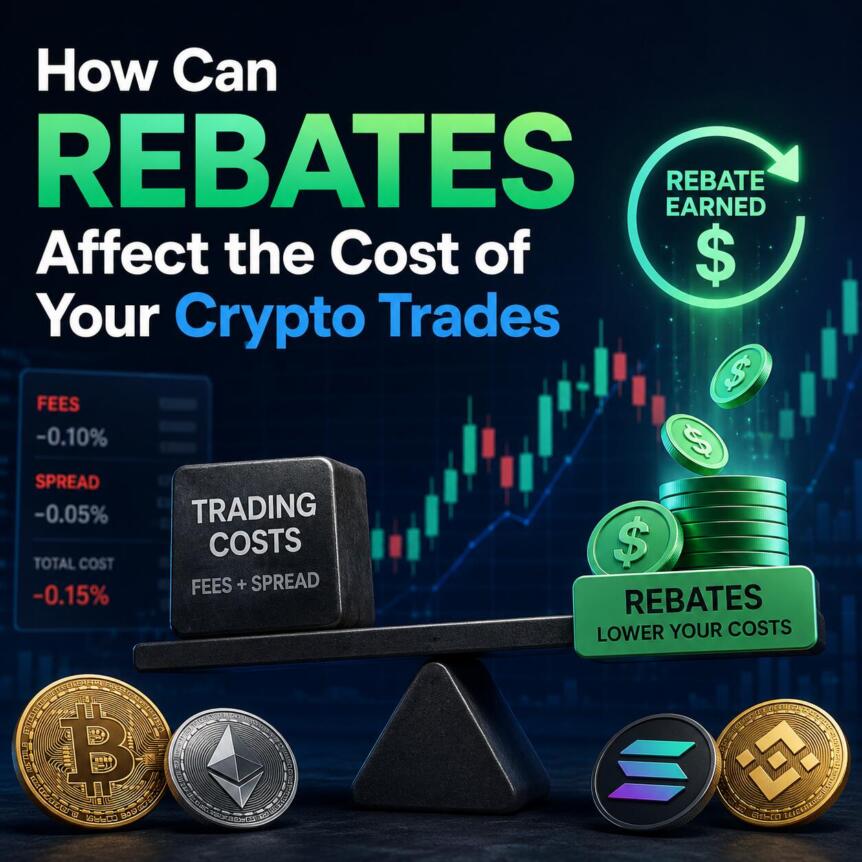
A rebate is a portion of your trading cost that gets paid back to you. Every time you place a trade, your broker earns money, usually through the spread (the small gap between the buy price and the sell price) or through a commission. A rebate program returns a share of that money to your account.
Think of it like cashback on a credit card. You were going to spend anyway, so getting a percentage back lowers what the activity actually costs you. With trading, the more you trade, the more those small amounts add up.
The key thing to understand is that a rebate does not change the price of Bitcoin or any other asset. It does not promise profit. It simply reduces the cost of doing business, which means more of your capital stays with you.
How trading costs work on crypto
When you trade crypto through a broker rather than buying coins outright, you are usually trading a contract that tracks the price. The broker makes the market available and charges for it in one of two ways.
The first is the spread. If Bitcoin can be bought at 60,010 and sold at 59,990, that 20 dollar gap is the spread, and it is effectively a cost you pay the moment you enter and exit a position.
The second is commission, a flat or percentage fee charged per trade or per lot.
For an active trader, these costs are not trivial. Someone placing dozens of trades a month can easily spend hundreds of dollars on spreads and commissions without ever thinking about it, because the cost is baked into the price rather than shown as a separate bill at the end of the month.
A worked example with real numbers
Let us put some figures to it. Imagine a beginner who trades crypto fairly regularly.
Say each round trip trade, meaning opening and then closing a position, costs about 10 dollars in spread. If this trader places 20 trades in a month, that is 200 dollars in trading costs for the month, or 2,400 dollars over a full year.
Now add a rebate. Suppose the trader uses a broker offering a 35% rebate, such as Exness, through a verified partner code. That means 35% of the 200 dollars in monthly costs comes back: 70 dollars returned each month. Over a year, that adds up to 840 dollars back in the account.
With a 33% rebate, the kind RoboForex offers through a partner code, the math is similar: 66 dollars returned each month, or roughly 792 dollars over the year.
To be clear, the trader still paid the spread up front. The rebate did not make trading free. But getting 792 to 840 dollars back over a year can be the difference between a small loss and breaking even, or between an average year and a good one. For a beginner working with a modest account, that is meaningful money.
Your own numbers will differ depending on how often you trade, which instrument you choose, and your account type. The principle holds either way: a higher rebate percentage and higher trading activity both increase how much you get back.
How do you actually get a rebate?
Rebates are not always advertised on a broker’s front page. Often they are unlocked through a partner or referral code that you enter when you register your account. Without the code, you open a standard account and leave the rebate on the table.
This is where comparison resources help. Sites such as brokerpartnercodes.com collect verified partner codes for brokers like Exness and RoboForex, show what each code unlocks, and explain how to apply it during signup. Using one is usually as simple as copying the code, pasting it into the partner code field when you register, and confirming the rebate is active on your account.
A quick checklist before you commit to any rebate offer:
Confirm the rebate is lifetime rather than a one off bonus, so it keeps paying on future trades. Check how the rebate is paid, whether daily, weekly, or straight to your trading balance. And make sure the broker itself is properly regulated and genuinely suits your needs, because a generous rebate means very little if the broker is a poor fit for you.
A word of caution
Rebates lower your costs, but they do not remove the risk of trading itself. Crypto is volatile, and contracts that track crypto prices can move against you quickly. Industry disclosures regularly note that a large majority of retail traders lose money trading these products. A rebate is a way to keep more of your capital working for you, not a reason to trade more than you can comfortably afford to lose.
The takeaway
For a beginner, the lesson is simple. Price direction gets all the attention, but cost quietly shapes your results over time. Rebates are one of the few levers you can pull to reduce that cost with almost no effort, and over a year of regular trading the savings can add up. Before you open an account, it is worth checking whether a partner code could put a slice of every trade back in your pocket.