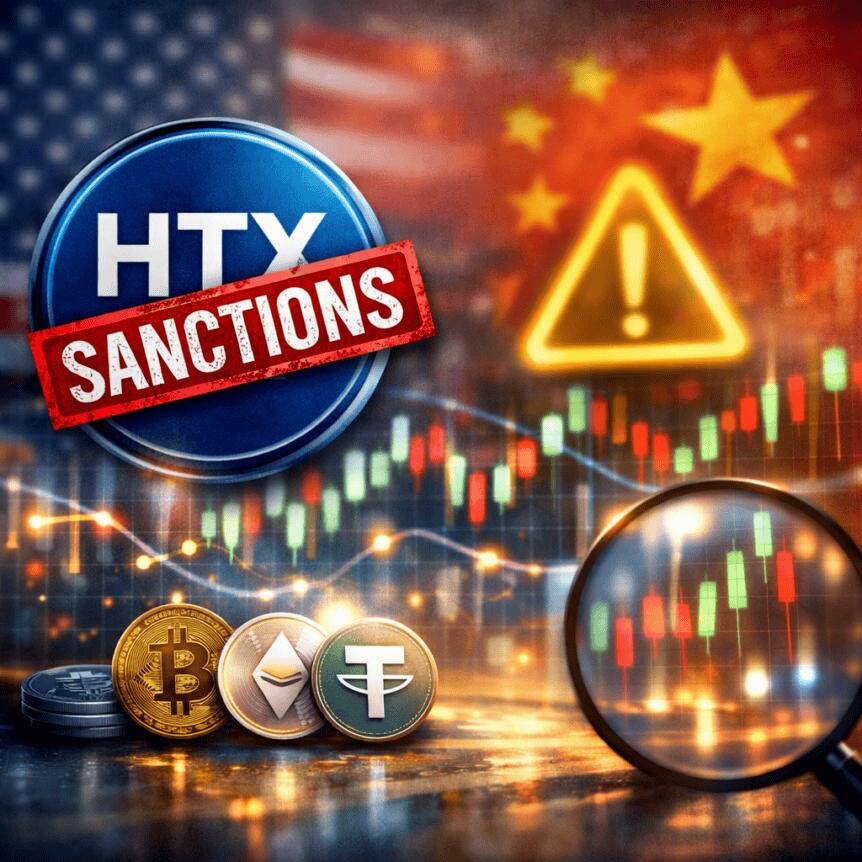
The United Kingdom has sanctioned Huobi Global S.A., the Panama-based company behind the HTX exchange, amid allegations of providing financial support to Russia-linked networks. The move has sparked a lively debate among blockchain researchers and industry observers, who warn that broad sanctions could ripple across the crypto compliance fabric and disrupt established practices for curbing illicit activity in DeFi and beyond.
Regulators asserted there were reasonable grounds to suspect HTX had supported Russia’s government through financial services and funds routed via sanctioned entities A7 Limited Liability Company and Garantex. HTX has rejected the characterization, insisting that the sanctioned entity is not the exchange itself.
Amid the sanctions discourse, researchers highlighted potential collateral damage to the industry’s risk governance. Galaxy Digital’s Alex Thorn suggested that the scope of the sanctions—covering “all of HTX”—could affect legitimate users and complicate stablecoin and sanctions screening practices. Security researcher Taylor Monahan argued that imposing broad sanctions could undermine years of work to encourage DeFi protocols to screen and block stolen funds, insisting that most HTX users are legitimate. Blockchain investigator ZachXBT added that on-chain address tainting tied to the sanctions has been “catastrophic” for tracing work, warning that the concept of “risk” may be diluted in practice.
The UK action comes on the heels of sanctions announced on May 26 targeting Huobi Global S.A. for alleged support of Russia-linked financial networks. The government cited connections to entities previously sanctioned in relation to Russia-linked activity, framing the move as part of a broader regulatory effort to curb illicit financial flows in crypto markets. Related coverage has noted parallel regulatory actions, including actions by UK authorities against HTX promotions in other contexts.
Key takeaways
- The UK sanctions Huobi Global S.A. (HTX), the operator behind HTX, citing potential support for Russia’s government through linked entities A7 and Garantex.
- Industry observers warn that blanket sanctions may disrupt legitimate users and complicate compliance workflows across stablecoins, KYC/AML, and sanctions screening.
- HTX denies the core allegation, stating the sanctioned entity is separate from the exchange and that the sanctioning rationale may conflate distinct entities.
- Global Ledger reports HTX processed about $21.06 billion in high-risk crypto flows from 2021 through May 2026, with roughly $7.64 billion linked to Russian high-risk actors and darknet markets.
- There have been downstream effects, including forced actions by DeFi projects and HTX’s own responses, such as delisting a partner’s USD stablecoin and suspending trading pairs.
Regulatory action and pathway to enforcement
According to regulatory communications, the UK authorities asserted that HTX had facilitated financial services and funds that supported Russia’s government via sanctioned intermediaries. This framing places HTX within a broader sanctions regime designed to impede illicit state-linked financial networks, a domain where cross-border enforcement and jurisdictional differences frequently shape outcomes. The sanctions posture underscores how national regulators are leveraging crypto-enabled financial activity to police geopolitical risk, with implications for exchanges, custodians, and liquidity providers seeking to maintain compliant cross-border operations.
HTX’s denial—that the sanctioned entity is distinct from the exchange—highlights a central enforcement tension: how to delineate between a platform and its partners or affiliates in a tightly coupled ecosystem. For legal and compliance teams, the case emphasizes the importance of precise entity mapping, robust sanctions screening, and clear contractual controls to prevent inadvertent exposure to sanctioned flows. The evolving regulatory narrative also intersects with ongoing debates about licensing frameworks and the scope of enforcement under regimes like MiCA in the European Union, which seeks to harmonize crypto-asset regulation across member states, and parallel US authorities’ postures under the SEC, CFTC, and DOJ enforcement levers.
Industry perspectives on enforcement and DeFi hygiene
Industry voices emphasize that sanctions can create unintended frictions for legitimate users and complicate efforts to trace illicit flows in a permissionless environment. Alex Thorn of Galaxy Digital cautioned that an expansive sanction targeting “all of HTX” could slow or complicate legitimate user activity and blur the lines between sanctioned and non-sanctioned participants. The divergence in how stablecoin issuers decide when to freeze or restrain token movement—an area of ongoing regulatory scrutiny—adds another layer of complexity for compliance teams navigating cross-border settlements and sanctions compliance.
Taylor Monahan, a prominent blockchain security researcher, argued that sanctions that blanket a major exchange may undermine the industry’s long-running push to foster best practices in tracing and blocking stolen funds. She asserted that a significant portion of HTX’s user base is legitimate, urging regulators to balance enforcement with practical considerations for users and service providers focused on legitimate financial activity.
On-chain tracing perspectives were echoed by ZachXBT, who criticized the sanctions as an “overreach” and said that taint would “catastrophic[ly]” affect investigative work. He suggested that broad address tainting could erode the quality of risk signals that investigators rely on to assess exposure, potentially elevating false positives and complicating due diligence across counterparties.
Operational impact and on-chain dynamics
Market participants have begun to observe downstream effects from the sanction regime. A Global Ledger report attributed HTX with processing approximately $21.06 billion in high-risk crypto flows between 2021 and May 2026, with about $7.64 billion linked to Russian high-risk entities and darknet markets such as Garantex and related entities. While this figure provides a baseline for risk assessment, it also underscores the challenges regulators face in distinguishing legitimate commerce from illicit activity within a highly interconnected ecosystem.
In the wake of sanctions, some DeFi projects have taken precautionary steps to reassess exposure to HTX-related addresses. World Liberty Financial, a project associated with the broader, Trump-linked DeFi ecosystem, reportedly froze HTX-linked addresses after conducting sanctions compliance reviews. HTX responded by delisting the DeFi platform’s USD1 stablecoin and suspending several trading pairs, illustrating how regulatory actions can cascade into liquidity and product offerings across the crypto landscape. These developments highlight the practical implications for on-chain risk management, liquidity provisioning, and the reliability of sanctions screening in fast-moving markets.
Ongoing regulatory coverage in related spaces—such as actions against HTX’s promotional activities by UK regulators—illustrates the breadth of regulatory oversight touching crypto businesses. For exchanges and market participants, the episode reinforces the need for robust compliance frameworks that address sanctions exposure, sanctions list screening, and the potential for cross-border asset freezes to affect settlement rails and customer solvency protections.
Policy context and cross-border implications
The HTX sanctions sit within a broader policy discourse about how jurisdictions coordinate responses to geopolitical risk in crypto markets. Regulators are increasingly leveraging sanctions regimes to constrain sanctioned entities’ access to fiat channels and crypto rails, while industry stakeholders stress the necessity of preserving access for legitimate users and ensuring that enforcement actions do not undermine the integrity of compliance programs. In parallel, policymakers are considering the interoperability of global standards with regional regimes such as MiCA, which aims to regulate crypto-asset service providers within the EU, and the evolving enforcement posture of major jurisdictions like the United Kingdom, the United States, and others. Ongoing debates center on licensing clarity, cross-border supervision, and the harmonization of AML/KYC expectations for exchanges, wallets, and fiat ramps.
Regulators also emphasize the importance of transparent attribution and clear delineation of sanctioned entities to minimize disruption to legitimate user activity. As enforcement patterns evolve, compliance teams should monitor any shifts in sanctions language, guidance on cross-border transfers, and the development of standardized due-diligence practices that can adapt to evolving geopolitical risks without compromising user access or financial inclusion.
Closing perspective
As authorities refine how sanctions interact with rapidly evolving crypto networks, the HTX case underscores the need for precise governance of sanctioned entities and a prudent balance between enforcement and practical risk management. For institutions and compliance professionals, the episode highlights the importance of rigorous entity mapping, robust sanctions screening, and proactive cross-border coordination to navigate a landscape where policy, technology, and markets intersect in complex ways.