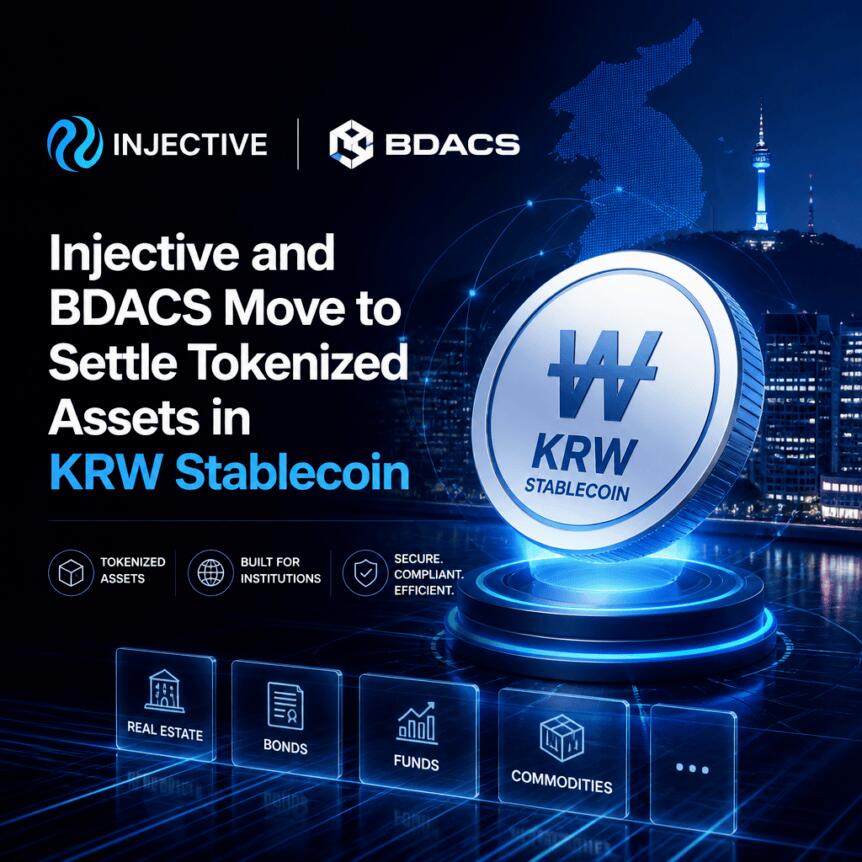
Injective has signed a memorandum of understanding with BDACS, a South Korean digital asset custodian, to support a won-backed stablecoin for tokenized asset trading on its network. The initiative is designed to give institutions a Korean won settlement option, potentially reducing reliance on US dollar stablecoins for activities tied to real-world assets (RWAs).
Under the arrangement announced Tuesday, BDACS’s KRW1 stablecoin would act as the exclusive won-denominated settlement asset for RWAs on Injective. That means approved market participants could trade and settle tokenized assets directly in Korean won, rather than routing transactions through dollar-pegged stablecoins.
Key takeaways
- Injective will use BDACS’s won-backed KRW1 as the exclusive settlement asset for RWAs on its tokenized asset markets.
- BDACS says KRW1 is fully backed by Korean won reserves, with minting and redemption initially limited to approved institutional partners.
- The program is tied to South Korea’s broader regulatory work on won-backed stablecoins under the proposed Digital Asset Basic Act.
- South Korean exchanges have reportedly seen net stablecoin outflows for 18 straight months through June, according to industry data cited by Cointelegraph.
- Injective has been expanding institutional infrastructure, including US SEC registration as a transfer agent for its institutional services arm.
A won settlement layer for tokenized assets
Stablecoins remain central to how crypto markets handle fast settlement, but most of the ecosystem is still heavily oriented around the US dollar. Injective’s agreement with BDACS aims to change that for at least one important use case: institutional trading and settlement of tokenized real-world assets on a layer-1 network.
BDACS states that KRW1 is “fully backed” by Korean won reserves. The memorandum also specifies that minting and redemption would initially be limited to approved institutional partners, subject to regulatory approval. For investors and institutions, the operational difference is straightforward: if tokenized assets can settle in KRW instead of US dollars, the workflow can better match local cash management and reduce exposure to cross-currency settlement frictions.
While the details of implementation are still contingent on approvals, the scope of the plan is notable. Injective is positioning KRW1 not as a secondary token option, but as the exclusive won-denominated settlement asset for RWAs on its platform under the agreement.
Regulation in South Korea is the swing factor
The BDACS–Injective memo arrives as South Korea continues building out a legal framework for won-backed stablecoins. Lawmakers are working on the proposed Digital Asset Basic Act, which the government aims to finalize by the end of 2026. Until that framework is in place, practical rollout is likely to depend on how regulators define issuers, licensing pathways, disclosures, and operational limits.
A July policy report by Hashed Open Research and the Solana Policy Institute argued for more flexibility in stablecoin issuance while legislation is developed, including interim licensing guidance. According to Cointelegraph, the proposed law would create a broader regulatory structure for digital assets—covering stablecoin issuance rules, disclosure requirements, and market conduct.
This matters because stablecoin issuance typically brings two intertwined risks for regulators: reserve management (including proof of backing and redemption processes) and market integrity (including who can issue, how transparency works, and how stablecoins interact with broader financial systems). Injective’s involvement, framed around settlement for tokenized RWAs, adds another regulatory layer—since tokenized assets can themselves touch securities and market-structure questions.
South Korea’s stablecoin regulatory efforts also sit in a global context. The article notes the US GENIUS Act, which established a federal regulatory framework for payment stablecoins, and the European Union’s MiCA rules for stablecoin issuers. Together, these developments highlight a wider trend: stablecoins are increasingly moving from “informal market infrastructure” toward a regulated financial instrument category.
Why won-backed stablecoins are gaining attention
Even with regulatory momentum worldwide, stablecoin supply remains heavily dollar-led. Industry data cited by Cointelegraph via Stablecoin Beat indicates that dollar-backed tokens make up more than 99% of total stablecoin supply. That imbalance helps explain why institutions outside the US often face operational and risk-management challenges when they want crypto-native settlement but prefer local currency handling.
Cointelegraph also points to ongoing demand and flow signals from South Korea. It cites industry data showing the country’s five largest crypto exchanges recorded net stablecoin outflows for 18 consecutive months through June. While the memorandum does not directly attribute causes for those outflows, the trend suggests that Korean market participants may have been moving stablecoin liquidity offshore rather than keeping settlement assets within local won-denominated rails.
A won-backed settlement asset, if it scales, could address part of that friction. Rather than relying on US dollar stablecoins for tokenized asset settlement, institutions could align trading and settlement with Korean won, which may reduce certain conversion steps and allow more direct integration with local banking and treasury processes—assuming regulators and approved partners can operate within the compliance regime.
Injective’s institutional push and next steps to watch
Injective is not new to institutional-oriented infrastructure. In August, its institutional services arm registered with the US Securities and Exchange Commission as a transfer agent, enabling it to maintain ownership records and help facilitate securities transfers. That step aligns with Injective’s broader push to support tokenized securities and other RWA-related markets, where recordkeeping and operational controls are especially important.
Cointelegraph also reports Injective’s native token market capitalization as roughly $887 million, based on CoinMarketCap data. While token valuation is not directly related to the KRW1 memo’s technical feasibility, it can affect market confidence and liquidity—factors that matter if institutions expect robust trading conditions around tokenized asset workflows.
For now, the most important uncertainty is timing and permissibility. The KRW1 settlement role is tied to regulatory approval, and BDACS says minting and redemption will initially be restricted to approved institutional partners. Readers should watch for how South Korea’s stablecoin rules clarify eligibility for issuers and redemption systems, and whether interim licensing guidance (discussed in the July policy report) accelerates the path from memorandum to real settlement usage.
If South Korea’s regulatory process stays on schedule and approved institutions begin using KRW1 for tokenized RWA settlement on Injective, the development could become a practical alternative to dollar-centric stablecoin settlement. The key question is whether regulators will enable enough market participants—and enough mint/redemption throughput—to make won-backed settlement a scalable option rather than a limited pilot.