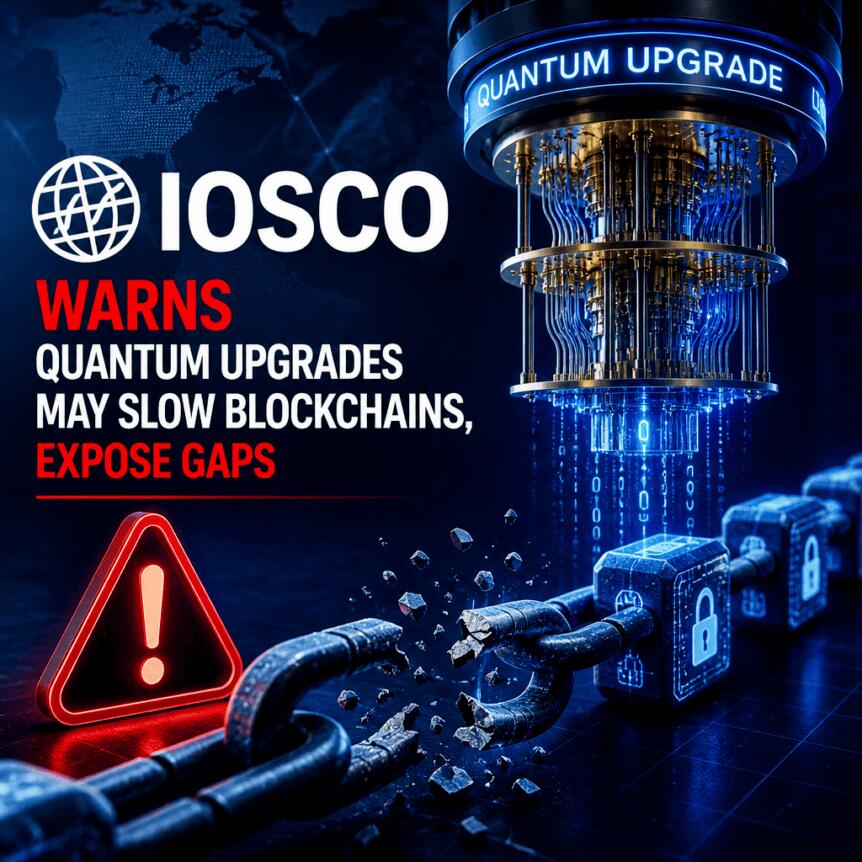
Regulators are warning that the move to quantum-resistant cryptography—long viewed as an eventual safety upgrade—could come with immediate performance and cost trade-offs for blockchain networks.
In a report released Thursday, the International Organization of Securities Commissions (IOSCO) said that some post-quantum digital signatures can be significantly larger than the cryptographic signatures used to authorize transactions today. That increase in signature size can reduce how many transactions fit inside each block, potentially leading to slower throughput, greater congestion, higher fees, and additional storage requirements.
Key takeaways
- IOSCO says certain quantum-resistant signatures require far more data per transaction than current signature schemes, which can reduce transactions per block.
- An experiment cited by IOSCO found Solana test traffic running about 90% slower when using quantum-resistant signatures.
- IOSCO emphasizes that even if networks upgrade, apps and dormant wallets that keep using older keys may remain vulnerable.
- Layer-2 systems may still face risk if they rely on vulnerable settlement layers or depend on older cryptographic material for cross-chain actions and upgrades.
- Preparations could take years, meaning timing, migration planning, and network design choices matter well before a quantum threat becomes practical.
Why post-quantum signatures could make blockchains heavier
IOSCO’s core concern is practical: blockchains don’t just need secure cryptography, they need efficient cryptography that fits within tight block size and bandwidth constraints. According to IOSCO, certain quantum-resistant signatures take up much more space than the signatures currently used to authorize transactions.
Because blocks have limited capacity, larger signatures can mean fewer transactions are included each time. In turn, that can worsen congestion during peak demand. The report also points to knock-on effects such as higher fees and increased storage needs for nodes that must retain the data associated with transactions.
To illustrate the potential magnitude of this issue, IOSCO referenced an experiment using a test version of Solana. In that case, the test reportedly ran about 90% slower when quantum-resistant signatures were used, underscoring that “migration risk” is not purely theoretical.
“No quantum computer yet” doesn’t remove the migration problem
IOSCO stressed that there is currently no known quantum computer capable of breaking the cryptographic systems that secure public blockchains today. Even so, the regulator argued that entities should begin planning early, because the upgrade process may take years.
This framing matters for investors and operators: cryptography migrations are not simply a software toggle. They require coordination across ecosystems—protocol developers, wallet providers, exchanges, custody services, and end users. Even when a chain upgrades, it may not fully protect users if older keys and signature schemes remain in use.
IOSCO also warned about a common asymmetry in upgrades: layer-1 networks use cryptography for both transaction authorization and consensus-related processes (reaching agreement on which blocks to add). If an upgraded network still leaves dormant funds or existing applications relying on older cryptographic material, those assets may remain exposed.
Layer-2 upgrades may not be “end-to-end” by default
IOSCO’s report extends the concern beyond base layers. For layer-2 networks, quantum-resistant approaches can, in principle, improve the verification of transactions using quantum-resistant proofs. However, IOSCO cautioned that layer-2 designs can still depend on vulnerable components, particularly when they must interact with settlement layers, move assets between chains, or approve network upgrades.
That distinction is important: a layer-2 protocol might use post-quantum methods for parts of its workflow, yet still rely on older cryptographic assumptions when finalizing transactions on a layer-1 chain, migrating assets, or executing governance actions. In other words, quantum readiness may require end-to-end mapping of which cryptographic primitives are used where—not just swapping signatures in one component.
The industry timeline is already shaping upgrade debates
The IOSCO warning arrives in a moment when several high-profile networks and advocates are already debating how and when to transition toward post-quantum designs.
Earlier coverage from Cointelegraph reported that Bitcoin advocate Samson Mow warned about the potential for larger post-quantum signatures to reduce Bitcoin’s throughput and argued that rushed migration efforts could introduce new vulnerabilities (see Cointelegraph’s report on Mow’s warning).
Meanwhile, Starknet’s community backed research into becoming an independent, quantum-resistant layer-1 network after concerns about dependence on Ethereum’s security upgrade timeline (as described in Cointelegraph’s earlier coverage).
On the research side, Ethereum contributor Justin Drake has outlined a post-quantum transition target for 2028, positioned ahead of Ethereum’s existing 2029 roadmap (covered by Cointelegraph in a separate report). While these timelines vary by ecosystem, they collectively show that “crypto agility” is becoming a scheduling and governance issue as much as a technical one.
What to watch next
For users, developers, and market participants, the next phase is likely to be less about whether quantum-resistant cryptography is necessary—and more about how networks measure the performance costs, manage key migrations for long-lived wallets and applications, and ensure layer interactions don’t reintroduce older cryptographic weak points. IOSCO’s report suggests those decisions will directly affect fees, throughput, and node/storage requirements long before a quantum threat is technologically realizable.