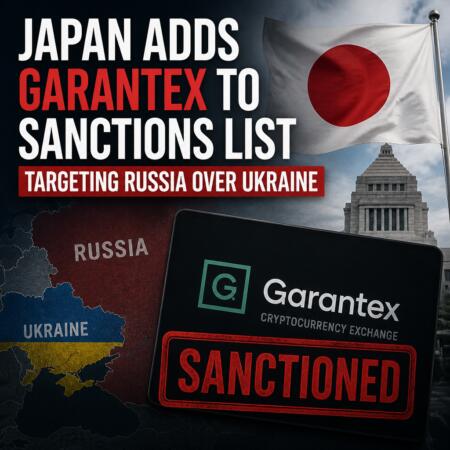
The Japanese government has expanded its sanctions against Russia by adding the cryptocurrency exchange Garantex to a new set of measures aimed at disrupting Russian financial activity tied to the war in Ukraine. The update was announced in a joint statement released Friday by Japan’s Ministry of Foreign Affairs, Ministry of Finance, and Ministry of Economy, Trade and Industry.
In addition to the exchange, the new package includes 33 organizations and nine individuals connected to Russia, with the changes focused on an asset-freeze framework designed to restrict payments and other capital transactions involving designated parties. The government also targeted 35 vessels associated with the so-called “shadow fleet,” which is used to move Russian oil while evading existing sanctions.
Key takeaways
- Japan added crypto exchange Garantex to its expanded Russia sanctions list, increasing pressure on platforms alleged to facilitate sanctions evasion.
- The asset-freeze measures cover 33 organizations and nine individuals, alongside restrictions aimed at 35 “shadow fleet” vessels.
- Japan’s restrictions are intended to reduce Russia’s revenue from crude oil exports by disrupting the financial flows around sanctioned trade.
- Blockchain intelligence firm TRM Labs has suggested sanctions may be less effective if targeted firms already maintain contingency plans to shift operations quickly.
Japan expands asset-freeze measures to target Garantex
Japan’s latest sanctions build on a broader international effort to limit how Russian-linked entities access financial services, including through cryptocurrency rails. According to the joint statement issued by the three Japanese ministries on Friday, authorities added Garantex to the list of organizations subject to asset-freeze rules.
An asset-freeze framework generally functions as a choke point for payments and capital transactions, limiting counterparties’ ability to interact with designated entities. In practice, such measures aim to reduce liquidity and operational flexibility for sanctioned targets—particularly where crypto exchanges may serve as bridges between different jurisdictions or payment methods.
New restrictions extend beyond crypto to the “shadow fleet”
The sanctions package also targets 35 vessels identified as part of Russia’s “shadow fleet,” a term commonly used to describe shipping networks that support Russian oil exports despite sanctions pressure. The measures reportedly restrict services needed to keep these ships operating, including repairs and insurance.
By combining financial restrictions with trade and shipping-related limitations, Japan is aligning its approach with the logic used by many sanction regimes: squeezing revenue streams at multiple points in the supply chain. Japan’s statement indicates the overall objective is to reduce Russia’s earnings from crude oil exports.
Why the focus on exchanges matters for sanctions enforcement
Garantex has already faced sanctions in other jurisdictions. The exchange was previously sanctioned by the US and the EU, among others, for facilitating efforts by Russian entities to evade financial restrictions.
Given that crypto exchanges can be used to move value across borders quickly—often through complex webs of counterparties—designations of specific trading venues signal a push to limit how sanctioned groups access crypto on-ramps and off-ramps. Japan’s decision suggests that regulators view Garantex not just as a local operator, but as a node in a wider financial network that could be leveraged to bypass conventional enforcement.
Japan’s move also sits alongside earlier reporting that US regulators escalated their action against Garantex. Earlier coverage by Cointelegraph noted that the US Treasury’s Office of Foreign Assets Control (OFAC) sanctioned Garantex a second time, along with its successor, Grinex.
TRM Labs warns sanctions may be blunted by contingency planning
Even with the additional designations, enforcement effectiveness may be complicated by how sanctioned firms prepare for regulatory actions. Blockchain intelligence firm TRM Labs previously told Cointelegraph that Garantex may have maintained a contingency plan allowing it to mitigate the impact of sanctions—reportedly by shifting activities to successor structures.
TRM Labs’ view, as summarized in the referenced report, is that entities targeted by sanctions may “appear to prepare contingency plans well in advance of anticipated enforcement measures.” The implication is that, rather than collapsing when enforcement arrives, such entities can migrate clients, infrastructure, and funds to successor platforms—potentially limiting how long sanctions remain disruptive.
This creates a key tension for policymakers: while designating additional entities can increase compliance costs and reduce access to some services immediately, the long-term impact may depend on how quickly successor platforms can be identified and interdicted. For market participants and compliance teams, that means sanctions risk may not be confined to a single name, and monitoring may need to extend to related entities and operational patterns.
What to watch next
Japan’s addition of Garantex and the “shadow fleet” vessel designations highlights a sanctions strategy that targets both financial transfer pathways and the logistics that support sanctioned trade. Investors, exchanges, and compliance teams should watch whether further follow-up designations expand to related successor entities and whether the shipping and insurance restrictions measurably disrupt sanctioned oil flows.