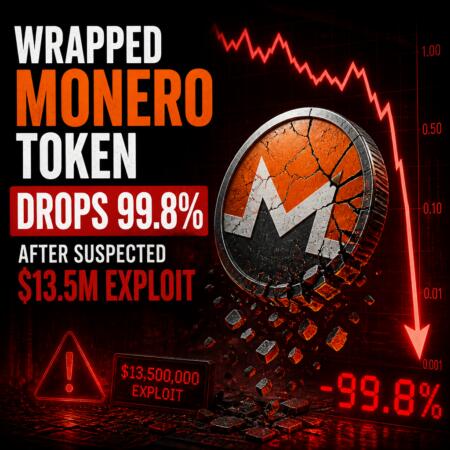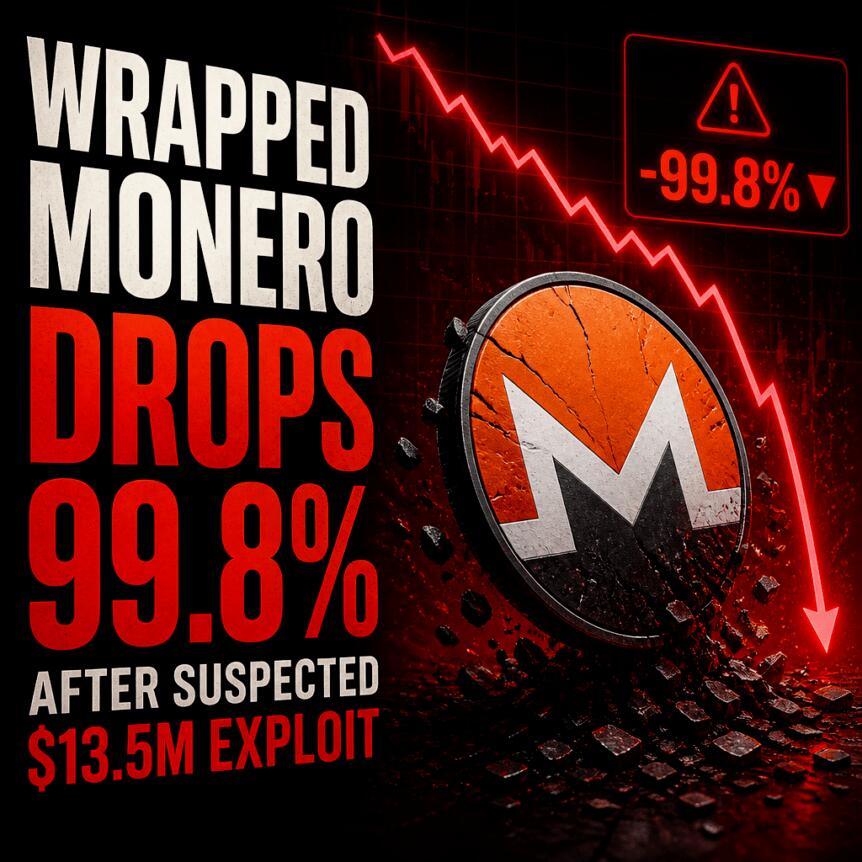
A wrapped version of Monero, known as XMR1, suffered a dramatic collapse on Hyperliquid on Friday after a wallet that received tokens from the asset’s deployer account sold roughly $13.5 million worth of the position, according to blockchain analytics firm Bitquery. The token reportedly fell from around $500 to $1 within about 30 minutes, a decline of roughly 99.8%.
Bitquery emphasized that the turmoil was concentrated in the wrapped token on Hyperliquid (XMR1) rather than Monero’s native cryptocurrency. Wrapped tokens are meant to mirror the value of another asset while enabling trading on blockchains where the original token may not be directly supported.
Key takeaways
- Bitquery traced the selloff behind XMR1’s collapse to a wallet that received ~5.2 million XMR1 from the deployer account.
- About $13.28 million in USDC was reportedly moved to Arbitrum and then converted to 7,467 ETH via CoW Protocol.
- Some funds appear to connect to earlier hacks in November through purchases of XMR1, though Bitquery said it found no direct on-chain link to Friday’s suspected exploit.
- Operator PerpetualCow pointed to hosting risk, alleging a hosting provider breach of customer data and internal files, but provided no timeline for a relaunch.
What Bitquery found about the Friday selloff
In its investigation, Bitquery reported that the wallet involved in the most damaging trades received 5.2 million XMR1 from the deployer account. After receiving the tokens, the wallet sold approximately $13.5 million worth of XMR1 on Friday.
Bitquery further mapped how the proceeds were handled. The firm said it observed $13.28 million in USDC being transferred to Arbitrum, where $13.22 million was exchanged for 7,467 ETH through CoW Protocol. Bitquery added that most of the ether was later bridged to Ethereum.
For traders, this kind of tracing matters because it helps distinguish between a sudden liquidity or market-maker failure and a scenario where the wrapped token is being actively liquidated shortly after distribution from the deployer side. In this case, Bitquery’s flow analysis points more strongly to an end-to-end sell workflow rather than a slow market breakdown.
Earlier November hack funds were reportedly routed through XMR1
Bitquery also looked beyond Friday’s collapse and analyzed whether the deployer-linked activity had ties to previous compromises. The firm reported that proceeds from four hacks earlier in November—involving Across Protocol, Kava, Lighter, and Safe—appeared to be used to buy approximately $6.6 million worth of XMR1.
Bitquery said this pattern appears to have been used as a route toward acquiring native Monero. However, the analytics firm also stated it found no on-chain evidence linking those November incidents to the Friday movement tied to the suspected exploit.
That distinction is important: even if funds from earlier attacks used the same wrapped-token rail, Friday’s specific sequence still remains unproven as a continuation of those earlier events. Investors and monitoring stakeholders are likely to watch whether the deployer-linked wallet behavior repeats, or whether this was a separate breach event affecting the XMR1 issuing or control layer.
Control of the deployer key remains unconfirmed
Despite tracing token movements and conversions, Bitquery said it could not establish how the deployer account’s private key was obtained or who controlled it during the transfers. As a result, the underlying mechanism of the suspected compromise remains unconfirmed based on on-chain evidence alone.
That uncertainty is a key takeaway for anyone evaluating operational risk in wrapped-token systems. When the supply mechanism is tied to a deployer or issuing authority, the security of that control point can be more decisive than the token contract itself—particularly during periods of rapid liquidity shifts.
Wagyu operator attributes the collapse to a hosting provider breach
While Bitquery focused on on-chain flows, the operator of the service behind XMR1, Wagyu, offered a different explanation. PerpetualCow, the pseudonymous operator, said the collapse stemmed from an alleged breach involving hosting provider 1984.
According to PerpetualCow, customer data and internal server files were exposed. The operator claimed the XMR1 deployer key had been stored on a server that was later deleted, but the hosting provider allegedly retained logs and associated files connected to the key.
PerpetualCow also pledged to personally reimburse affected traders and said Wagyu would relaunch at a later date, though no specific timeline was provided. Cointelegraph reached out to the operator for additional details about reimbursement and the alleged breach but reported it had not received a response by publication.
For users, the practical question now is how reimbursement and relaunch governance will be handled—especially if the suspected issue involved infrastructure access rather than a flaw in the wrapped-token design. If keys or logs were retained by a third-party hosting provider, the remediation likely needs to extend beyond redeploying smart contracts to include tighter operational controls and auditing of access pathways.
Readers should watch for verified updates on the relaunch process, any publicly shared security findings related to hosting access, and whether monitoring firms can connect Friday’s deployer-linked activity to a specific compromise vector. Until the control timeline is clarified, the broader lesson for wrapped-token markets remains the same: the reliability of the issuing layer can be as consequential as on-chain liquidity itself.