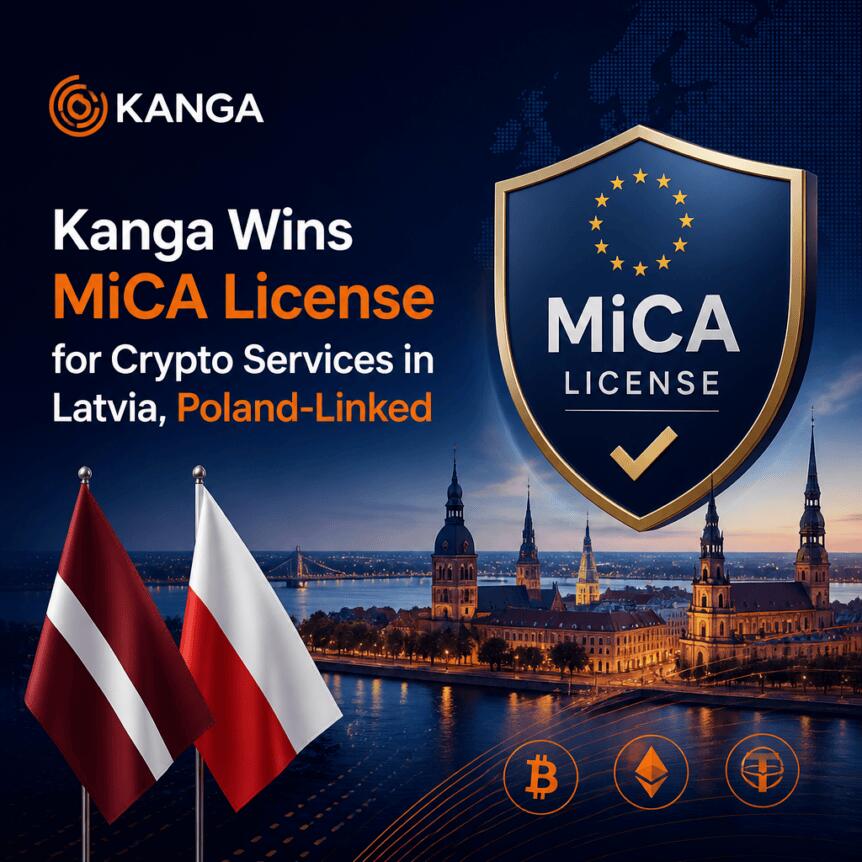
Kanga, a Polish-founded crypto exchange, has secured Markets in Crypto-Assets Regulation (MiCA) authorization in Latvia, positioning the firm to expand its crypto services across the European Union. The development reflects a broader pattern of firms using MiCA’s licensing and cross-border notification mechanics to establish an EU-wide operating footprint ahead of the bloc’s regulatory transition.
According to a statement shared with Cointelegraph, SIA AlphaRoute, which operates under the Kanga Exchange EU brand, received a Class 3 MiCA license from the Bank of Latvia after its Supervisory Committee approved the authorization. The license—granted on June 18—covers activities including crypto custody, trading, and transfers across the EU.
Key takeaways
- Kanga’s EU expansion is enabled by a MiCA Class 3 license granted to SIA AlphaRoute by the Bank of Latvia.
- The license authorizes core exchange functions—crypto custody, trading, and transfers—through MiCA cross-border processes.
- The decision highlights how firms can meet EU-wide compliance requirements even when home-country MiCA legislation is delayed.
- Poland’s continued legislative uncertainty remains a key variable for the domestic crypto industry and regulatory planning.
- Prosecution and enforcement actions in the region, including investigations into major exchanges, raise compliance expectations for licensed operators.
MiCA licensing in Latvia enables EU-wide service delivery
MiCA established a harmonized framework for regulating crypto-asset service providers across the European Union. For firms, the practical significance is that authorization in one EU member state can support service provision elsewhere through MiCA’s cross-border notification approach, subject to meeting applicable conditions.
In Kanga’s case, the authorization was issued to SIA AlphaRoute, operating under the Kanga Exchange EU brand. The Bank of Latvia granted the Class 3 MiCA license following approval by its Supervisory Committee, as described in the firm’s statement.
The license authorizes services that typically fall within the scope of regulated crypto-asset activities, including custody of crypto-assets, execution of crypto-asset trades, and crypto transfers. For compliance teams and institutional stakeholders, the key takeaway is that these activities are now framed under MiCA supervision rather than relying on fragmented national rules.
The firm indicated it plans to provide customers with additional details on operational changes and service terms through its official communication channels. From a risk and governance perspective, customer disclosures and updated contractual documentation are often necessary when firms transition into MiCA-aligned frameworks, especially where custody and transfer obligations are involved.
Why timing and the transitional period matter
Kanga said it began the pre-licensing process in Latvia in November 2025 after reviewing several jurisdictions. In remarks attributed to SIA AlphaRoute CEO Dominik Tomczyk, the firm emphasized the importance of using MiCA’s transitional period to prepare organizationally for the new regulatory framework.
In practical terms, firms that initiate licensing pathways early can typically allocate more time for compliance build-out—such as licensing-ready governance structures, operational controls, and procedures that align with MiCA requirements. This matters for institutions that rely on regulated service providers, since it affects diligence workflows, onboarding risk assessments, and ongoing monitoring.
The firm also signaled that it will communicate operational changes and service terms through established channels. That point is relevant for regulators and supervised entities because it provides an audit trail of how customer-facing policies are updated when regulatory status changes.
Poland’s MiCA legislative delay and political deadlock
Kanga’s progress comes as Poland remains without MiCA implementation legislation ahead of the EU’s July 1 transitional deadline. The situation underscores a structural challenge for regulated crypto businesses: while MiCA is directly applicable across the EU, member-state implementation steps and national alignment can still influence readiness, local licensing pathways, and supervisory coordination.
Cointelegraph reports that Poland’s legislative process has been slowed by repeated presidential vetoes. The Polish president vetoed a government-backed crypto bill for a third time on June 11, according to reporting that attributes the veto to objections that successive versions did not address adequately, including provisions considered excessively burdensome for crypto companies. Lawmakers from the Poland 2050 party—part of the governing coalition led by Prime Minister Donald Tusk—reportedly submitted a revised proposal incorporating changes requested by the president. The proposal’s sponsors reportedly aim to remove certain provisions, reduce some fees, and make the framework less restrictive, with Poland 2050 calling for expedited parliamentary consideration.
For firms headquartered in Poland, the legislative deadlock can create uncertainty around local administrative timelines and expectations for compliance documentation in domestic interactions. As a result, firms may pursue licensing in other EU jurisdictions—such as Kanga’s Latvia pathway—to reduce regulatory friction and achieve EU-wide authorization through MiCA.
Enforcement pressure and higher compliance expectations
Regulatory developments in the region are not limited to legislative timelines. Poland’s crypto sector, for example, faces increased scrutiny following a fraud investigation into Zonda, described as the country’s largest crypto exchange. As reported by Cointelegraph, prosecutors estimated that customer losses exceed 350 million zlotys (around $92.7 million). Such enforcement actions typically influence compliance expectations for all market participants, including licensed providers.
For institutional compliance monitoring, this matters in two ways. First, enforcement activity can accelerate stricter supervision across the sector, including expectations around market integrity controls, client asset safeguards, and risk management. Second, it can affect counterparties’ due diligence posture, as regulated status under MiCA may become a more prominent factor when institutions select custody, exchange execution, or transfer services.
The combination of MiCA licensing progress in some EU states and unresolved national legislative implementation in others also creates a compliance landscape in flux. Firms operating across borders need to ensure their compliance programs account for differences in supervisory practices, reporting procedures, and customer disclosure requirements—while still meeting the harmonized MiCA baseline.
Closing perspective
Kanga’s Latvia-based MiCA authorization illustrates how crypto-asset firms can use EU licensing pathways to achieve broader market access even amid domestic legislative uncertainty. The next key development to watch is how Poland’s stalled MiCA implementation evolves after the latest proposal and whether supervisory coordination tightens further in response to ongoing enforcement actions.