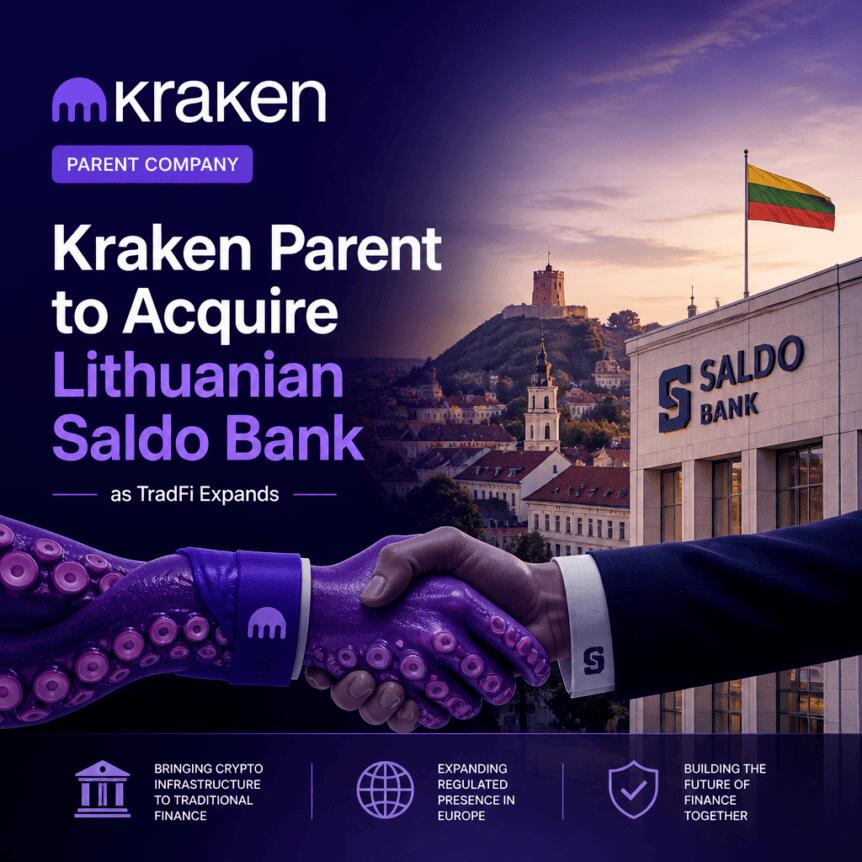
Payward, the parent company of cryptocurrency exchange Kraken, has signed an agreement to acquire Lithuania-based Saldo Bank, signaling a further push from crypto infrastructure into regulated retail banking. The deal is designed to expand Payward Banking’s ability to offer traditional financial products across several European markets, while leveraging an EU banking license already held by Saldo Bank.
Under the terms announced by Payward, the company will acquire Saldo Finance Oy, a Finnish holding company whose subsidiary, Saldo Bank UAB, operates as a digital bank licensed in Lithuania. Payward said the transaction supports what it described as a long-term infrastructure strategy.
Key takeaways
- Payward will acquire Saldo Finance Oy to gain access to Saldo Bank UAB’s EU digital banking license and operations.
- The bank’s current authorization is passported into the Netherlands, supporting broader EU market access.
- Payward expects the deal to close in 2027, pending regulatory approvals.
- The acquisition is positioned to expand Payward Banking’s product set, including deposit interest, lending, and banking-as-a-service.
- Payward’s plan aligns with its recent move to roll out a crypto-linked debit card in the US via Kraken’s payment app, Krak.
What Payward is buying—and why an EU license matters
Payward said it has entered into a definitive agreement for the acquisition, detailed in a Wednesday press release. The target structure matters: Saldo Finance Oy is the holding company that controls Saldo Bank UAB, which is a digitally focused lender licensed in Lithuania.
For Payward, the practical value is regulatory. According to Payward, Saldo Bank’s EU banking license and existing footprint would allow it to expand its services across four operating markets, including Lithuania, Finland, Sweden, and Germany. Payward also stated that the bank’s authorization is passported into the Netherlands.
This is a different kind of expansion than building financial features inside a crypto platform. A regulated EU bank can support core banking functions that are difficult to replicate through crypto infrastructure alone—especially where deposit-taking, lending structures, and banking distribution models are concerned.
Planned expansion: deposits, lending, and banking-as-a-service
Payward expects to use Saldo Bank’s capabilities to broaden what Payward Banking can offer customers and partners. The company said the acquisition would enable traditional services such as interest-bearing deposit products and lending offerings.
Payward also highlighted banking-as-a-service capabilities, describing functions that could include card issuance, passporting, and lending tools for small and medium enterprises. In other words, the aim is not solely retail banking; Payward is also framing the bank as a platform layer that can be used to distribute financial services to businesses and clients in multiple EU jurisdictions.
The company characterized the acquisition as a way to “serve European clients the way a primary financial institution should,” emphasizing a model where assets can be held in one regulated place and then put to work.
Payward co-CEO Arjun Sethi said a regulated EU bank is “the piece that lets us serve European clients the way a primary financial institution should: one place to hold assets, move them freely, and put them to work.”
Timeline and regulatory hurdles to watch
Payward said the acquisition is expected to close in 2027, subject to customary regulatory approvals. That timeframe leaves room for several uncertainties that investors and partners typically track in bank-related M&A: supervisory review in relevant jurisdictions, approval of ownership and governance changes, and any conditions placed on the bank’s business plan.
The deal also comes as Payward continues to demonstrate it wants to bridge crypto activity and traditional payment infrastructure. In August, Payward launched a multi-asset debit card in the US through Kraken’s payment app, Krak, allowing users to spend crypto and fiat and earn up to 2% cashback in dollars or Bitcoin, according to earlier coverage from Cointelegraph (Kraken’s US debit card rollout).
While the US card effort and the EU banking acquisition are separate initiatives, they share a broader theme: bringing crypto-linked value to everyday financial workflows. The question now is how quickly Payward can translate a bank license into scalable product distribution across EU markets once the acquisition clears regulators.
How this fits into Payward’s broader strategy
Kraken’s parent has been positioning Payward as more than a crypto service operator. The company’s stated focus is on building the infrastructure required to support traditional financial functions alongside crypto-related offerings—an approach that increasingly resembles how mainstream fintechs expand through regulated entities rather than relying solely on banking partners.
This acquisition would give Payward Banking direct control over a licensed bank in the EU, offering a potential foundation for deposit and lending products, along with banking-as-a-service tools such as card issuance and lending capabilities for SMEs. If approved, Saldo Bank’s existing retail term deposits in Lithuania, Finland, Sweden, and Germany may also provide a starting point for scaling.
However, readers should separate expectation from execution. The agreement is only a first step; the closing depends on regulatory review, and the company’s ability to expand in four markets will likely require careful rollout planning, risk management, and compliance execution after the deal is finalized.
For now, the key things to monitor are the regulatory process through to 2027 and the pace at which Payward Banking converts Saldo Bank’s license and passported authorization into new products and distribution partnerships across the EU.