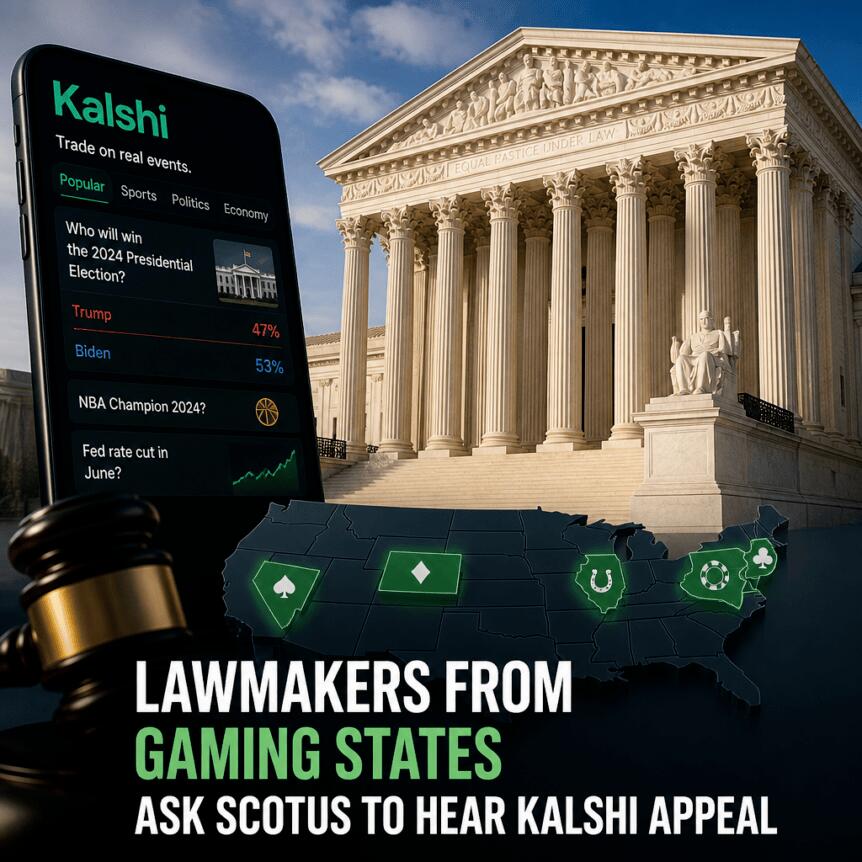
US state lawmakers have stepped into the Kalshi prediction-markets dispute, filing an amicus brief urging the Supreme Court to address whether state gaming regulators can rein in platforms that offer event-based “contracts” linked to sports and other outcomes.
The filing—submitted by the National Council of Legislators from Gaming States (NCLGS) on Tuesday—backs the position of New Jersey’s Attorney General and gaming authorities as they pursue a petition for a writ of certiorari. The Supreme Court docket in question stems from a Sept. 2 request, which asks justices to consider New Jersey’s legal challenge to Kalshi and to clarify the balance between state authority and federal oversight.
Key takeaways
- NCLGS filed an amicus brief supporting New Jersey and state gaming regulators in their dispute with Kalshi over prediction-market activity.
- The lawmakers argue that a ruling for Kalshi would effectively leave states “powerless” to regulate prediction-market sports betting.
- The brief warns that any preemption ruling could force broader changes to the regulated gaming landscape across US jurisdictions.
- Kalshi has not yet filed its official Supreme Court response; the deadline for its brief is Nov. 9.
Why the Supreme Court case matters for state gaming oversight
At the center of the controversy is jurisdiction: New Jersey and gaming authorities are asking the Supreme Court to weigh in on whether state governments—or federal agencies—have the legal authority to regulate prediction-market platforms operating through event contracts.
According to the amicus brief, if the Supreme Court rules in a way that limits state regulation of Kalshi’s so-called “sports betting” activities, states would lose the ability to set rules for how such products are marketed and offered within their borders. The NCLGS argues that this would create “substantial harm and confusion,” in part because it would undermine existing regulatory frameworks designed for heavily supervised gaming activities.
The lawmakers also frame the issue as one that should remain a matter for state control over “gaming-related matters.” However, the brief acknowledges a competing argument raised in the dispute: that certain event contracts traded on federally regulated markets could fall under the CFTC’s exclusive jurisdiction. In other words, the underlying fight is not only about whether states want to regulate, but about whether the law allows them to do so in light of federal regulatory authority.
Potential ripple effects beyond one platform
A notable part of the NCLGS filing is its emphasis on what a favorable ruling for Kalshi could trigger across the US gaming industry.
In its argument, the group contends that if Kalshi’s products are treated as beyond state regulation, then other highly regulated operators—such as casinos and pari-mutuel businesses—may seek to restructure offerings to obtain similar legal treatment. The amicus brief warns that this would compel states to reconsider entire regulatory regimes tied to “vice activity” if federal preemption is found in this area.
While the Supreme Court has not yet ruled, the way the lawmakers describe downstream consequences highlights a key investor and operator concern: if the legal boundary between state oversight and federal preemption shifts, the compliance costs and product design strategies for companies in regulated gambling ecosystems could change quickly.
How the dispute reached the Supreme Court
New Jersey’s petition for a writ of certiorari is part of an appeal that followed an earlier decision by the US Court of Appeals for the Third Circuit. The Supreme Court petition, filed Sept. 2, asks the Court to consider New Jersey’s case against Kalshi and potentially resolve a broader jurisdictional question affecting prediction markets.
The framing of the case is important because it may determine whether state regulators can enforce traditional gaming laws against prediction-market products, or whether federal regulation—particularly the CFTC’s role—dominates in areas where event contracts intersect with federally supervised markets.
At present, the Supreme Court has not announced a decision, and the outcome could hinge on how the Court interprets the relationship between state gaming authority and federal jurisdiction in this specific category of financial-like instruments tied to real-world events.
What happens next in Kalshi’s Supreme Court response
Kalshi has not yet provided an official response to the certiorari petition in the Supreme Court. The company has until Nov. 9 to file its brief stating its position.
In earlier commentary associated with the initial filing, a Kalshi spokesperson told Cointelegraph that the platform “could not be regulated by 50 different regulators.” That stance reflects a central theme in prediction-market regulation debates: companies argue that fragmented state regimes can create legal uncertainty, while state lawmakers argue that gaming should remain subject to local oversight.
As the case moves forward, attention will likely focus on whether the Court views the relevant contracts as properly falling within federal regulatory authority, and—if not—what standards states may apply to similar products going forward.
For now, market participants, gaming operators, and developers should watch for the Supreme Court’s progress on certiorari and, critically, the arguments Kalshi makes in its upcoming Nov. 9 brief—because the justices’ interpretation of jurisdiction could reshape how prediction markets and related products are offered across US jurisdictions.