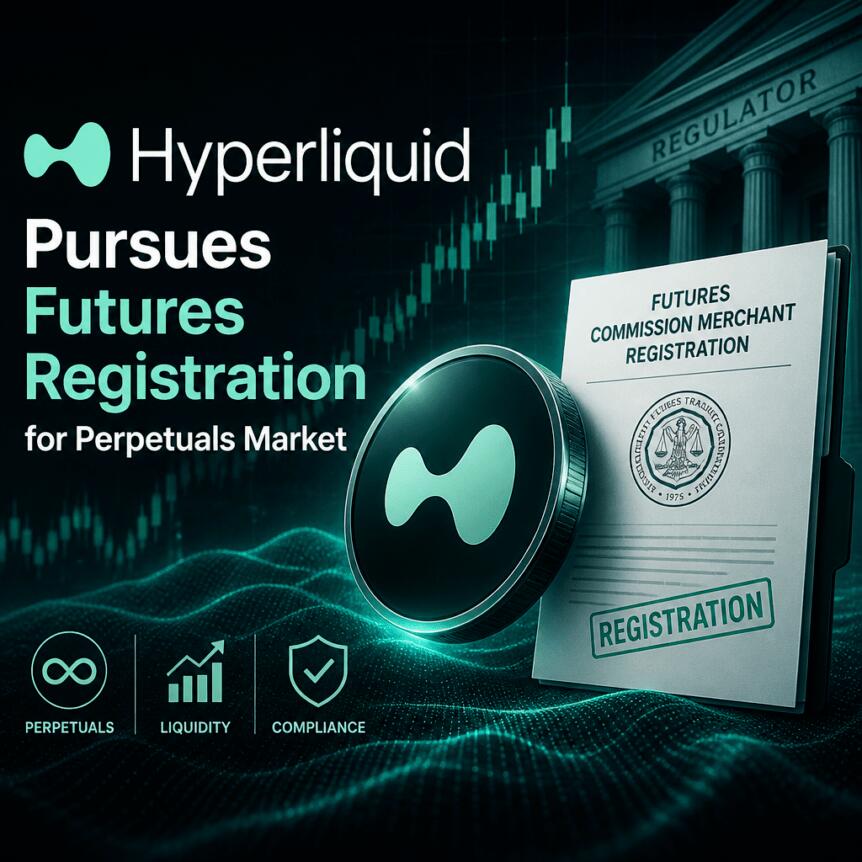
A subsidiary of Nasdaq-listed Hyperliquid Strategies is seeking to enter the U.S. derivatives market as a futures commission merchant (FCM), a regulatory step aimed at bringing Hyperliquid-based perpetual futures onshore.
In its quarterly results for the period ended Sept. 30, CEO David Schamis said the company’s plan is to leverage ownership of HYPE—the token tied to the Hyperliquid ecosystem—while setting up the necessary infrastructure to support U.S. access to markets deployed on the protocol.
Key takeaways
- Hyperliquid Strategies’ subsidiary has applied to become a futures commission merchant (FCM) to support onshore perpetual futures.
- The proposal is linked to Hyperliquid’s HIP-3 framework, which enables independent operators to launch custom perpetual markets by staking 500,000 HYPE tokens.
- Under proposed HIP-3 features, some markets could be permissioned, with participation restricted to approved addresses—requiring regulatory approval.
- ICE (the parent of the NYSE) previously announced a plan with Trade[XYZ] to bring Hyperliquid-based perpetual markets to the U.S., pending regulatory approvals.
- In the same quarter, Hyperliquid Strategies reported large HYPE purchases and ongoing share buybacks, with Schamis tying the value capture to programmatic buybacks.
FCM application targets U.S. market access
Hyperliquid’s expansion into the U.S. derivatives landscape hinges on regulatory permission. According to Hyperliquid Strategies’ quarterly results filed for the quarter ended Sept. 30, its FCM application is intended to help bring Hyperliquid perpetual futures markets to U.S. customers.
Schamis framed the approach as two parts: holding HYPE to capture economics associated with the Hyperliquid protocol, and establishing an FCM to help move markets onto regulated U.S. rails. The filing indicates that both the FCM process and any permissioned markets described in the HIP-3 roadmap would require regulatory approval.
How HIP-3 could power permissioned perpetuals
Hyperliquid’s HIP-3 “builder/deployed perpetuals” framework describes how independent operators can create custom perpetual futures markets using Hyperliquid’s onchain infrastructure. The framework requires staking 500,000 HYPE tokens (reported in the filing as $38.8 million).
The results filing also points to proposed HIP-3 features that would enable permissioned perpetual markets. Under this concept, market operators could restrict participation to approved addresses, creating a more controlled structure for market access.
Crucially for U.S. plans, the company said the FCM subsidiary would handle U.S. customer accounts for permissioned markets deployed on Hyperliquid. That linkage underscores how Hyperliquid is trying to map an onchain market-building model onto a compliance-heavy environment where customer onboarding and market operations must be overseen under U.S. rules.
ICE and Trade[XYZ] plan Hyperliquid onshore
The FCM application comes alongside a separate industry effort to bring Hyperliquid-based perpetual markets into the U.S. Earlier announcements point to coordination at the market-structure level.
On Oct. 29, Intercontinental Exchange (ICE)—the parent of the New York Stock Exchange—announced an agreement with Trade[XYZ] to bring Hyperliquid-based perpetual markets onshore, subject to regulatory approvals. ICE said it plans to operate a dedicated market and clearing structure under the agreement.
That ICE/Trade[XYZ] initiative does not replace the FCM step; instead, it highlights a broader effort spanning both market infrastructure and regulatory handling. In practice, the FCM application and the permissioned-market design described under HIP-3 suggest that Hyperliquid’s U.S. rollout is being shaped not just by technology, but by the compliance and operational requirements of regulated derivatives trading.
Capital moves: HYPE buys, PURR repurchases, and value capture
Hyperliquid Strategies’ regulatory filings also provide a window into how the company is positioning itself financially while pushing toward U.S. expansion.
During the quarter, Hyperliquid Strategies raised $911 million in equity capital. The company reported spending $785 million to acquire 9.1 million HYPE tokens and spending $17 million to repurchase 2.7 million PURR shares. As of Sept. 30, Hyperliquid Strategies held 38.5 million HYPE, valued at $3.5 billion at the time.
Schamis argued that Hyperliquid is capturing value from “onchain finance” activities that generate real fees and that most of that value flows back to HYPE holders through programmatic buybacks. He suggested the firm’s strategy aligns incentives between protocol growth and token economics.
Market data cited in the results indicates Hyperliquid Strategies’ shares fell 9.6% on Thursday, closing at $8.76, according to Yahoo Finance.
What to watch next
Hyperliquid’s push into regulated U.S. perpetuals now depends on two layers of approval: the FCM application and the regulatory authorization required for permissioned Hyperliquid markets. Investors and market participants should focus on whether the FCM filing progresses and whether proposed permissioning mechanics under HIP-3 receive approval—alongside ongoing developments tied to the ICE and Trade[XYZ] onshoring plan.