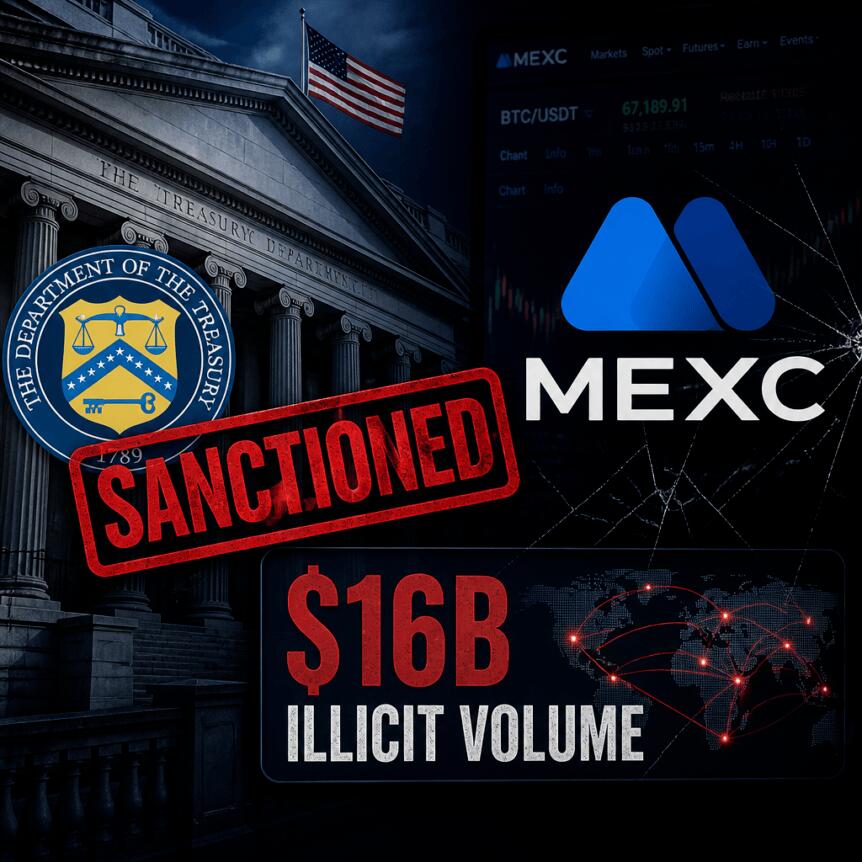
The U.S. Department of the Treasury has issued an order targeting MEXC Global, barring the crypto exchange from access to the U.S. financial system. The action, carried out by the Treasury’s Financial Crimes Enforcement Network (FinCEN), alleges that MEXC facilitated at least $16 billion in cryptocurrency transactions linked to sanctions evasion, cybercrime, and other illicit activity.
FinCEN’s order claims that between May 2021 and May 2026, MEXC handled transactions involving sanctioned groups associated with Iran, Russia, and North Korea. Within that figure, the Treasury highlighted roughly $1.5 billion tied to Russian sanctions evasion. The order will take effect 30 days after it is published in the Federal Register, during which time U.S.-based financial institutions are prohibited from processing money transfers involving the exchange.
Key takeaways
- The Treasury’s FinCEN issued an order to cut MEXC Global off from the U.S. financial system, citing transactions linked to illicit finance.
- FinCEN alleges at least $16 billion in transactions connected to sanctions evasion, cybercrime, and other illegal activity over a May 2021–May 2026 window.
- The order will effectively restrict U.S. banks and other financial institutions from processing transfers involving MEXC starting 30 days after Federal Register publication.
- Treasury frames the move as part of Operation Economic Outcast, a broader campaign aimed at reducing Iran’s ability to circumvent U.S. sanctions through digital assets.
- As of Friday, DefiLlama data cited in the report placed MEXC’s total assets at about $4.48 billion, underscoring the practical scale of the target.
What the Treasury order does
FinCEN’s order is designed to limit MEXC’s ability to operate through U.S. financial rails. Once it becomes effective, U.S. financial institutions cannot process money transfers that involve MEXC Global. In practice, that means the exchange may face major operational friction when interacting with counterparties that rely on U.S. banks, payment networks, or other regulated channels.
The Treasury’s rationale focuses on compliance and risk: it argues that institutions cannot participate in the U.S. financial system while also supporting activity it characterizes as undermining sanctions and enabling criminal behavior.
Sanctions evasion claims across multiple jurisdictions
FinCEN’s allegations are not limited to one geography. The agency asserts that MEXC handled transactions involving sanctioned groups tied to Iran, Russia, and North Korea from May 2021 to May 2026. According to the Treasury’s press materials cited in the coverage, this included about $1.5 billion tied to Russian sanctions evasion.
This matters for how the case is likely to be interpreted by compliance professionals and market participants. Rather than a narrow dispute about a single compliance process or isolated incident, the Treasury is describing a sustained activity pattern across multiple sanctioned jurisdictions, which can carry broader implications for how exchanges manage onboarding, transaction screening, and counterparties.
Operation Economic Outcast and the Treasury’s broader push
The MEXC action is also presented as part of Operation Economic Outcast, a U.S. Treasury campaign that began in August with the stated goal of cutting off financial entities that enable Iran’s sanctions evasion.
While the order targets MEXC specifically, the framing signals a continuing strategy: using enforcement and financial access restrictions to pressure crypto firms that—according to the government—enable circumvention efforts. For traders and users, these steps can translate into sudden changes in exchange accessibility, banking relationships, and the availability of certain fiat on-ramps or settlement routes.
For industry participants, the move also increases the pressure to demonstrate robust compliance controls, especially around sanctions screening and transaction tracing. Even in cases where a firm is not directly accused of owning or operating illicit infrastructure, the key issue for regulators is often whether prohibited activity can be routed through the platform at scale.
Why the timing matters for markets
FinCEN’s order is scheduled to take effect 30 days after Federal Register publication. That lead time is significant: it provides a window for affected parties—including exchanges, banks, payment providers, and major counterparties—to adjust their workflows and risk policies.
Investors and market participants may watch for secondary impacts during that period, such as changes to customer access, potential transfer restrictions, and shifts in liquidity patterns across trading pairs that depend on MEXC. The order does not itself describe how MEXC will be able to service users globally after the U.S. restriction begins, but financial access restrictions can ripple quickly across exchange operations.
DefiLlama data cited in the coverage put MEXC’s total assets at about $4.48 billion as of Friday. That snapshot suggests the exchange remains sizable, meaning the enforcement action could be relevant well beyond compliance headlines, particularly for users who maintain balances on the platform or depend on it for specific market access.
What’s next for MEXC and U.S. compliance pressure
Treasury Secretary Scott Bessent underscored the agency’s position that firms cannot simultaneously support activity it links to sanctioned regimes and maintain access to the U.S. financial system. Earlier coverage from Cointelegraph also highlighted the broader theme of how law enforcement and compliance bodies increasingly treat crypto infrastructure as a focal point for illicit finance and cyber-enabled threats.
For now, the most important near-term question is how MEXC will respond once the order becomes effective and how U.S. counterparties implement the transfer restrictions. Readers should watch for Federal Register publication timing, any adjustments to MEXC’s banking and on-ramp arrangements, and further enforcement actions under the same campaign priorities.