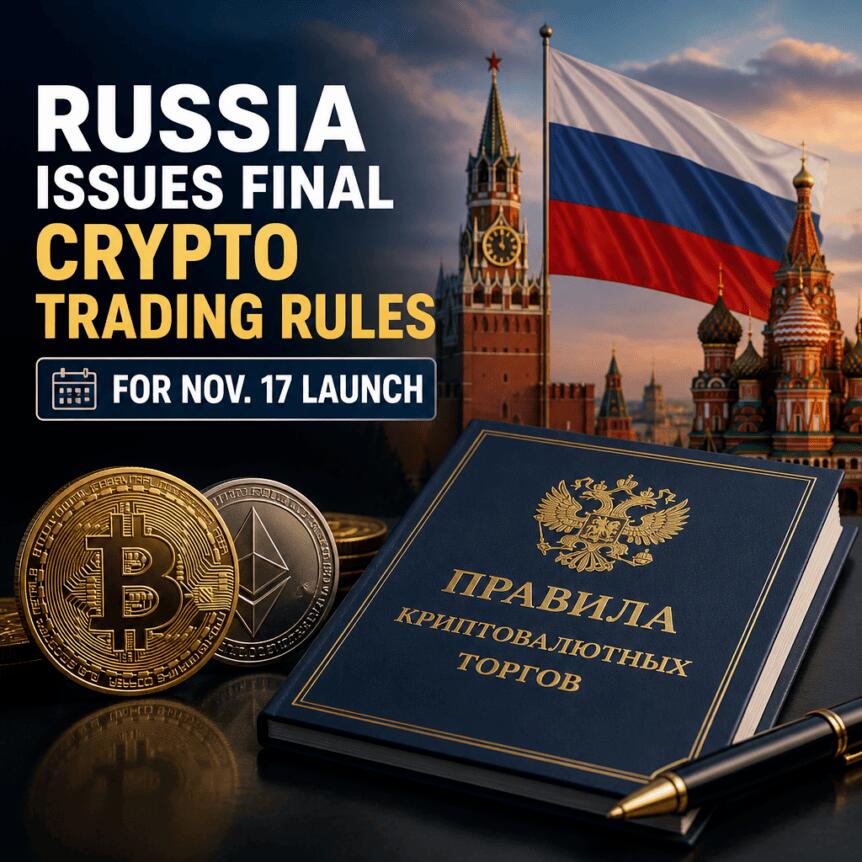
Russia’s central bank has completed the framework that will allow regulated intermediaries to sell certain cryptocurrencies to retail customers, starting Nov. 17. The updated rules open the door for retail access to Bitcoin (BTC), Ether (ETH) and Tether USDt (USDT), while keeping participation behind compliance checks and placing tighter boundaries around activity outside approved channels.
According to the central bank’s final directive, retail investors who are not classified as “qualified” may buy up to 300,000 rubles (about $3,700) in crypto per year through each intermediary. Qualified investors are not subject to the same purchase cap, but all investors must pass a mandatory test before they can trade.
Key takeaways
- Retail trading via regulated intermediaries begins Nov. 17 for BTC, ETH, and USDT.
- Non-qualified investors are capped at 300,000 rubles per year per intermediary; qualified investors face no purchase limit under the rules.
- All investors must complete a mandatory test before trading, regardless of investor category.
- Russia is simultaneously tightening restrictions on peer-to-peer trading and on transfers from regulated accounts to self-custody wallets.
- Moscow Exchange is preparing to start crypto trading on Dec. 1, initially via pilot transactions.
What Russia’s finalized retail rules allow
The central bank’s finalized regulations set clear conditions for how “non-qualified” and “qualified” investors can participate in a structured crypto market. Under the rules, retail customers can purchase BTC, ETH, and USDT through intermediaries such as brokers, asset managers and crypto exchange providers.
The annual limit for non-qualified investors is set at 300,000 rubles per intermediary. For readers tracking how widely crypto access may expand, the “per intermediary” structure is particularly important: it means the total amount a retail investor could potentially buy depends on how many intermediaries they use, even though each individual channel has its own ceiling.
Beyond eligibility and caps, the directive introduces a common gatekeeping step for all participants. The mandatory test requirement is designed to ensure investors complete a basic suitability or knowledge check before they can place trades.
These rules build on broader legislation Russia’s financial authorities have been rolling out. Earlier, President Vladimir Putin signed a law on Aug. 4 establishing a regulated crypto market under central bank oversight, according to coverage of the legislative framework.
How the central bank picked the eligible cryptocurrencies
Before the final rules were adopted, Russia’s central bank published draft regulations describing which assets could be offered for public trading. In that draft, BTC, ETH and USDT were identified as eligible based on factors such as market capitalization, average daily trading volume, and at least five years of price history on foreign exchanges.
This matters because the selection criteria signal a preference for coins with deeper liquidity and longer operating history—an approach intended to reduce volatility and operational risk in a retail-facing system. While the final directive confirms the eligible list, readers should note that the eligibility logic could still influence whether additional assets are considered in future updates, even though this article does not specify any new additions beyond the three cryptocurrencies.
The regulatory timeline also shows how quickly Russia moved from framework to implementation. The law took effect Sept. 1, and the central bank later authorized Sberbank—Russia’s largest bank—to offer crypto exchange services in October.
Moscow Exchange to begin trading on Dec. 1
Alongside retail access rules, Russia’s major securities venue is preparing to launch its own crypto trading operations. Moscow Exchange—described as Russia’s largest securities exchange and a publicly traded company—has been preparing to launch cryptocurrency trading on Dec. 1, initially through pilot transactions.
For traders and market participants, the timing of Moscow Exchange’s move is a key component of how quickly the regulated market may gain liquidity and visibility. A central exchange launch often changes how institutions structure custody, order routing, and compliance workflows, and it can also affect whether retail participation concentrates around broker-mediated offerings or becomes more directly accessible through trading venues.
Restrictions outside the regulated system tighten further
Russia’s push for regulated retail access is paired with restrictions on crypto activity beyond those approved pathways. The central bank states that direct peer-to-peer crypto trading will be prohibited starting July 1, 2027.
In addition, transfers from regulated digital accounts to self-custody wallets are already banned, according to the central bank. Separately, Russia maintains a prohibition on using cryptocurrency to pay for goods and services.
Taken together, these constraints indicate that while consumers may gain access to major cryptocurrencies through intermediaries, the government’s policy direction still prioritizes centralized monitoring and control. For retail investors, this could significantly change how they plan to manage assets, especially if they previously relied on moving crypto to personal wallets or using peer-to-peer channels.
It also creates a structural tension that readers should watch: access is expanding through regulated rails, but autonomy—particularly self-custody and P2P exchange—continues to face legal limits and future enforcement.
What to monitor next
With regulated retail trading scheduled to begin Nov. 17 and Moscow Exchange planning a Dec. 1 start for pilot trading, the immediate question is how intermediaries implement the test process, enforce the 300,000 ruble annual cap for non-qualified investors, and transition volume into the new regulated environment. Investors and builders should also track how Russia prepares for the July 1, 2027 ban on peer-to-peer trading, as the change could reshape where and how demand flows.