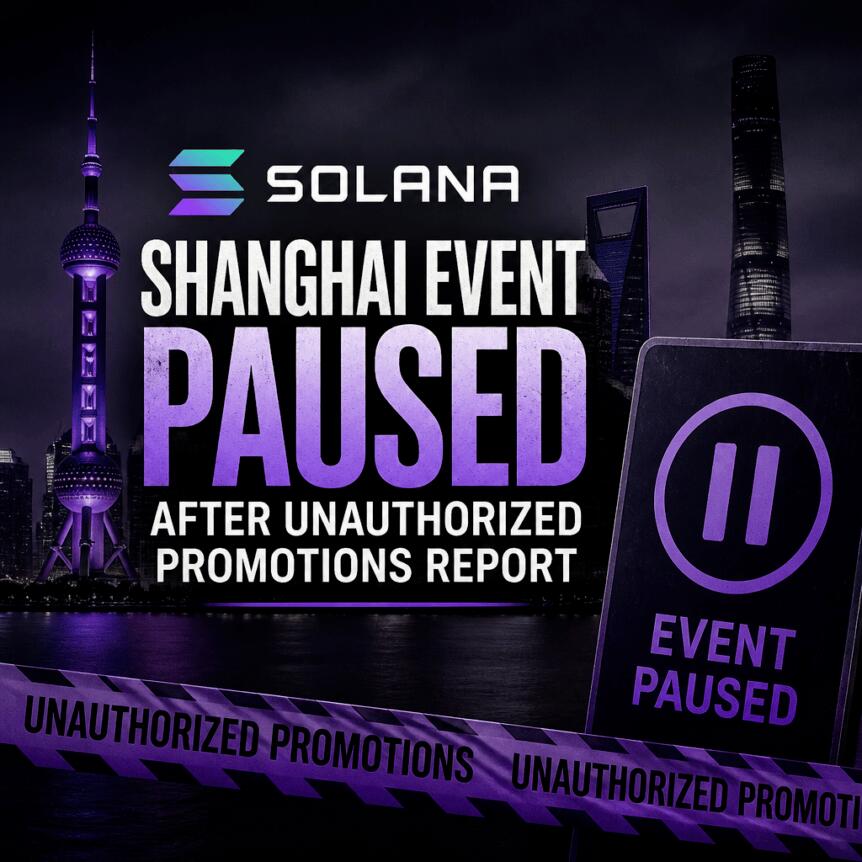
Chinese authorities reportedly stopped a Solana-related event planned for Shanghai after alleging unauthorized promotional activity involving domestic entities, according to Financial News, a state-backed publication. The report, citing an unnamed official linked to the People’s Bank of China (PBOC), said Solana promoted its brand through local channels, including advertisements placed in Shanghai’s Lujiazui financial district.
The incident underscores that China’s stance toward crypto is not limited to trading activity. Regulators appear to extend scrutiny to marketing, fundraising-style promotion, and any crypto-related services that could be interpreted as facilitating digital asset issuance or exchange.
Key takeaways
- Financial News reports Shanghai authorities halted a Solana event over alleged unauthorized promotional activity using domestic entities.
- The cited PBOC-linked official also described Solana’s technical support for crypto issuance and trading as illegal under Chinese rules.
- The Shanghai disruption is the second reported interruption of a Solana event in mainland China within roughly two years.
- Earlier Solana China event troubles included venue and public-safety concerns rather than only compliance allegations.
- Recent PBOC guidance has reinforced broader restrictions, including a ban on unauthorized issuance of yuan-pegged stablecoins.
Why authorities reportedly intervened in Shanghai
In a report published Friday, Financial News said Chinese authorities halted the Solana Accelerate event in Shanghai. The publication cited an unidentified official from a department of the PBOC who alleged that Solana promoted its brand using domestic entities without proper authorization.
The official pointed to advertising in Shanghai’s Lujiazui district as an example of the conduct they believed violated local requirements. The report did not provide further detail on the specific entities involved, but it framed the issue as promotional activity connected to a major blockchain brand operating in China.
Beyond marketing concerns, the official claimed that Solana offers technical services that support the issuance and trading of cryptocurrencies. In their view, those activities fall under categories prohibited by Chinese regulations.
Solana events in China: compliance scrutiny and operational friction
The Shanghai halt represents the second reported disruption of a Solana event in mainland China in a two-year span. The earlier case, according to a post from Solana’s Chinese-speaking community on X, occurred in October 2025 and reportedly ended early due to venue capacity limits and public-safety concerns.
That prior disruption differed in stated cause: it was tied to event logistics and safety, rather than allegations of unauthorized promotion or crypto-related services. Taken together, the two incidents suggest a broader pattern in which Solana’s on-the-ground activity in China can run into both regulatory interpretation and practical constraints.
What Solana’s leadership said about the Shanghai event
After the Shanghai event was disrupted, Solana Foundation president Lily Liu addressed the situation on X. In an Oct. 16 post, Liu said organizers postponed the Shanghai event “to comply with local requirements” after the number of registrations unexpectedly quadrupled, pushing attendance beyond the event cap that had been pre-registered with local authorities.
The statement focused on compliance with local rules and the mismatch between planned capacity and actual interest. However, Financial News’s Friday account emphasizes a different core allegation: that Solana’s brand promotion through domestic entities—and the company’s purported technical role in crypto issuance and trading—triggered regulatory intervention.
This divergence matters for readers trying to understand what actually changed. On the one hand, Solana’s leadership highlighted registration volume and an event-cap problem. On the other, the PBOC-linked official’s account framed the issue as broader compliance around promotional activity and crypto-enabling services. Investors and builders watching China exposure for blockchain projects will likely want clarity on whether the authorities targeted the promotional methods, the event itself, or both.
PBOC’s wider restrictions on crypto-related activities
The Shanghai reports arrive in a regulatory environment that has tightened repeatedly in recent years. In February, the PBOC and other agencies issued a notice reiterating crypto-related restrictions and introducing a specific ban on unauthorized issuance of yuan-pegged stablecoins, according to a notice published on the PBOC website.
While the Solana Accelerate incident is framed around an event in Shanghai, the February guidance points to a consistent policy direction: authorities are willing to limit not only trading or custody, but also functions that may be interpreted as supporting token issuance, exchange, or stablecoin mechanisms tied to the yuan.
In that context, Financial News’s cited official characterization of Solana as providing technical services that support issuance and trading aligns with the broader approach described in the PBOC notice—at least from the authorities’ perspective.
What to watch next for Solana and other crypto events
For now, the key uncertainty is whether future China-based Solana activity will be shaped more by capacity and operational compliance—or by marketing and crypto-technical activity allegations like those described in the Shanghai report. Builders and event organizers looking to operate in mainland China may need to treat promotional plans, partner involvement, and on-the-ground interpretation of “crypto-enabling” services as major risk factors alongside basic logistical constraints.