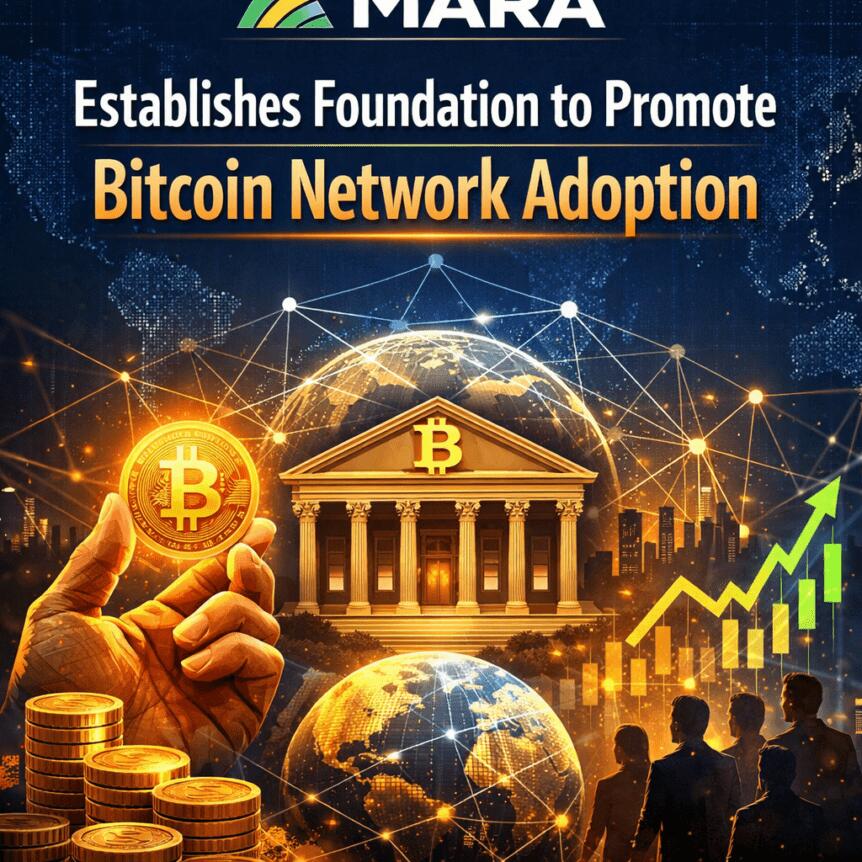
Bitcoin miner MARA Holdings has unveiled the MARA Foundation, a new initiative announced at the Bitcoin 2026 conference in Las Vegas. The foundation is positioned to bolster the health of the Bitcoin network and the communities that rely on it as a tool for financial sovereignty, governance, and resilience.
According to MARA, the foundation will pursue measures to harden Bitcoin against security threats, including quantum computing, while expanding access to self-custodial Bitcoin and providing a suite of educational resources. It also aims to foster a robust and healthy fee market for Bitcoin transactions, reinforcing what MARA calls the core properties that make Bitcoin sound, durable money.
Key takeaways
- The MARA Foundation launches with an initial $100,000 contribution pool and a public-vote mechanism to determine grant recipients among three Bitcoin-focused nonprofits.
- The foundation’s stated mission encompasses security hardening (including quantum threat preparedness), broader self-custody access, education for developers and policymakers, and support for a healthy Bitcoin fee market.
- The initial grant recipients are 256 Foundation (open-source Bitcoin mining platform), Libreria de Satoshi (Latin American Bitcoin education), and SafeNet (a community-operated, Bitcoin-powered wireless network for underserved communities).
- The move comes amid a broader industry shift as miners explore AI and high-performance computing to diversify revenue, a backdrop underscored by a notable decline in Bitcoin hashrate since September.
- MAR A’s emphasis on global reach highlights the Global South, where Bitcoin is increasingly seen as a tool to counter financial oppression and hyperinflation, according to the foundation.
Foundation aims and the vote to fund change
At the core of MARA’s announcement is a commitment to reinforce Bitcoin’s security and accessibility. The foundation said it intends to implement measures that “harden Bitcoin against security threats,” with quantum computing singled out as a particular area of focus. In addition to security hardening, MARA highlighted plans to widen self-custody access to Bitcoin and provide an array of educational resources, spanning technical development and policy considerations.
Beyond security and education, MARA said it wants to nurture a more robust fee market for Bitcoin transactions. The framing emphasizes Bitcoin’s potential as a durable, censorship-resistant money and a tool for financial sovereignty across diverse communities.
To seed the foundation’s activities, MARA opened a $100,000 contribution fund and invited the public to vote on how the money should be allocated. The three candidates are:
- 256 Foundation — an open-source Bitcoin mining platform focused on community-driven development.
- Libreria de Satoshi — a Latin American Bitcoin education initiative aimed at expanding literacy and access to Bitcoin concepts.
- SafeNet — a Bitcoin-powered, community-operated wireless network designed to serve underprivileged communities.
In presenting the fund, MARA emphasized a broader mission: to enable “financial sovereignty worldwide,” with a particular focus on the Global South — including parts of Africa and Latin America — where Bitcoin is increasingly deployed as a hedge against hyperinflation and restrictive financial regimes. The foundation framed its work as supporting communities that use Bitcoin to strengthen local economies and broaden access to sound money, alongside a door-to- policymaker engagement and developer resources.
Context: a miner-led shift and network health
The MARA Foundation’s launch mirrors a larger industry moment, as corporate Bitcoin miners diversify beyond traditional operations into AI and high-performance computing to pursue higher-revenue opportunities. This trend has coincided with fluctuations in network activity; notably, Bitcoin’s overall hashrate has declined by about 28.8% since September, according to data tracked by CoinWarz. The drop reflects both cyclical dynamics in mining and the competitive pressures that come with expanding workloads beyond pure hashing.
Industry observers have framed these shifts as a potential pivot point for Bitcoin’s ecosystem: more capital and institutional attention on governance, security, and education could bolster long-term network health even as miners hunt for new business lines. MARA’s initiative aligns with a growing expectation that corporate actors will take more deliberate steps to support Bitcoin’s infrastructure, user protections, and educational outreach.
In related discourse, industry coverage has spotlighted ongoing conversations about quantum resistance and post-quantum improvements for Bitcoin and other blockchains, underscoring that security planning remains a live, forward-looking concern for developers, miners, and policymakers alike. For readers seeking broader context, technology thinkers have recently proposed concrete pathways for quantum-resilient designs within the ecosystem.
Global south focus and educational outreach
A distinctive thread of MARA’s announcement is its emphasis on the Global South. The foundation said its mission includes expanding access to sound money and strengthening local economies in regions most affected by financial oppression and currency volatility. By pairing funding with educational initiatives, MARA aims to equip both Bitcoin developers and policymakers with tools to navigate security implications, governance questions, and practical adoption challenges in diverse markets.
Educational resources are envisioned as a bridge between technical advancement and real-world impact, enabling communities to better understand, deploy, and safeguard Bitcoin in environments with varying levels of infrastructure and regulatory maturity. The initiative signals a trend toward more structured corporate philanthropy in the Bitcoin space, anchored by concrete projects with measurable community benefits.
Related reading: industry coverage on quantum resistance roadmaps and the broader debate around post-quantum upgrades for major networks.
Overall, the MARA Foundation’s launch underscores a broader conviction within the crypto sector: that Bitcoin’s longevity hinges not only on price or mining capacity, but on security, access, and education that empower users worldwide to participate in sound money and financial sovereignty.
Readers should watch the outcome of the community vote and the subsequent rollout of funded projects, as well as any further steps the foundation announces to engage developers, educators, and policymakers in shaping Bitcoin’s resilient future.