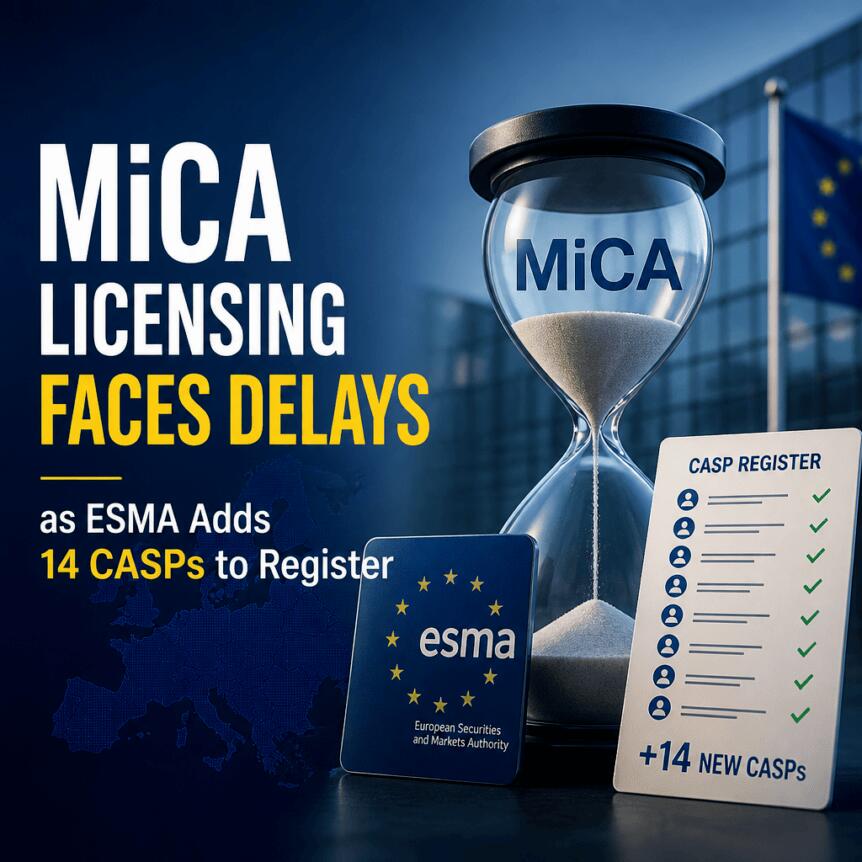
European regulators have added 14 more crypto-asset service providers (CASPs) to the Markets in Crypto-Assets (MiCA) framework register, according to an ESMA update released on Thursday. The latest expansion lifts the total number of licensed CASPs to 294 and suggests that the post-deadline licensing pace is easing after a sharp early surge.
The European Securities and Markets Authority (ESMA) updated its interim MiCA register as part of its ongoing rollout of the bloc’s crypto-licensing regime. Earlier, ESMA had made a major jump on July 3, adding 37 CASPs in its first large post-deadline update after the transitional period ended.
Key takeaways
- ESMA’s Thursday update adds 14 CASPs, bringing the total licensed providers in its interim MiCA register to 294.
- Ripple Payments Europe, Bison Bank (Portugal), and Croatia’s state-owned Hrvatska poštanska banka (HPB) are among the new entries.
- Banks and other established financial institutions continue to expand into MiCA-regulated crypto services in Europe.
- ESMA reported no changes to its registers for electronic money tokens (EMTs) and asset-referenced tokens (ARTs) in this round.
- Two additional entities were added to ESMA’s non-compliant list following actions by Italy’s CONSOB.
More traditional finance firms enter the MiCA register
The new CASPs underline how traditional financial institutions are steadily formalizing their crypto exposure under Europe’s MiCA rules. Among the most notable additions is Ripple Payments Europe, the payments unit of blockchain company Ripple, which now appears in ESMA’s register as a MiCA-licensed service provider.
ESMA also listed Bison Bank, based in Portugal, and Hrvatska poštanska banka (HPB), a state-owned bank in Croatia. In addition, the update included two German cooperative banks: Volksbank Schwarzwald-Donau-Neckar and Raiffeisenbank Auerbach-Freihung.
Outside the banking sector, Liechtenstein-based Kaiser Partner Privatbank was also added, expanding the presence of private banking groups offering regulated crypto services under MiCA.
Beyond these new entries, ESMA’s register already includes a range of well-known institutions. The list reportedly features firms such as Spain’s BBVA and CaixaBank, Germany’s Commerzbank, France’s CACEIS Bank, and Standard Chartered Luxembourg—an indication that MiCA licensing is increasingly overlapping with mainstream financial infrastructure in the region.
A visible slowdown after the initial post-deadline jump
Comparing Thursday’s additions with ESMA’s previous large update highlights a shift in momentum. On July 3, ESMA added 37 CASPs in the first major post-deadline register expansion after MiCA’s transitional phase ended. Thursday’s 14-company increase is smaller, implying a slower licensing cadence as the market absorbs regulatory requirements at scale.
For investors and industry participants, the practical takeaway is that the number of MiCA-approved providers is still climbing, but the fastest phase of onboarding may be giving way to a more incremental process. That can matter for counterparties evaluating regulated access across Europe, as well as for projects planning compliance timelines and partnership strategies.
EMT and ART approvals remain stalled
While CASP licensing continues to move forward, ESMA’s registers for EMTs and ARTs showed no changes in this update. ESMA did not report any new entries for electronic money tokens—crypto-assets intended to maintain a stable value against a single official currency—or for asset-referenced tokens, which are designed to reference multiple assets such as currencies or commodities.
In the latest figures, the EMT register continues to count 21 unique issuers. The ART register, by contrast, remained unchanged with no approved issuers listed.
That contrast is significant: MiCA’s structure distinguishes between licensing providers (CASPs) and approvals for token categories (EMTs and ARTs). Even as more firms gain authorization to offer services, the pipeline for token issuance—particularly ARTs—appears to be moving more slowly.
New entities on ESMA’s non-compliant list
ESMA also reported additions to its non-compliant register. Following actions by Italy’s securities regulator, the Commissione Nazionale per le Società e la Borsa (CONSOB), two entities were added: Reversal Investment Group and Kortex.
With these updates, the non-compliant list now totals 164 entries, including crypto exchange MEXC. For readers tracking MiCA enforcement, this matters because the register is not limited to approvals—it also signals which market participants regulators view as falling short of compliance expectations.
Going forward, the main issue to watch is whether ESMA’s next post-deadline licensing rounds return to higher volumes or continue to taper off, and whether progress for EMTs and especially ARTs accelerates beyond the current static position. Those developments will shape how quickly regulated token products can emerge alongside the growing network of MiCA-authorized service providers.