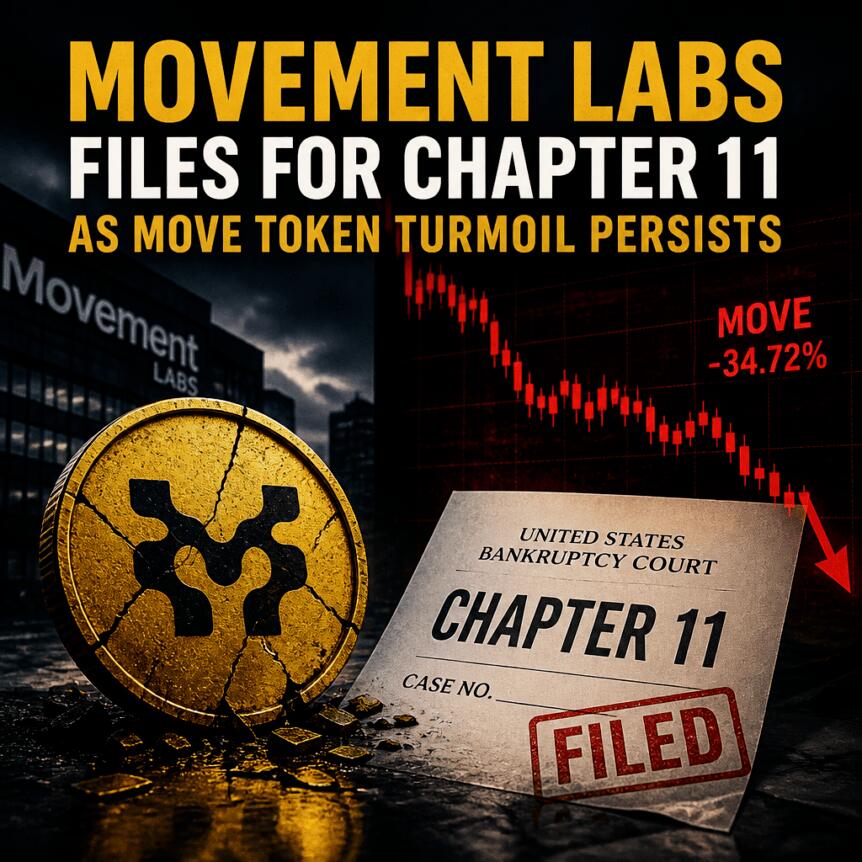
Movement Labs, the team behind the Movement Ethereum layer-2 blockchain, has filed for Chapter 11 bankruptcy protection in the US Bankruptcy Court for the District of Delaware, according to court records. The filing, made July 15, uses Subchapter V—an expedited reorganization track intended for qualifying small businesses—while the company restructures under court supervision.
The court has already approved interim requests that allow Movement Labs to keep operating through the process. Those approvals include maintaining bank accounts and cash management systems, along with access to debtor-in-possession (DIP) financing to fund continued operations. Creditors have until Sept. 14 to submit claims.
Key takeaways
- Movement Labs filed for Chapter 11 under Subchapter V, enabling continued operations while it restructures.
- Interim court approvals cover cash handling and DIP financing to support day-to-day operations during bankruptcy.
- The petition applies to Movement Labs only, according to Move Industries CEO Torab Torabi.
- Multiple earlier setbacks tied to MOVE token trading and market-making concerns preceded the bankruptcy filing.
Court-supervised reorganization begins under Subchapter V
In its Chapter 11 filing, Movement Labs sought protection as it reorganizes following a period of disruption for the Movement ecosystem. The petition was filed July 15 in the District of Delaware and placed the company under court oversight, with Subchapter V designed to streamline the path to reorganization for eligible businesses.
Per the court approvals reported in the filing process, Movement Labs was allowed to continue using its banking and cash management arrangements. The court also authorized debtor-in-possession financing—an important step in Chapter 11 cases because it can help preserve operational continuity while liabilities are addressed.
The timeline for creditors is set at Sept. 14 to file claims, giving holders of potential debts a defined window to participate in the bankruptcy process.
What “Chapter 11” means for the ecosystem
After the bankruptcy filing became public, Move Industries CEO Torab Torabi clarified that the court protection applies only to Movement Labs. Torabi wrote on X that Move Industries—described as having taken over development and operations of the Movement ecosystem—continues to operate normally.
Earlier coverage and Movement’s own communications indicate that Move Industries assumed responsibility for development and operations from Movement Labs in December 2025, through a transfer described in a post on the Movement Network website: Movement Network Foundation and Move Industries announce completion of.
That distinction matters for readers trying to separate the corporate entity in bankruptcy from the broader project. While Chapter 11 may affect contracts, liabilities, and certain company-held assets, it does not automatically mean all ecosystem activity halts—especially where another operator is already handling development and operations.
A market-making controversy and listing actions preceded the filing
Movement Labs’ bankruptcy comes after months of controversy connected to the launch of Movement’s MOVE token and a market-making agreement that drew scrutiny.
According to earlier reporting from Cointelegraph, Movement Labs suspended co-founder Rushi Manche in May 2025 over a deal he helped broker with Web3Port. The market maker reportedly received 66 million MOVE—about 5% of the token’s supply—and later sold the holdings. Cointelegraph noted this was followed by an independent investigation, with the reported sales creating downward pressure on the token’s price.
Cointelegraph also reported that Coinbase suspended trading for MOVE later in May 2025 after determining the token no longer met its listing standards, while review into the market-making arrangement was ongoing.
In the period since those events, the MOVE token faced prolonged weakness. Cointelegraph cited a continued decline, stating the token has fallen more than 94% over the past year to roughly $0.01. The article referenced CoinGecko for the one-year price chart: CoinGecko.
Investors and users: what to watch next
Chapter 11 filings often signal the beginning of a longer restructuring process, and this one is likely to add a layer of legal complexity to questions around Movement Labs’ obligations and any assets under its control. Even if Move Industries continues operating, the bankruptcy proceedings can still influence how related contracts are handled and how remaining stakeholders are treated.
With creditors now having until Sept. 14 to file claims, the next steps worth monitoring are the bankruptcy court’s ongoing approvals, the scope of DIP financing over time, and whether subsequent filings clarify what parties will be prioritized during restructuring.