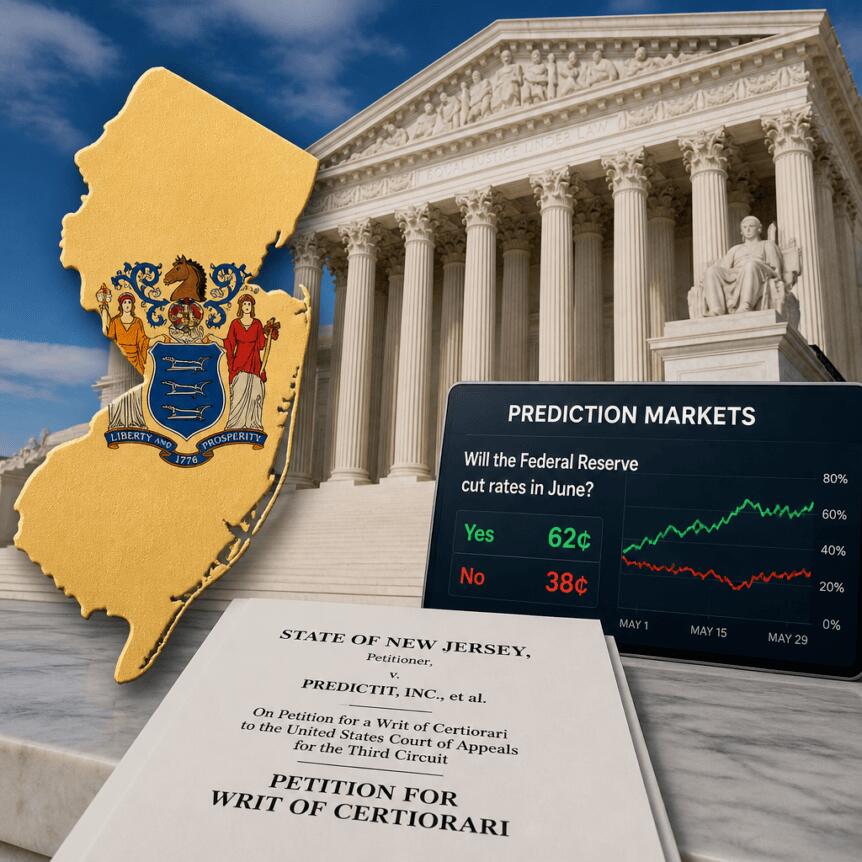
New Jersey’s top legal and gaming enforcement officials have asked the US Supreme Court to step into a fast-growing dispute over prediction markets—specifically whether state regulators can enforce gambling rules when a platform argues it is operating under a federal framework.
Attorney General Jennifer Davenport and Mary Jo Flaherty, interim director of the New Jersey Division of Gaming Enforcement, filed a petition for a writ of certiorari on Wednesday, seeking the Supreme Court’s review of New Jersey’s enforcement action against Kalshi. The case centers on whether federal law preempts states from regulating sports bets conducted within their jurisdictions, even when the platform says its markets are registered with the Commodity Futures Trading Commission (CFTC).
Key takeaways
- New Jersey has petitioned the US Supreme Court to decide the scope of federal preemption over state regulation of sports betting on prediction-market platforms.
- The dispute is tied to whether CFTC-registered prediction markets fall under the Commodity Exchange Act and are treated as “swaps,” as argued by Kalshi.
- New Jersey’s filing points to civil actions reportedly brought by gaming regulators in at least 20 states to resolve similar jurisdictional questions.
- New Jersey warns that a Kalshi win could make many sports-betting arrangements illegal if they are offered outside CFTC-registered trading venues.
- Kalshi says it disagrees with the appeal, arguing that prediction markets cannot function under a patchwork of state regulators.
Why New Jersey wants the Supreme Court involved
In its petition, New Jersey argues that the Supreme Court is needed to resolve a jurisdictional conflict that has left prediction market operators and regulators in uncertainty. Davenport said prediction-market companies claim they offer legal sports betting across all 50 states, but that they “refuse to follow the gambling laws of any State.” She framed the dispute as Congress not creating a blanket exemption from state law for sports-betting activities.
New Jersey’s petition asks the justices to address a specific question about the 2010 Dodd-Frank Wall Street Reform and Consumer Protection Act: whether that law preempts states from regulating sports bets occurring within their jurisdictions when those bets are offered on markets registered with the CFTC.
The legal battleground: CFTC registration and “swaps”
The Supreme Court request follows an April opinion from the US Court of Appeals for the Third Circuit. According to reporting on that decision, the appellate court ruled 2-1 against New Jersey’s gaming authorities, rejecting Kalshi’s argument that it had a “reasonable chance of success” in asserting that the CFTC’s Commodity Exchange Act preempted state law.
The Third Circuit’s ruling addressed—at least for the purpose of the lower court dispute—whether Kalshi could rely on federal preemption stemming from the CFTC framework. A central part of New Jersey’s appeal is a challenge to the agency-level argument that sports bets issued through prediction-market platforms should be treated as “swaps” within the CFTC’s jurisdiction.
In New Jersey’s characterization, the key point is that federal law does not displace state sports-gambling enforcement—even where the markets are registered with the CFTC. Cointelegraph reported that it reached out to the CFTC for comment on the petition but did not receive an immediate response.
What a Kalshi victory could mean for state enforcement
New Jersey’s filing argues that the stakes extend beyond one company. The Attorney General’s announcement suggests that if Kalshi were to prevail on preemption grounds, federal prohibitions on trading “swaps” outside CFTC-registered markets could be read to make certain sports-betting activities illegal even in states where the activity would otherwise be permitted.
The logic, as presented by New Jersey, is straightforward but consequential: if CFTC preemption is broad enough to block state gambling enforcement, then sports bets structured as “swaps” would be required to comply with federal venue restrictions. That could leave market participants with fewer lawful pathways—depending on how the platform structures its offerings and where and how trading occurs.
Kalshi, however, rejected the approach. In a statement to Cointelegraph, spokesperson Dani Lever said the company disagreed with New Jersey’s decision to seek Supreme Court review, arguing that it cannot be “regulated by 50 different regulators.” Lever added that the company remains confident in the lower courts’ rulings and said nothing in New Jersey’s filing changes its position.
Why this case matters for the broader prediction-market sector
Whether the Supreme Court will take the case is uncertain. Observers have noted that the justices could consider the underlying preemption question in similar prediction-market disputes—whether those involve New Jersey, Nevada, or future enforcement actions against other platforms. But the timing and which specific dispute the court chooses remain open.
That uncertainty is itself part of the problem for the industry. For platforms, the outcome determines whether their compliance strategy is primarily federal—tied to CFTC registration and the Commodity Exchange Act—or whether states can continue to impose their own betting and licensing regimes even when platforms believe their offerings fit within federal categories.
For investors and users, the practical implication is clear: legal risk can vary sharply by jurisdiction, and the structure of a platform’s market and trading mechanics may be treated differently depending on where enforcement occurs. A Supreme Court ruling could reduce that uncertainty—or, depending on how the court rules, potentially increase it by narrowing the range of activities that states may regulate.
As the case heads toward a likely Supreme Court decision or continued appellate litigation, the most important thing to watch is whether the Court grants review and, if so, how it frames the Dodd-Frank preemption question around CFTC “swaps.” Until then, prediction markets remain in a legal gray zone where federal registration arguments and state gambling enforcement can collide in unpredictable ways.