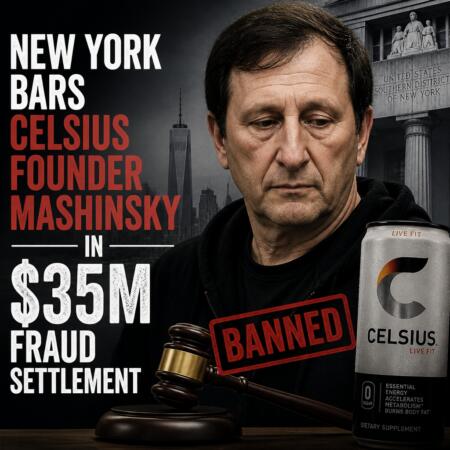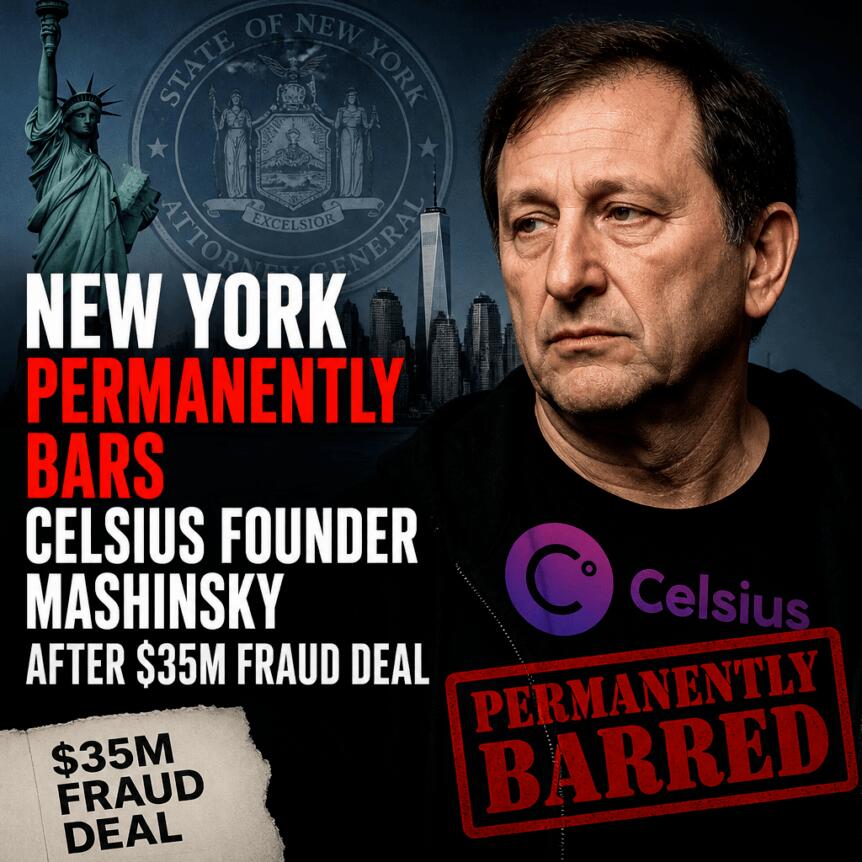
New York Attorney General Letitia James has permanently barred former Celsius CEO Alex Mashinsky from working in the cryptocurrency, securities and commodities industries, according to an agreement announced Friday. The settlement also includes conditional payments that could total up to $35 million, depending on Mashinsky’s compliance with related forfeiture and sentencing terms.
The order resolves a 2023 civil case in which New York alleged Mashinsky misled hundreds of thousands of investors about the safety of Celsius before the platform’s collapse in 2022. James’ office said the final settlement requires Mashinsky to make a $25 million payment to New York if he does not forfeit an additional $10 million in ill-gotten gains to the federal government beyond assets he has already forfeited.
Key takeaways
- Mashinsky has been permanently barred from the cryptocurrency, securities, and commodities industries under a New York Attorney General settlement.
- The agreement includes conditional payments: $25 million to New York if he fails to forfeit an extra $10 million to the federal government, and an additional $10 million if he does not serve his full prison sentence.
- The New York action stems from allegations that Celsius was presented as low-risk while investors were allegedly kept in the dark as losses mounted.
- The New York ruling comes after prior enforcement actions by the CFTC and FTC that separately restricted his activities in trading and finance.
A permanent industry ban tied to a larger restitution framework
In the press release announcing the agreement, New York said the settlement finalizes enforcement following claims that Mashinsky and Celsius misrepresented the safety of funds held on the platform prior to its 2022 failure. The agreement is available through the New York Attorney General’s website: AG James bans former cryptocurrency CEO who defrauded investors.
Under the terms described in the announcement, the financial consequences are structured around two conditions. First, if Mashinsky does not forfeit an additional $10 million in ill-gotten gains to the federal government—beyond assets already forfeited—he must pay New York $25 million. Second, the settlement calls for another $10 million payment if he does not serve his full prison sentence.
These conditions are particularly significant because they tie the New York settlement to the broader enforcement and forfeiture landscape, rather than operating as an isolated state action. For investors and creditors following the Celsius fallout, the mechanism underscores how multiple regulators have sought to align penalties across civil and criminal proceedings.
What New York alleged about Celsius’s “high yield” pitch
New York’s 2023 lawsuit, referenced in Friday’s announcement, argued that Mashinsky promoted Celsius as a safer alternative to traditional banks while advertising returns that allegedly reached as high as 17%. The complaint claimed that behind the marketing, Celsius was exposed to risky investments and accumulating losses that were not adequately disclosed to customers.
According to the 2023 lawsuit, by early 2022 Celsius had amassed roughly $20 billion in digital assets but struggled to generate enough revenue to sustain the returns customers were promised. As losses and funding pressure increased, the company allegedly moved toward increasingly risky strategies, according to the CFTC, which is cited in the New York filing.
As the crisis unfolded, Celsius froze customer withdrawals in June 2022 and then filed for bankruptcy the following month. The bankruptcy disclosures, as described in the agreement materials, included a shortfall of more than $1 billion between assets and liabilities.
The New York Attorney General’s office also reported that by August 2026, more than $3.4 billion had been distributed to Celsius creditors through the bankruptcy process. For market participants, this figure matters because it helps frame the case’s ongoing impact: even after the collapse and prosecutions, creditors’ recoveries continue to develop through bankruptcy administration.
How the settlement fits with prior federal actions
The New York agreement is the latest step in a legal record that includes multiple regulatory bans and civil restrictions. Earlier this year, federal regulators reached their own arrangements affecting Mashinsky’s ability to work in parts of the finance and trading ecosystem.
In June, the Commodity Futures Trading Commission (CFTC) permanently barred Mashinsky from trading and from registering with the agency. Earlier coverage from Cointelegraph described the CFTC action as a permanent ban from trading; the report also noted the broader restrictions tied to Mashinsky and Celsius-related wrongdoing.
Before that, an April settlement with the Federal Trade Commission had already barred him from working in crypto and finance and required a $10 million payment, alongside a largely suspended $4.72 billion judgment. Additionally, the SEC had been part of the enforcement picture: in September, the agency reached an agreement in principle with Mashinsky, and a federal judge dismissed the SEC’s civil lawsuit without prejudice on Sept. 29 pending final settlement procedures.
Beyond regulatory actions, Mashinsky is serving a 12-year federal prison sentence for fraud. The criminal case is tied to a December 2024 guilty plea described by the U.S. Department of Justice. The federal sentence also included orders for forfeiture of more than $48 million.
Taken together, the New York settlement reinforces a pattern regulators have pursued across different jurisdictions: restricting future participation by individuals tied to alleged misrepresentations and customer harm, while also seeking coordinated financial consequences.
Ongoing efforts to challenge the conviction
The agreement also lands while Mashinsky has been pursuing attempts to vacate his federal conviction and sentence. The materials reference that, since May, he has represented himself in proceedings. Prosecutors opposed his motion in August, arguing that his claims were “without merit,” according to the filing described in earlier reporting.
In addition, a judge denied Mashinsky’s request for discovery, and a subsequent order on Oct. 5 left that decision unchanged. The materials state that Mashinsky has until Dec. 11 to respond to the government’s opposition to his petition.
This procedural backdrop matters for how readers interpret the permanence of New York’s ban. Even if a conviction challenge remains pending, the settlement represents a separate state enforcement resolution with its own conditions and requirements.
For Celsius-related creditors and the broader crypto lending industry, the immediate takeaway is that enforcement is continuing long after the platform’s collapse—through bans, conditional payments, and coordinated forfeiture mechanisms. The next thing to watch is whether Mashinsky’s ongoing efforts to overturn his conviction affect the remaining legal landscape around forfeiture and compliance, and how regulators continue to translate Celsius-era allegations into permanent access restrictions.