Kelp DAO’s $292 million breach on a Saturday emerged as the year’s largest crypto exploit, drawing attention to cross-chain security gaps and intensifying scrutiny of DPRK-linked cyber operations. Investigators point to LayerZero’s infrastructure as a factor, while researchers and industry players weigh the implications for DeFi security and governance models.
Kelp DAO has stated that the attack stemmed from weaknesses in LayerZero’s cross-chain messaging setup, specifically the use of a single verifier configuration to approve messages across chains. LayerZero, for its part, said preliminary indicators point to TraderTraitor, a subgroup of North Korea’s Lazarus Group, as the actor behind the breach. Independent researchers have traced stolen funds to Lazarus-linked activity, underscoring the persistent risk posed by the DPRK’s cyber operations to decentralized finance and users alike.
Key takeaways
- The Kelp DAO exploit is attributed to LayerZero’s cross-chain messaging framework and a single-verifier configuration, with initial attribution leaning toward TraderTraitor, a Lazarus Group subgroup.
- Arbitrum’s Security Council froze 30,766 ETH tied to the incident, illustrating a governance-driven move to curb losses even as it tests the bounds of decentralization and protocol sovereignty.
- North Korea-linked actors have escalated their DeFi-focused campaigns, with April’s Drift hack adding to a broader pattern that researchers say now totals hundreds of millions of dollars in attributed theft this spring.
- Retail crypto crime remains on the rise, according to the FBI’s IC3 2025 report, with losses and complaints spanning investment scams, fake job schemes, and social-engineering attacks tied to older and newer targets alike.
LayerZero, Kelp DAO and the cross-chain security debate
The Kelp DAO incident centers on how cross-chain messaging ecosystems—designed to move liquidity and data across networks—can become vectors for theft when misconfigurations align with attacker capabilities. Kelp DAO acknowledged that the breach exploited its reliance on LayerZero’s messaging framework, arguing that a single-verifier configuration enabled unauthorized cross-chain messages. LayerZero’s response framed the event as linked to the attacker cluster associated with Lazarus-linked figures, with initial signals pointing toward TraderTraitor, a subgroup identified by security researchers and industry observers.
The event surfaces a broader question: as DeFi protocols lean on sophisticated cross-chain infrastructures to unlock liquidity, how should governance and security balance between open, decentralized designs and the need for rapid, centralized interventions to prevent further harm? The Kelp episode also echoes earlier incidents where attackers leveraged infrastructure-level weaknesses rather than novel smart-contract bugs, highlighting how adversaries may increasingly target the supporting systems that enable cross-chain composability.
Independent researchers have noted that stolen funds from the Kelp breach appear to have mixed with earlier Lazarus-linked exploits, suggesting a pattern where DPRK-linked actors recycle and launder proceeds across wallets and chains. Such findings align with broader concerns that attacker ecosystems are becoming more coordinated and persistent, spanning multiple campaigns rather than isolated incidents.
North Korea’s evolving toolkit and the risk to the broader crypto ecosystem
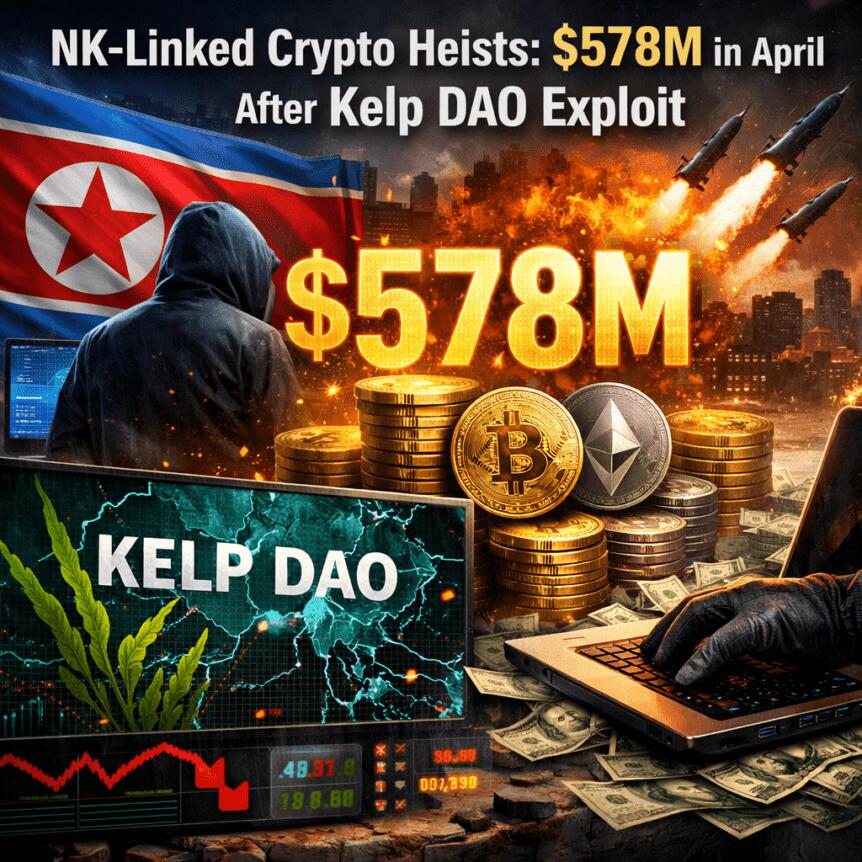
The Kelp incident follows a string of high-profile DPRK-linked exploits in 2025 that have redirected attention to the group’s cyber espionage and fraud tactics. In April, the Drift protocol hack—an apparent North Korea-linked operation—accounted for roughly $285 million in losses, pushing the month’s attributed total to about $578 million across major incidents. Taken together with other incidents, analysts say these acts represent the most significant wave of DPRK crypto theft since the Bybit breach earlier in the year.
Security researchers and policy monitors have long warned that DPRK-backed actors blend traditional cyber-espionage playbooks with financially motivated operations. A recurring pattern involves recruiters and “IT worker” schemes designed to infiltrate legitimate tech and crypto companies, sometimes by posing as remote workers or contractors. This tactic, researchers note, funds the DPRK’s weapons-development programs, according to United Nations and other authorities cited in industry reporting.
U.S. authorities have responded with sanctions and public guidance. In March 2025, the U.S. Treasury sanctioned individuals and entities tied to North Korean IT worker fraud networks, while the FBI’s IC3 program issued guidance in mid-2025 urging employers to verify applicants’ professional histories and favor in-person verification where possible. Despite such measures, the Drift and Kelp breaches show that North Korean operatives are adapting—sometimes leveraging face-to-face interactions to build trust before initiating sophisticated cross-chain intrusions.
Beyond the headline hacks, smaller-scale incidents illustrate a broader leakage path into the retail space. For instance, Zerion reported DPRK-linked actors employing AI-assisted social engineering to steal modest sums, underscoring how crowding effects from larger hacks filter down to everyday users. The industry’s recurrent challenge remains immediate risk mitigation for users while authorities and firms continue to chase accountability for the perpetrators.
Governance, intervention and the ethics of freezing assets
One of the most consequential aspects of the Kelp episode was the Arbitrum Security Council’s decision to freeze 30,766 ETH implicated in the breach. The move—unprecedented in its explicit override of a blockchain state—has sparked a debate within the ecosystem about when, if ever, governance should intervene to preserve funds or protect users. Ledger’s chief technology officer Charles Guillemet described the outcome as “probably good, but not a comfortable one,” emphasizing that freezing the funds likely prevented further losses even as it exposed a difficult truth: decentralization does not always shield networks from governance actions in a crisis.
The Arbitrum decision, while preserving resources for affected users, illustrates the tension inherent in today’s rollup-based architectures. The governance mechanism exists by design to allow a trusted body to act when necessary, but it also challenges the ideal of credibly neutral infrastructure. In the Kelp case, the root cause was not a post-launch vulnerability in a single contract but a misconfiguration in cross-chain messaging that points to a broader risk: as ecosystems become more interconnected, the line between protocol weakness and systemic risk grows thinner.
Industry observers highlight that the Kelp incident reinforces a clear takeaway: attackers are increasingly probing the spaces between blockchains—bridges, relays, and validators—as much as they probe the individual protocols themselves. For builders, the imperative is not only to patch existing smart contracts but to harden the inter-chain fabric against cross-chain messaging failures, misconfigurations and governance overreach. For investors and users, the message is twofold: proceed with heightened caution around cross-chain liquidity, and demand transparent, timely disclosures when security incidents occur.
As these dynamics unfold, the broader market faces a persistent question: how to balance rapid recovery with principled governance? The Kelp and Drift cases provide a sobering test of whether the industry can coherently align incentives around safety, accountability, and the preservation of value when real-time decisions can alter the fate of funds that are already in motion.
Looking ahead, analysts expect continued attribution efforts and more formal investigations that could clarify whether TraderTraitor and other Lazarus-linked actors are systematically behind a wave of DeFi intrusions. Regulators may also intensify their focus on cross-chain security standards, while projects experiment with enhanced verification, multi-sig controls, and post-incident recovery playbooks to limit losses without compromising the decentralized ethos.
What to watch next: researchers will likely publish deeper analyses on LayerZero usage patterns and verifier configurations, while Arbitrum and LayerZero may roll out mitigations to reduce the likelihood of similar breaches. Stakeholders should monitor updates on governance policies, potential sanctions, and new best practices aimed at guarding users against both technical and social-engineering threats in a rapidly evolving threat landscape.
In the meantime, the fusion of infrastructure risk, state-sponsored threat activity, and governance mechanics offers a stark reminder: as DeFi grows more interconnected, securing the backbone—cross-chain messaging and related governance—will determine how quickly the sector can rebound from each major incident.