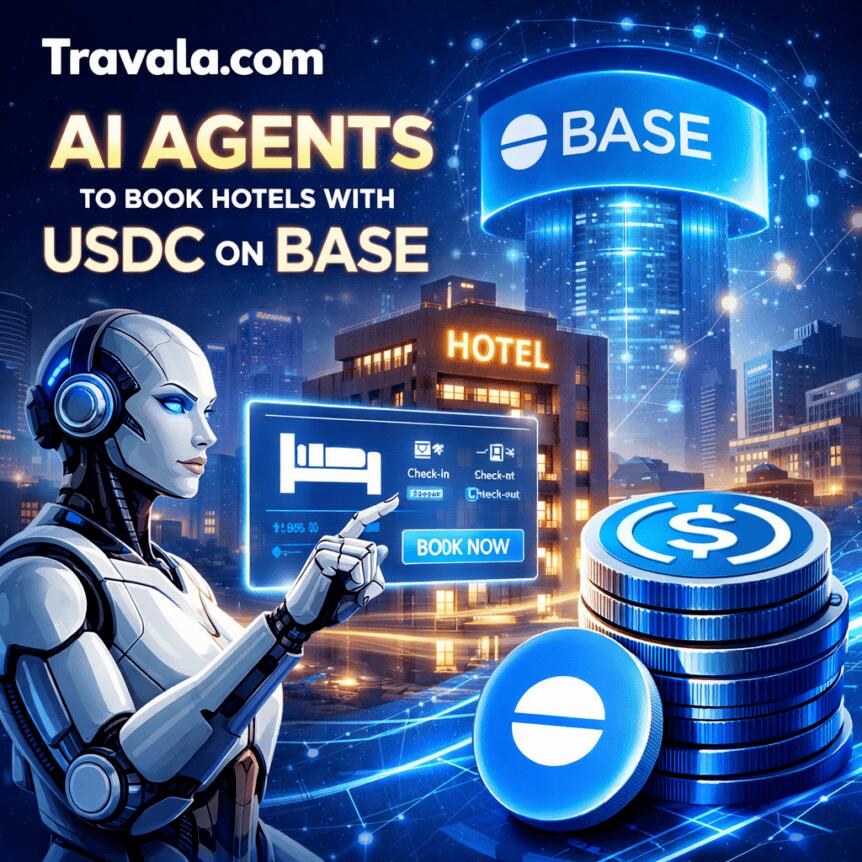
Singapore-based crypto travel platform Travala has rolled out what it calls the world’s first agentic AI travel protocol. The system enables AI agents to search, reserve, and pay for hotels using USDC on Base, a Coinbase-backed layer-2 network. The move extends agentic AI stablecoin payments into travel bookings and positions Travala at the forefront of AI-enabled checkout infrastructure for travel commerce.
The Travala Travel Multi-Chain Protocol (MCP) is live through Claude Desktop, with external developers invited to integrate the capability into their own travel-agent experiences, the company said in a statement shared with Cointelegraph. The protocol bridges Travala’s hotel catalog with AI agents via the Model Context Protocol, an open standard designed to connect AI applications with external tools. Payments are conducted over Coinbase’s x402 protocol on Base, enabling gasless USDC transactions, near-instant settlement, and typical booking costs around $0.01.
Key takeaways
- Travala launches an agentic AI travel protocol on Base, enabling AI agents to book hotels using USDC with near-zero fees and fast settlement.
- The system links Travala’s inventory to AI agents via the Model Context Protocol, with payments executed through x402 on Base and ERC-7715 session keys allowing in-wallet signing control.
- Final payment authorization remains with the traveler, meaning the protocol is autonomous in its operations but not fully hands-off for end users.
- Travala’s network covers more than 2.2 million hotels, including listings from Marriott, Hilton, and IHG, with plans to expand to flights and other travel products.
- A 10% Coinbase Wrapped BTC (cbBTC) rebate is offered on completed stays booked through the AI agents, adding a financial incentive for developers and travelers.
Autonomy in practice: what changes for travelers and builders
Travala frames the MCP as a meaningful step toward an autonomous travel economy, while still preserving user control. CEO Juan Otero described the launch as “the death of the checkout button,” framing it as a move from a static checkout experience to an ongoing, agent-led shopping process. Even as AI agents search and propose options, the traveler retains final signing authority within their wallet, meaning the AI merely initiates payment requests that require human approval before funds move.
The protocol uses ERC-7715 session keys to manage interactions. This design allows an AI agent to request payment while the traveler’s wallet holds the ultimate signing power. In practice, this supports a continuous conversational thread—an AI agent can carry context across searches, bookings, and cancellations in a single chat, reducing repetitive prompts and friction in the booking flow.
Connecting inventory with agent-enabled commerce
Travala says its MCP taps into a catalog of over 2.2 million hotels, with listings sourced through prominent aggregator partners and major brands, including Marriott, Hilton, and IHG. The company highlighted that the integration could eventually extend beyond hotel stays to other travel products, such as flights. The broader vision includes leveraging Travala’s AVA loyalty token to support future MCP use cases, potentially tying loyalty rewards to AI-driven booking workflows.
External developers can adopt Travala’s MCP via Claude Desktop, enabling other travel agents to embed the same AI-enabled checkout flow. While automation advances, the model preserves a human-in-the-loop approach to payments, providing a security and control layer that may appeal to users wary of fully autonomous transactions.
Context within the evolving AI-payments landscape
Travala’s announcement arrives amid a growing wave of AI-driven payments infrastructure within the crypto ecosystem. Industry coverage has noted a surge in agentic payments on Base, with x402-linked wallets reportedly surpassing 100 million transactions. The broader ecosystem includes solutions from Fireblocks, MoonPay, Exodus, and Oobit, all aiming to enable AI agents to spend stablecoins and other digital assets without manual intervention at every step.
Chainalysis has documented the rising use of agentic payments on Base, a trend that has supported broader experimentation with programmable payments in AI workflows. The combination of a stablecoin (USDC), a scalable L2 network (Base), and an open toolset (Model Context Protocol and ERC-7715 session keys) creates a cohesive environment for automated travel payments that still respects user consent and control.
Strategic implications for the travel-tech and crypto sectors
Travala’s MCP signals a shift from purely crypto-enabled checkout to AI-assisted, programmatic booking workflows. For investors and developers, it highlights a frictionless, low-cost payment layer that could accelerate adoption of AI agents in live commerce. The integration with major hotel brands underscores the potential for large-scale inventory to be accessible through AI channels, potentially expanding the use cases for stablecoins in consumer travel.
From a strategic perspective, the combination of gasless payments, near-instant settlement, and predictable fees could incentivize larger, more complex bookings to move through AI agents. Yet the model’s reliance on traveler approval means risk controls remain in place, reducing the likelihood of unauthorized charges and aligning with user-centric security expectations. This hybrid approach—automated negotiation and human oversight—may become a template for other sectors exploring agentic commerce.
Broader adoption and next steps
Travala has signaled that the MCP will evolve beyond hotels, with flights and other travel products on the roadmap. The venture also points to potential expansions of the AVA loyalty program, potentially integrating reward mechanics with AI-driven booking journeys. As more developers adopt the framework, the breadth and depth of AI-empowered travel options could grow, drawing in users who value speed, transparency, and control in their online travel experiences.
Observers will want to monitor how adoption scales among developers and whether the autonomous capabilities can mature to reduce the amount of human intervention required for routine bookings. The interplay between user trust, safety measures, and AI efficiency will shape how quickly and widely agentic travel becomes mainstream.
Additional reporting on related developments in AI-driven payments and agent-based commerce continues to emerge, with industry outlets highlighting parallel efforts to streamline settlement and reduce operational frictions across platforms.
As the ecosystem evolves, Travala’s MCP could become a test case for how autonomous financial workflows interact with real-world consumer purchases, potentially setting a benchmark for the next wave of AI-enabled travel experiences.
Travala was founded in 2017 and currently accepts more than 100 cryptocurrencies alongside fiat currencies, positioning itself as a bridge between traditional travel booking and crypto-enabled commerce.
Readers should watch for updates on the MCP’s expansion into flights and other travel categories, as well as any regulatory or security considerations that emerge as AI agents gain more autonomy in payment workflows.