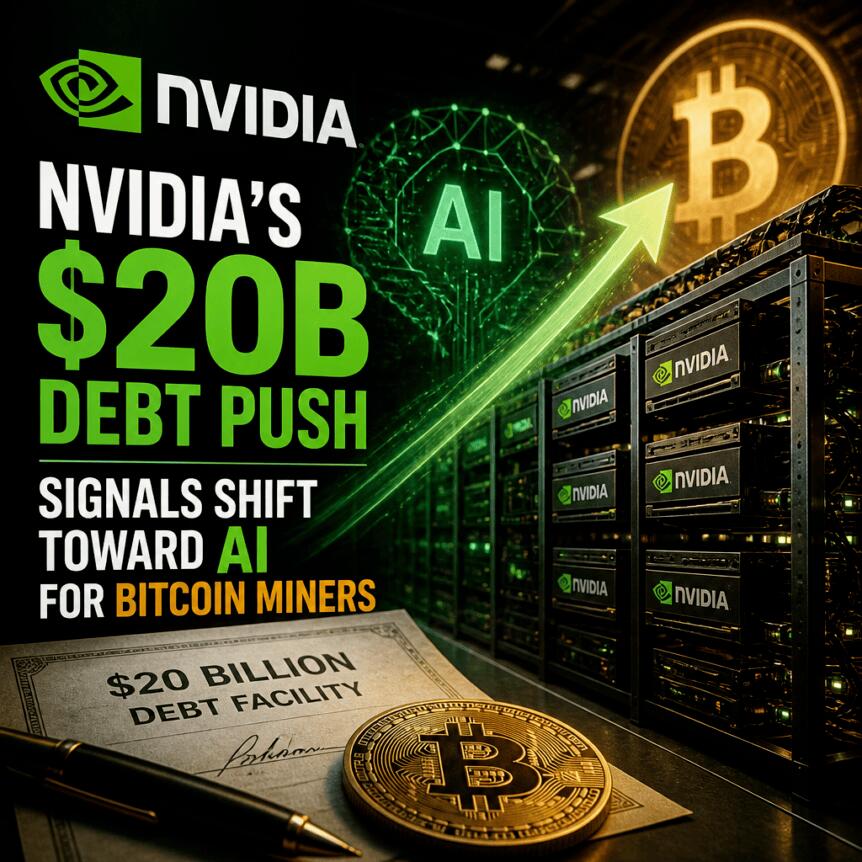
Nvidia is reported to be preparing a large bond sale tied to its AI spending plans, a move that reinforces how aggressively the global tech sector is funding new compute capacity. According to Bloomberg, the chipmaker is seeking to raise at least $20 billion through a multi-part offering to finance AI-related investments and refinance existing obligations.
The report also frames Nvidia’s capital markets push as another signal of sustained demand for AI infrastructure—demand that has, in turn, opened a door for some Bitcoin miners to explore business models beyond crypto. As miners face tighter margins after the 2024 halving, the search for alternative revenue streams is becoming more prominent alongside the AI buildout.
Key takeaways
- Nvidia is reportedly aiming to raise $20 billion via a bond sale spanning seven maturities from two to 30 years.
- The longest-dated notes are expected to yield about 0.9 percentage points above comparable U.S. Treasuries, according to Bloomberg.
- Nvidia’s dominance in AI hardware means its spending plans are closely watched by the broader AI infrastructure industry.
- Bitcoin miners have increasingly used their power and data-center assets for high-performance computing and AI hosting as crypto mining economics remain under pressure.
- Research cited by Cointelegraph indicates miners have been selling off portions of their Bitcoin holdings, including more than 15,000 BTC between October and March, per TheEnergyMag.
Nvidia’s bond plan spotlights AI-funding momentum
Bloomberg reported on Monday that Nvidia is pursuing a high-grade bond offering after identifying the financing needs for its AI expansion. The plan, as described by people familiar with the matter, includes issuing notes across seven maturities, ranging from two years to 30 years.
Pricing details matter for investors because they reflect how the market is currently valuing long-term risk and growth. Bloomberg said the longest-dated bonds are expected to yield roughly 0.9 percentage points above comparable U.S. Treasury securities. While the exact deal terms weren’t finalized in the coverage, the structure suggests Nvidia is looking to lock in funding across a broad time horizon.
For the AI supply chain, the significance is straightforward: Nvidia is positioned at the center of large language model infrastructure through its GPUs, which are widely used by hyperscalers and cloud providers. When such a major platform vendor seeks debt financing at scale, it can be read as a vote of confidence in continued AI investment cycles.
Why this matters for Bitcoin miners’ diversification
Even though Nvidia’s bond offering is not a crypto story on its own, it arrives at a moment when parts of the mining sector are searching for stability outside Bitcoin block rewards. The shared thread is infrastructure: data centers, power capacity, and computing hardware utilization.
Cointelegraph noted that an increasing number of Bitcoin miners have started repurposing energy-intensive facilities for high-performance computing and AI hosting. Instead of relying solely on mining revenue, companies are positioning existing infrastructure—especially power and hosting capabilities—as assets that can serve the AI buildout.
The reporting points to miners that have historically been more closely associated with crypto, including HIVE Digital, TeraWulf, Hut 8, and CleanSpark. Each is described as exploring data center capacity offerings by leveraging internal infrastructure and power agreements to capture demand for computing resources.
This shift is not merely strategic branding. For miners, the practical advantage is that they already operate or control sites where electricity costs and uptime are key—two variables that are also central to operating AI workloads. If the demand for compute remains strong, data-center-led diversification can reduce reliance on a single revenue stream.
Bitcoin mining economics stay tough after the 2024 halving
The push toward AI-adjacent services is happening against a difficult backdrop for core mining economics. According to Cointelegraph’s coverage, the industry has faced heightened margin pressure following the April 2024 halving, which lowered reward issuance and intensified strain when mining difficulty and operating costs remain elevated.
Cointelegraph characterizes the environment using language attributed by analysts as among the harshest in history—an environment that has encouraged miners to take actions such as selling parts of their Bitcoin treasuries, reducing leverage, and looking for non-crypto revenue streams.
To illustrate how widespread the treasury selloff has been, Cointelegraph cited data from TheEnergyMag, stating that Bitcoin miners collectively sold more than 15,000 BTC between October and March. Another reference in the piece points to a timeline acceleration: sales reportedly became faster after BTC peaked above $126,000 in October, based on reporting from TheEnergyMag via MinerWeekly.
That combination—continued sell pressure alongside diversification plans—suggests miners are trying to balance short-term liquidity needs with longer-term repositioning. It also underlines why external funding and infrastructure demand can matter to miners even if the catalyst is coming from traditional tech capital markets.
From mining to AI infrastructure: the next valuation test
As miners explore new roles, investors are likely to focus on whether those businesses can offset weaker mining margins over time. In Cointelegraph’s reporting, analysts at Bernstein are referenced as expecting IREN to derive the vast majority of its value from AI infrastructure, tied to growth in the company’s cloud AI business. The point is less about instant profitability and more about the direction of future cash-flow drivers—an increasingly important question for companies that once relied almost entirely on Bitcoin mining revenue.
What remains uncertain is whether these AI-focused operations can scale quickly enough and on favorable economics to fully compensate for the cyclical nature of mining. The near-term treasury actions highlighted by TheEnergyMag indicate that many miners still need financial support and flexibility as they transition.
Readers should watch whether large-scale AI compute demand continues to translate into sustained demand for hosting and infrastructure services—especially given how much of that ecosystem depends on hardware providers like Nvidia. If AI spending remains robust, it may create a clearer bridge between traditional infrastructure financing and the longer arc of miners’ diversification; if it weakens, the transition will likely face harsher economic tests.