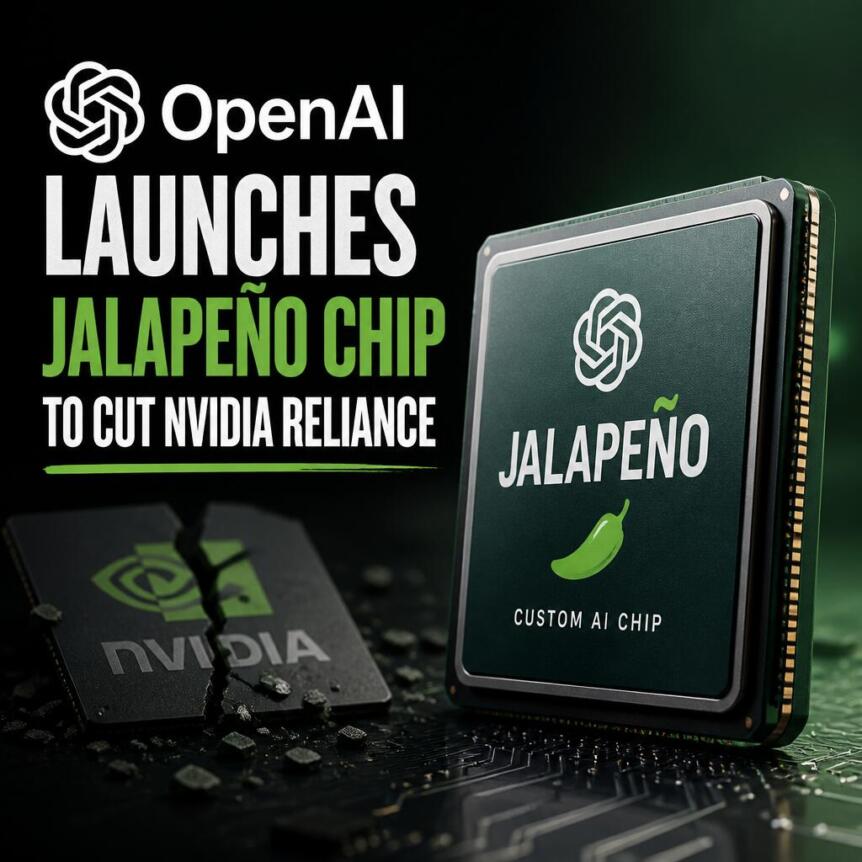
OpenAI launched its first custom artificial intelligence processor, Jalapeño, as the company moves deeper into AI hardware. The OpenAI Jalapeño chip was developed with Broadcom and designed for inference workloads that support products such as ChatGPT, Codex, and future AI agents.
The launch puts OpenAI in closer competition with Nvidia, which dominates AI chips across training and inference markets. However, OpenAI did not describe the processor as a full replacement for external accelerators.
OpenAI Targets More Control Over AI Infrastructure
OpenAI said Jalapeño forms part of its full-stack strategy, which connects hardware, models, and software systems. The company said custom silicon could help it serve more users while lowering operating costs.
The OpenAI Jalapeño chip focuses on inference, which supports AI responses after models complete training. That makes the processor important for daily AI services, especially as ChatGPT usage grows across consumer and enterprise markets.
OpenAI said it completed the processor in nine months. That timeline drew attention because major technology companies continue to compete for limited AI computing resources.
Greg Brockman, OpenAI’s president and co-founder, said the company built Jalapeño to improve efficiency at scale. “By designing more of the stack ourselves, we can serve more intelligence with greater efficiency and keep pushing advanced AI toward broader access,” he said.
Enterprise Deals Expand OpenAI’s Reach
The chip launch came as OpenAI expanded its enterprise business. The company recently signed a multi-year agreement with BBVA to extend ChatGPT Enterprise access from 11,000 employees to 120,000 workers across 25 countries.
BBVA plans to use OpenAI tools for customer service, risk analysis, software development, and internal operations. OpenAI also said the agreement gives BBVA access to its product, research, and technology teams.
The OpenAI Jalapeño chip could support this growing enterprise demand as banks and large companies adopt generative AI tools. It also gives OpenAI more flexibility as customer workloads increase.
In addition, Visa announced a strategic partnership with OpenAI for agentic commerce. Visa said the deal would enable secure payment capabilities inside AI-powered shopping experiences.
IPO Talk Builds Around OpenAI
OpenAI’s hardware move also arrived as public listing speculation gained momentum. Sam Altman recently suggested the company could pursue an initial public offering within the next year.
Coinbase has also introduced pre-IPO futures tied to OpenAI, giving traders exposure to valuation expectations before any formal listing. Meanwhile, the OpenAI Jalapeño chip adds another layer to the company’s commercial growth story.
OpenAI has also promoted advertising opportunities linked to ChatGPT and demonstrated Codex to marketers. These moves show how the company is expanding beyond chatbot services into infrastructure, finance, payments, and enterprise software.