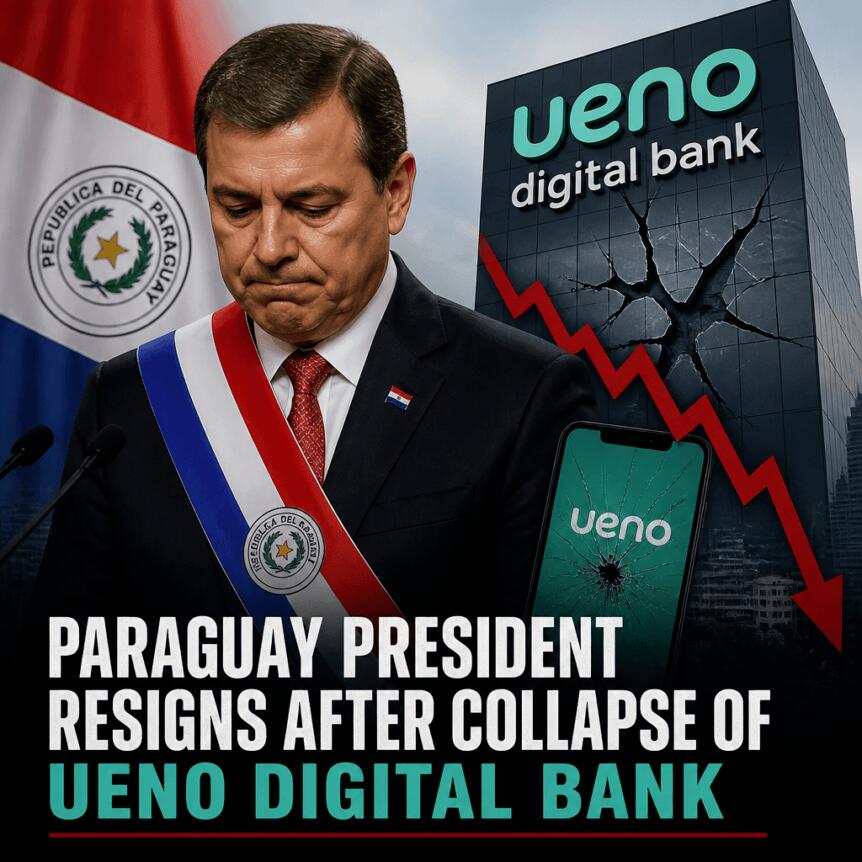
Paraguay’s President Santiago Peña has resigned amid a fast-moving banking crisis after the collapse of Ueno Bank, a lender that grew quickly into one of the country’s largest financial institutions. Peña said the decision was aimed at protecting “stability, social peace and democratic institutions,” and prioritizing Paraguayans whose savings were held through the banking system.
While Paraguay’s central bank moved to resolve Ueno Bank this week, the fallout has spilled into crypto markets and local usage. In parallel, asking prices for Tether’s USDt on a Bybit peer-to-peer (P2P) marketplace surfaced at a wide premium to the central bank’s reference rate, underscoring how easily liquidity bottlenecks can become visible in digital-asset rails.
Key takeaways
- Peña’s resignation follows Ueno Bank’s collapse, after regulators found its solvency ratio fell below Paraguay’s 12% regulatory minimum.
- The central bank initiated resolution proceedings, suspended Ueno Bank’s operations, and began depositor guarantee payouts for eligible clients.
- Reports from Paraguayan crypto exchange X4T indicate users are turning to stablecoins to access liquidity for everyday payments.
- Local P2P pricing for USDt has shown a significant premium versus the central bank’s reference exchange rate on at least one listing.
- Vice President Pedro Alliana is positioned to assume the remainder of the term if Congress accepts Peña’s resignation.
Peña steps down as Ueno Bank resolution deepens
In a video posted to X, Peña said he would step down to protect Paraguay’s institutional stability and to shield citizens who placed their savings in the financial system. His announcement came Thursday as political pressure intensified, including debate over impeachment proceedings related to alleged conflicts of interest, pension fund misuse, and claims of institutional cover-ups tied to Ueno Bank’s failure, according to Reuters.
Peña’s position also faced scrutiny due to his prior business ties to Grupo Vázquez, the conglomerate that controls Ueno Bank. Associated reporting cited that he remained a business partner of the group until March 2025, while Peña has denied wrongdoing and argued the dispute began as a regulatory issue before becoming political.
Under Paraguay’s Constitution, Vice President Pedro Alliana would succeed Peña for the remaining term if Congress accepts the resignation. Peña was elected in April 2023 and took office in August, with a five-year mandate set to end in 2028.
Central bank actions: solvency triggers and depositor payouts
On Tuesday, Paraguay’s central bank announced resolution proceedings for Ueno Bank after determining its solvency ratio fell below half the 12% regulatory minimum. The bank’s solvency deterioration was tied to adjustments to its financial statements, after which its solvency ratio reportedly reached 5.56%.
Authorities suspended Ueno Bank’s operations and restricted customer access to deposits as the resolution process began. The timing of the central bank’s intervention is especially consequential because Ueno had expanded rapidly since 2021 and, according to the report, served more than 3 million customers in a country of roughly 6.5 million people.
On Thursday, Paraguay’s central bank also announced the start of deposit guarantee payments. Eligible depositors with balances up to 10 million guaraníes (about $1,630) would be paid, assuming they had no outstanding debts to Ueno Bank and held accounts at other financial institutions. Under the deposit insurance system, deposits are protected up to 228.3 million guaraníes (about $37,200) per depositor, per financial institution.
In Asunción, the banking crisis triggered protests involving hundreds of depositors, pensioners, and workers demanding access to their funds and accountability from officials.
From regulatory scrutiny to liquidity gaps
The immediate resolution steps follow earlier regulatory attention. Ueno first came under scrutiny in June over loans tied to companies linked to its controlling shareholder, Grupo Vázquez. In an October statement, the bank acknowledged it had received regulatory notices on June 5 and July 24 that required adjustments to its related-party lending exposure.
By Nov. 2, the central bank initiated resolution proceedings after those adjustments—reflected in updated financial statements—pushed the solvency ratio down to 5.56%, below the regulatory threshold. That sequence matters for investors and users because it frames the collapse as a solvency and compliance story rather than a sudden operational disruption, and it helps explain why deposit access was curtailed rapidly once regulators acted.
Authorities also moved against executives: local reporting cited that eight Ueno Bank executives were detained on Nov. 3, including Grupo Vázquez president Miguel Vázquez and Ueno Bank president Juan Manuel Gustale. A court later ordered six executives held in pretrial detention and placed two under house arrest, according to ABC Color.
Paraguayan crypto users lean on stablecoins as rails tighten
Beyond traditional banking, the crisis appears to be changing how some Paraguayan users access funds. David Eisenmann, founder and CEO of crypto exchange X4T, told Cointelegraph that customers are using crypto to pay bills and protect savings while bank access remains restricted. Eisenmann said some users convert holdings into guaraníes or US dollars to meet obligations such as salaries and debt payments, while others buy dollar-backed stablecoins for quicker settlement.
“Customers are turning to their crypto holdings and converting them into guaraníes or dollars to make payments they couldn’t make with their bank deposits,” Eisenmann said, adding that when banking access is blocked, people look for alternative liquidity sources.
On X4T, Eisenmann reported that the prices of USDT and USDC in guaraní terms rose about 8% in recent weeks. He said the dollar’s strength against the local currency contributed to that recovery—pointing out that the increase began in October and accelerated this week—so the movement could not be attributed entirely to Ueno Bank’s collapse. Central bank data cited in the report shows the dollar gained about 1.6% against the guaraní between Oct. 1 and the month’s final trading day, and that even after this week’s rally it remained about 2.8% lower in 2026.
The broader message from crypto leadership also reflected stablecoin utility. Tether CEO Paolo Ardoino posted on X that “USDt is a lifeline for hundreds millions of people in the world,” responding to Cointelegraph coverage of the banking turmoil.
In addition to exchange sentiment, a market signal surfaced in Paraguay’s crypto trading venues. The report noted elevated asking prices for USDT on Bybit’s Paraguay peer-to-peer marketplace. One listing viewed early Thursday offered USDt at 6,942 guaraníes, roughly 13% higher than the central bank’s Nov. 4 reference rate of 6,144 guaraníes per US dollar.
While P2P asking prices can reflect local supply-demand imbalances rather than the “true” spot rate, the spread aligns with the report’s core theme: when traditional banking access tightens, digital liquidity can become both more valuable and more expensive—at least in certain venues.
What to watch next
As depositor guarantees begin and political leadership transitions toward Vice President Pedro Alliana, the key question for both Paraguay’s banking recovery and its crypto usage will be how quickly access to funds stabilizes for everyday users—along with whether stablecoin premiums on local venues normalize as deposit payouts expand.