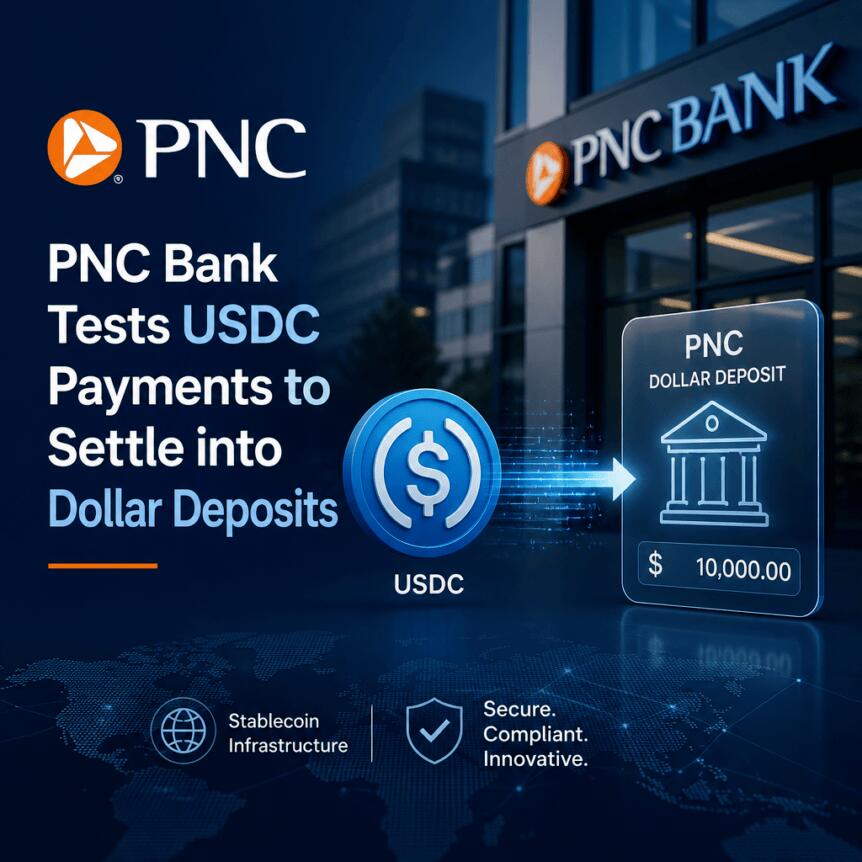
PNC Bank has started a limited pilot that lets eligible corporate and institutional clients receive payments in USDC—an ERC-20, US dollar-backed stablecoin—via Coinbase’s payments infrastructure. The bank says the program is designed to make it easier for businesses to access funds quickly while streamlining payment flows that may involve cross-border activity.
According to the announcement, the pilot supports USDC on Ethereum. Once received, payments are automatically converted into dollars and deposited into designated PNC accounts, meaning participating firms can use stablecoin rails without needing to hold the asset on their own balance sheets.
Key takeaways
- PNC is running a limited pilot for incoming USDC payments for eligible corporate and institutional clients through Coinbase.
- USDC payments are converted to fiat and deposited into PNC accounts, reducing operational burden for businesses.
- The bank positions the service as improving access to funds and cross-border payment efficiency.
- PNC previously expanded its relationship with Coinbase via a partnership that supported crypto services for PNC Private Bank clients.
- Citi has already moved in a similar direction by allowing stablecoin payments through its Spring by Citi platform with Coinbase handling fiat conversion.
A bank payment gateway for stablecoins
In the pilot described by PNC, participating customers can accept USDC payments using Coinbase Payments products. PNC says the service is intended to speed up access to funds and improve cross-border payment efficiency, two themes that have become increasingly common as traditional institutions explore stablecoins for settlement and transfer.
Just as importantly for everyday operators, PNC does not frame the initiative as a “hold stablecoins on your balance sheet” program. Instead, the bank says incoming stablecoin transfers are converted into dollars and deposited into clients’ designated PNC accounts.
PNC did not provide details such as pricing, settlement-time expectations, or how many customers are participating. Cointelegraph also reported that the bank did not respond to a request for additional information by publication time.
How PNC’s Coinbase relationship evolved
The stablecoin pilot is part of a broader cooperation between PNC and Coinbase that began in July 2025. In that earlier agreement, PNC said it would offer cryptocurrency services using Coinbase’s infrastructure while Coinbase would rely on PNC for banking support.
That partnership later expanded into trading services for certain clients: Cointelegraph reported that the deal resulted in Bitcoin trading for eligible PNC Private Bank clients in December.
By moving next to incoming stablecoin payments, PNC appears to be extending the same operational partnership—from enabling crypto access, to integrating stablecoin settlement into corporate cash flows. For businesses, that shift matters because receiving funds is often the most friction-heavy step in payment operations, particularly when counterparties want to move value quickly across borders.
Similar moves from other major banks
PNC’s announcement comes after a related initiative by Citi. Cointelegraph previously covered how Citi expanded its Coinbase partnership in September to enable institutional clients to accept stablecoin payments through Spring by Citi, with Coinbase converting those payments into fiat currency.
While the specific implementation details differ by bank and platform, the core pattern is consistent: traditional financial institutions are increasingly using stablecoins as an intermediary transfer mechanism while relying on regulated banking infrastructure for final fiat crediting.
That model may reduce the amount of stablecoin custody and accounting complexity that businesses would otherwise face, which is one reason these pilots can gain traction even before stablecoins become widely accepted as “everyday money.”
Why USDC is central to these pilots
USDC is the second-largest stablecoin by market capitalization, according to DefiLlama data cited in the coverage. DefiLlama lists USDC at $70.5 billion, behind Tether’s USDT at $176.8 billion. The same DefiLlama reference put the total stablecoin market at roughly $290.8 billion as of Monday.
These figures help explain why major institutions are gravitating toward US dollar-backed stablecoins rather than less widely used tokens. For banks, liquidity and operational predictability are critical—particularly when integrating with payment rails that must satisfy compliance, reconciliation, and customer service expectations.
Still, stablecoin adoption in banking remains at the “pilot” stage in many cases. PNC’s limited rollout, along with the absence of publicly stated fees and settlement-time benchmarks, underscores that these programs are likely being tested for reliability, throughput, and cost structure before any wider expansion.
As more banks experiment with stablecoin payment acceptance, the next question for market participants is whether these pilots evolve into broader offerings with transparent pricing, clearly defined timelines, and measurable performance outcomes.